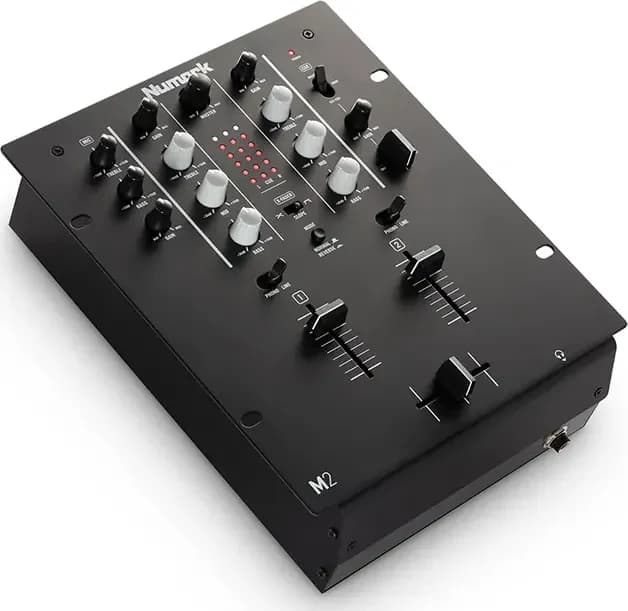
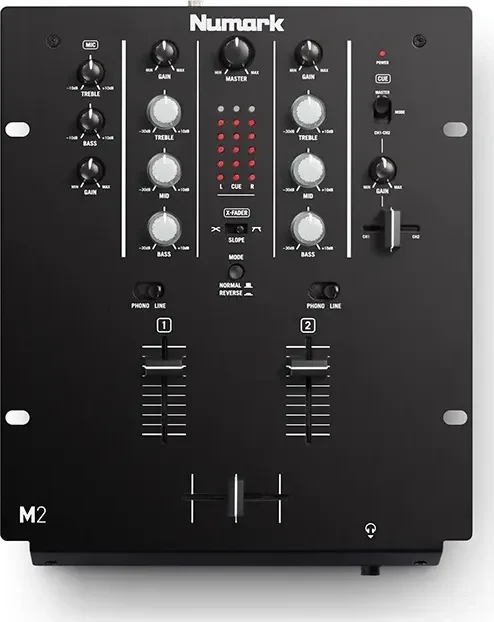

The Numark M2 is the cheapest way to get a real two-channel mixer with the controls that matter for scratching — a replaceable crossfader plus fader reverse and slope adjustment, so you can dial in a sharp cut. It has also been around long enough to prove itself: the M2 has sat in Numark's catalogue since the M-series line launched in 2011, essentially unchanged. As of mid-2026 it sells for around $119 in the US, while UK dealers list it near £129 against a £139.99 RRP — comfortably under anything else that takes scratching seriously. For a first practice mixer paired with a couple of turntables, it does the job without asking for much money.
Build and design
The M2 is a compact tabletop unit — 290 × 242 × 91mm and 3.0kg — sized to sit between two turntables in battle position without pushing them apart. The control surface is as simple as two-channel mixing gets: gain and 3-band EQ per channel, two channel faders, the crossfader with its reverse switch and slope control, a mic section with its own gain and EQ, and LED metering on the output. There is nothing here a beginner has to route around or accidentally mis-set, which matters more than it sounds when you are learning fader mechanics rather than menus.
Owners on Audiofanzine describe the metal casing as solid — one calls it "made to take serious punishment" — and the user reviews there average 4.0/5, a fair reflection of a unit that does little but does it dependably. The compromises show at the component level rather than the chassis: the pots and faders are light-feeling budget parts, and long-term owners report the faders getting tired with age. Power comes from an external 10V wall adapter rather than an internal supply, which is normal at this price but one more thing to lose in a bag.
That 2011-to-now production run is genuinely useful information for a buyer. Fifteen years of the same design means replacement crossfaders are easy to source, the failure modes are well documented, and the secondhand market is deep — Audiofanzine owners report used units changing hands for €60–70.
Crossfader, EQ and sound quality
A scratch mixer lives or dies by its crossfader, and this is where the M2 spends what little budget it has. Three things separate it from the toy tier. First, the fader is user-replaceable, so when it wears out you swap the part rather than the mixer — crossfaders are wear items, and on most other mixers this cheap a scratchy, bleeding fader means binning the whole unit. Second, there is a reverse switch, which flips the fader's direction — standard equipment on battle mixers, because some DJs find techniques like crabs and flares easier with the cut reversed. Third, the slope control adjusts the fader curve from a gradual blend for regular mixing to a sharp cut that opens the channel within the first few millimetres of travel, which is what fast scratch patterns need.
The stock fader itself is serviceable rather than special — nobody will mistake it for the Innofader Pro that Numark fits to the step-up Scratch. Owner reports bear this out: Audiofanzine reviewers rate the fader as fine out of the box, while one worn example is described as no longer cutting cleanly, with signal still audible when the fader is closed. That is exactly the failure the replaceable design exists for.
The rest of the audio path is basic analogue. Owners describe the 3-band EQ as effective for tone shaping and basic bass swaps, and each channel's gain makes level matching between phono and line sources straightforward. The known weakness is headroom: more than one owner reports audible hiss when the master is driven hard. Keep the channel gains sensible and the master moderate and the M2 stays clean enough for practice; push it and the noise floor makes itself known. There is no digital stage anywhere in the signal path — what goes in analogue comes out analogue.
Connectivity, and what isn't there
The rear panel covers the practice-room basics. Each channel has a phono/line switchable RCA input, so two turntables connect directly through real phono preamps — plus there are two further line-level RCA inputs, meaning a pair of media players or a phone can stay connected alongside the decks. A 1/4" mic input with dedicated gain and EQ sits on top of that. Output is master on RCA, a record out on RCA, and a 1/4" headphone jack. Cueing is handled by a miniature crossfader that blends cue and master in the headphones — an old-school touch that doubles as extra fader practice.
What is missing is easy to list: no USB audio interface, no effects, no XLR master, no booth output. The USB omission is the one to think about. With no built-in sound card, recording your sets means running the record out into a separate interface or recorder, and digital vinyl is off the table without external DVS hardware. But this is also why the M2 costs what it does. The cheapest name-brand two-channel mixer with a proper USB interface and DVS support is Pioneer DJ's DJM-250MK2 at around £299/€349 — nearly three times the price. At $119, Numark has spent the budget on the fader section instead of a USB stage, which is the right call for this mixer's actual job.
No effects is barely a loss for the target buyer. Scratch fundamentals are fader and EQ work; an echo-out button teaches nothing.
In use
Everything about the M2's design points at one setup: two turntables, a stack of practice records — or control vinyl through an external DVS rig — and headphones or a small pair of powered monitors on the RCA master. Owner accounts consistently describe it in exactly this role: an easy-to-use first mixer that gets out of the way. The uncluttered layout keeps the feedback loop fast — set your levels on the LED meters, match your EQs, and the rest of the session is fader time. The reverse switch and slope control also let the M2 grow with your technique: a beginner can start with a soft curve and steepen it as their cuts get faster, something the fixed-curve party-tier mixers below it cannot do.
The honest framing is that the M2 is a bedroom tool. RCA-only outputs and modest headroom rule out serious PA work, and the light-feeling pots would not enjoy regular gig transport. As a practice surface that teaches the fundamentals on hardware whose key wear item is user-replaceable, though, it has no real rival at the price.
How it compares
The obvious step-up is Numark's own Scratch, which adds an Innofader Pro, FX paddles and a Serato DVS licence for under $500 — the mixer to buy once scratching has gone from experiment to habit. The DJM-250MK2 is the pick if recording and rekordbox DVS matter more than fader features. If you need more inputs than scratching demands, the four-channel Numark M6 USB applies the same M-series formula with a sound card added. And if you are still weighing up the category, our guide to the best DJ mixers for beginners puts the M2 in context. As a first mixer bought to find out whether scratching sticks, it remains the lowest-risk ticket in.


