
DJ Tech Reviews

Akai Professional MPC Live III

The most powerful standalone MPC yet, with expressive pads and a step sequencer; deep, complex and heavy.

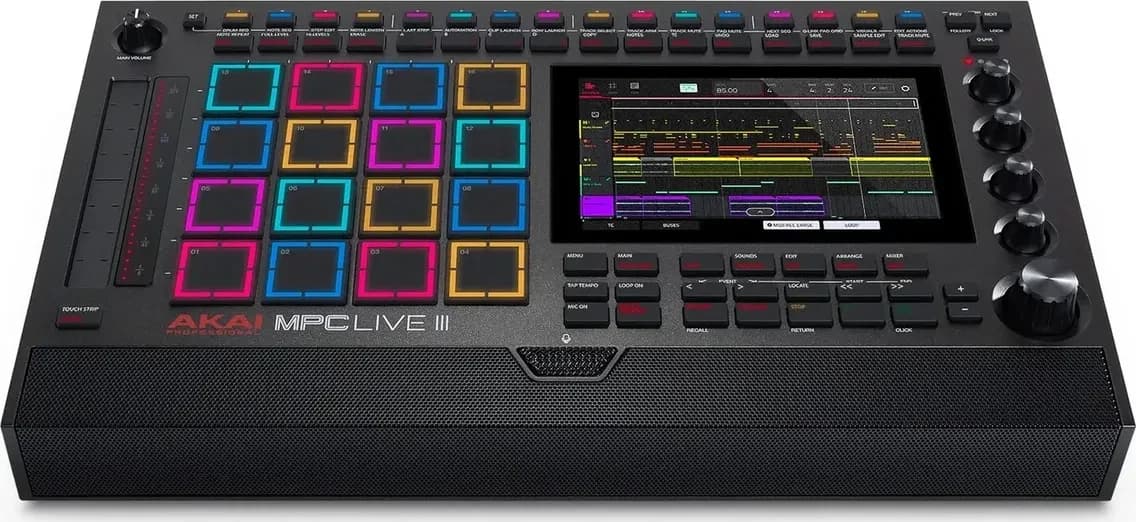
Akai Professional MPC Live III from the front

Photos: Akai Professional

All retailers and the price history

We may earn commission from links on this page. This does not affect our editorial independence.

5 of 6 professional reviews recommend it
Best for
Producers who want a complete studio without a laptop, at home or on stage.
Skip it if
You want a simple groovebox, mostly work in a DAW, or need something light.

The Internet’s Opinion

From 6 professional reviews and 28 owner reviews: a fair amount of evidence.

Five of six professional reviews recommend it as the most powerful and complete standalone MPC yet, and nearly all of the 28 owners read at Thomann and Guitar Center praise its speed, the MPCe pads and the step sequencer. The repeated reservation is complexity, a long learning curve and a menu-heavy OS, alongside the price and its 3.9 kg.

5 recommend1 mixed0 avoid

What people praise

  • Far more processing power: projects load quickly and run smoothly
  • The 3D-sensing MPCe pads feel great and add expression
  • Wide connectivity: mic preamps with phantom power, 24-channel USB-C audio, MIDI and CV
Show 4 more
  • The dedicated step sequencer and clip matrix bring new ways to build and perform tracks
  • Fully standalone, with a battery, speakers and a usable built-in mic
  • Strong bundled sounds and plugins
  • Solid build

What to know first

  • Deep and complex: a long learning curve and a menu-heavy, sometimes inconsistent OS
  • Expensive, and dearer than the MPC Live II
  • Big and heavy for a portable unit at 3.9 kg
Show 5 more
  • A busy panel with many functions on secondary layers
  • The clip matrix still has gaps and quirks
  • MPCe pad features work only with drum programs, not instrument plugins
  • USB-C audio does not work with every phone or device
  • 128 GB of internal storage feels small at the price
See the 6 reviews behind this

6 professional reviews (5 recommend, 1 mixed, 0 avoid); 28 owner reviews read at Thomann (27 posted across seven language pages, 3 under 20 words skipped) and Guitar Center (4 posted)Compiled 2026-10-17How this is compiled

Prices

Before you buy

Released
October 2025
Status
Current

Works with

  • MPC3 desktop softwareIncluded

    Runs the MPC3 OS standalone and works with the MPC3 desktop software; the MPC3 Pro Pack features ship with the Live III Manufacturer spec sheet (Akai Professional), checked 2026-10-17

  • Any DAW over USB-C24-channel audio interface

    Class-compliant USB-C connection with 24 channels of audio and 32 channels of MIDI Manufacturer spec sheet (Akai Professional), checked 2026-10-17

  • Ableton LiveController mode

    Connected over USB-C, the MPC can be used as a controller for Ableton Live Manufacturer spec sheet (Akai Professional), checked 2026-10-17

  • TurntablesRCA phono inputs

    Two unbalanced RCA phono inputs for sampling from vinyl Manufacturer spec sheet (Akai Professional), checked 2026-10-17

  • Synths and modular gearMIDI and CV/Gate

    Two 5-pin MIDI inputs and outputs and four stereo 1/8-inch CV/Gate outputs Manufacturer spec sheet (Akai Professional), checked 2026-10-17

  • Phones and computersUSB-C sampling

    Samples directly from a computer or smartphone over USB-C Manufacturer spec sheet (Akai Professional), checked 2026-10-17

You’ll also need

  • Studio monitors or headphonesFor mixing

    The built-in stereo monitors are for instant playback; six 1/4-inch TRS outputs and a 1/4-inch headphone output feed monitors or headphones Manufacturer spec sheet (Akai Professional), checked 2026-10-17

  • 2.5-inch SATA drive (optional)Extra storage

    128 GB is built in; a drive bay takes a 2.5-inch SATA drive and there is an SD card slot Manufacturer spec sheet (Akai Professional), checked 2026-10-17

  • Microphone (optional)For better vocals

    A condenser microphone is built in; two XLR/TRS combo inputs take external microphones or instruments Manufacturer spec sheet (Akai Professional), checked 2026-10-17

  • Extra plugins and expansions (optional)Paid add-ons

    Further effects, expansions, instruments and presets are sold through the MPC Store Manufacturer spec sheet (Akai Professional), checked 2026-10-17

Key specs

Pads
16 velocity- and pressure-sensitive MPCe pads with 3D sensing; 8 pad banks
Sequencing
16-step sequencer buttons, Clip Matrix for clip launching, Arrange mode
Display
6.9-inch (176 mm) full-colour multi-touch display
Standalone
Yes: rechargeable lithium-ion battery (up to 3 hours with typical use), built-in stereo monitors and condenser microphone
Processor and storage
8-core ARM processor, 8 GB RAM, 128 GB internal storage
Storage expansion
Bay for a 2.5-inch SATA drive, SD card slot, 2 x USB-A
All 15 specifications
Inputs
2 x XLR/TRS combo mic/line inputs; 2 x RCA phono inputs
Outputs
6 x 1/4" TRS outputs (3 stereo pairs); 1/4" headphone output
MIDI and CV
2 x 5-pin MIDI in, 2 x 5-pin MIDI out; 4 stereo 1/8" CV/Gate outputs
USB-C
Class-compliant 24-channel audio interface with 32 MIDI channels; direct sampling from a computer or phone
Wireless
Wi-Fi and Bluetooth
Tracks
Up to 32 plugin instrument instances and 16 audio tracks
Audio
24-bit converters at 44.1, 48 or 96 kHz; 32-bit floating-point processing
Dimensions (W x D x H)
435.9 x 256.0 x 67.1 mm (17.2 x 10.1 x 2.6 in)
Weight
3.9 kg (8.6 lb)

15 of 15 figures sourced; hover one for its source

Our take

Rory TassellWritten from the sources on this page, not from a loan unit.

Five of six professional reviews recommend the MPC Live III as the most powerful standalone MPC yet, and nearly all 28 owners read agree, citing its speed, MPCe pads, step sequencer and connections. The shared reservation is complexity: a long learning curve and a menu-heavy OS, leaving MusicTech 'impressed but not converted'. It is also dear and weighs 3.9 kg. Buy it to make music without a laptop; if you live in a DAW, a computer setup costs less.

What it is

Status, October 2026: current. Akai Professional still lists the MPC Live III.

What it is

The MPC Live III is a standalone music production centre from Akai Professional, part of inMusic, and the third generation of the battery-powered MPC Live. It went on sale in October 2025 (Attack Magazine). It runs the MPC3 operating system on its own, with no computer needed, and works alongside the MPC3 desktop software (Akai Professional product page).

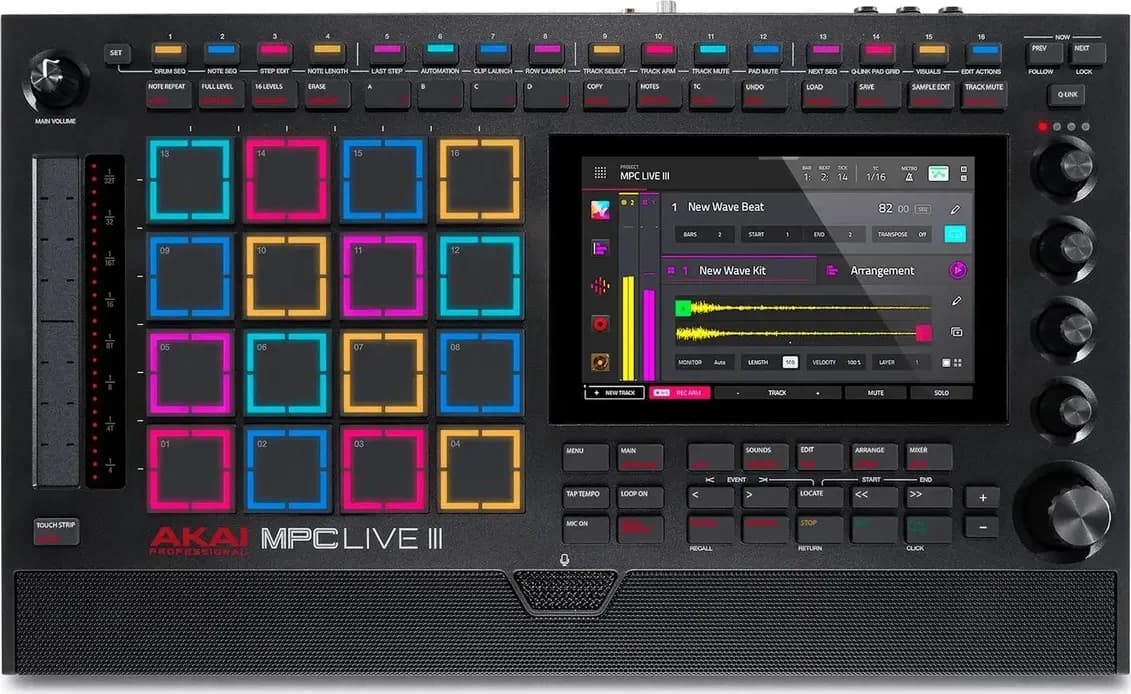
The top panel has 16 velocity- and pressure-sensitive MPCe pads with 3D sensing, which can blend sample layers and shape note repeats depending on where a pad is pressed, a row of 16 step-sequencer buttons, a touch strip, four Q-Link encoders and a 6.9-inch multi-touch screen. Akai says clip launching and step sequencing are firsts for an MPC; the Clip Matrix sits beside the classic sequences and an Arrange mode. Inside are an 8-core processor, 8 GB of RAM and 128 GB of storage, enough for Pro Stems separation and up to 32 plugin instruments. A battery rated for up to three hours, stereo speakers and a condenser microphone make it usable away from a desk.

The rear panel has two XLR/TRS combo inputs, a pair of RCA phono inputs for a turntable, six 1/4-inch TRS outputs, a headphone output, two MIDI inputs and two outputs, four stereo CV/Gate outputs, two USB-A ports, an SD card slot and a bay for a 2.5-inch SATA drive. The USB-C port works as a 24-channel audio interface with 32 MIDI channels and lets it act as a controller for Ableton Live; Wi-Fi and Bluetooth handle file transfer.

It measures 435.9 x 256.0 x 67.1 mm, weighs 3.9 kg and runs from the included 19 V power adapter or its internal battery.