
DJ Tech Reviews

Akai Professional MPC Sample

A pocket MPC with a fast, fun sampling workflow; one track and simple effects keep it a sketchpad.

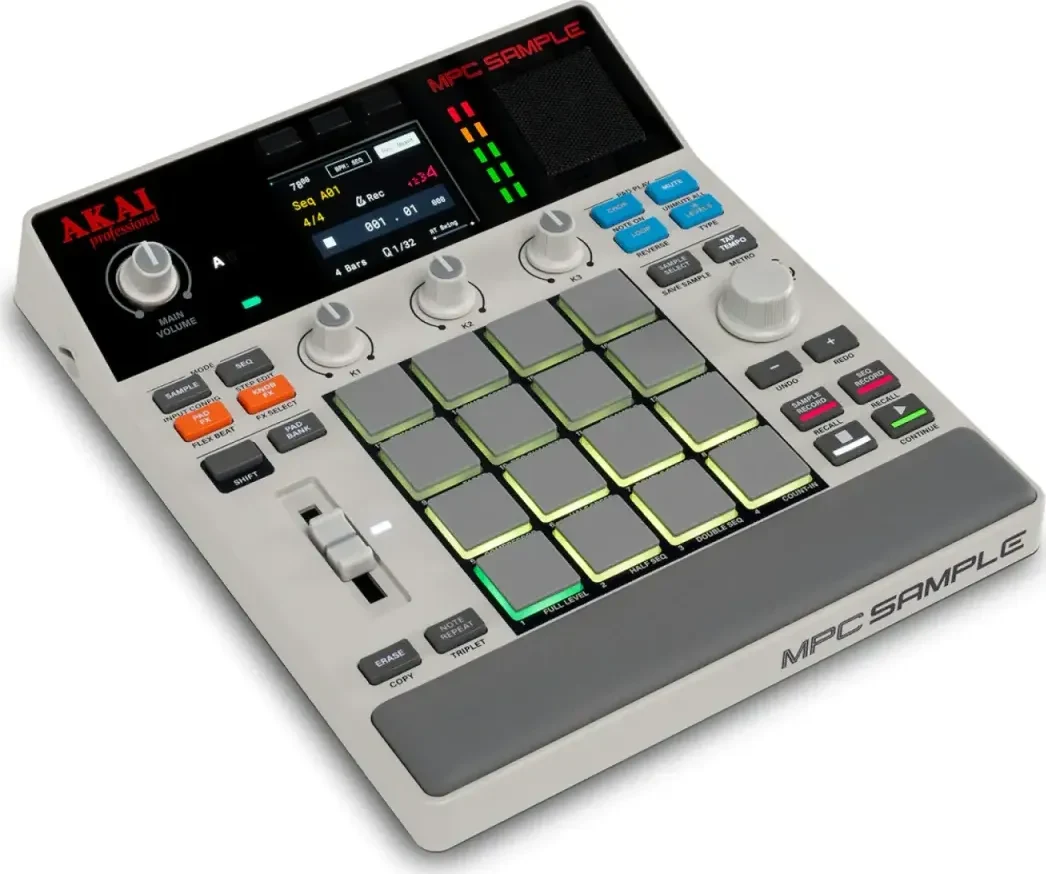
Akai Professional MPC Sample at an angle

Photos: Akai Professional

All retailers and the price history

We may earn commission from links on this page. This does not affect our editorial independence.

7 of 7 professional reviews recommend it
Best for
Beatmakers who want quick, portable sampling, and newcomers to the MPC workflow.
Skip it if
You need several tracks, deep sequencing or stems export to a DAW.

The Internet’s Opinion

From 7 professional reviews and 47 owner reviews: a fair amount of evidence.

All seven professional reviews recommend it as a fast, fun, portable MPC in the spirit of the early machines, and most of the 47 owners read at Thomann and Guitar Center agree. The limits are the expected ones for its size: one track, a basic sequencer and step editor, effects that are mainly for performance, and only a stereo mix out to a DAW.

7 recommend0 mixed0 avoid

What people praise

  • A fast, intuitive workflow that is quick to learn
  • Portable, with a battery, speaker and microphone for sampling anywhere
  • Fun to use, in the spirit of the early MPCs
Show 4 more
  • The MPC pads feel great despite their smaller size
  • Good factory kits and sounds
  • Good value for what it does
  • Solid build despite the toy-like looks

What to know first

  • Limited depth: one track, a basic sequencer and step editor, and little polyphonic playing
  • The effects are mainly for performance: they can't be recorded per sound or sequenced without resampling
  • Looks and feels like a toy to some
Show 2 more
  • The built-in speaker is only good for sketching
  • No stems or project export to a DAW, only a stereo mix
See the 7 reviews behind this

7 professional reviews (7 recommend, 0 mixed, 0 avoid); 47 owner reviews read at Thomann (45 posted across thirteen language pages, 9 under 20 words skipped) and Guitar Center (13 posted, 2 under 20 words skipped)Compiled 2026-10-17How this is compiled

Prices

Before you buy

Released
March 2026
Status
Current

Works with

  • MPC3 hardware and softwareProject import

    With MPC Sample 1.3 and MPC 3.8 or later, Sample projects open on bigger MPCs and the MPC3 software, and a drum track can be sent back Manufacturer spec sheet (Akai Professional (FAQ)), checked 2026-10-17

  • Any DAWUSB-C audio and MIDI

    Sends audio and MIDI to a DAW over USB-C, syncs by MIDI clock, and exports finished beats as audio files Manufacturer spec sheet (Akai Professional (FAQ)), checked 2026-10-17

  • Phones and computersUSB-C sampling

    Samples directly from Mac, Windows, iOS or Android devices over USB-C Manufacturer spec sheet (Akai Professional), checked 2026-10-17

  • Synths and drum machinesMIDI and sync out

    1/8-inch TRS Type A MIDI in and out and a sync out with configurable rates Manufacturer spec sheet (Akai Professional), checked 2026-10-17

  • Melodics60 free lessons

    Comes with 60 free Melodics finger-drumming lessons Manufacturer spec sheet (Akai Professional), checked 2026-10-17

You’ll also need

  • 1/8-inch to 5-pin MIDI adaptersNot included

    MIDI in and out are 1/8-inch TRS Type A jacks; adapters to 5-pin DIN are not included Manufacturer spec sheet (Akai Professional), checked 2026-10-17

  • USB-C power adapter or power bankSold separately

    It charges and runs from USB-C; a 5 V / 2 A wall adapter or power bank is sold separately Manufacturer spec sheet (Akai Professional), checked 2026-10-17

  • Phono preamp for vinylLine and mic inputs

    The two 1/4-inch inputs take mic or line level, with no phono preamp, so a turntable needs a preamp or a mixer in between Manufacturer spec sheet (Akai Professional), checked 2026-10-17

  • microSD card (optional)More storage

    8 GB is built in, about 2 GB of it factory content; a microSD slot adds more Manufacturer spec sheet (Akai Professional), checked 2026-10-17

Key specs

Pads
16 RGB-backlit velocity-sensitive MPC pads with poly aftertouch, smaller than full-size MPC pads
Sequencer
MPC sequencer with real-time swing, 960 PPQN; 16 sequences x 8 banks per project; Song mode
Display
2.4-inch full-colour LCD
Standalone
Yes: lithium-ion battery (about 5 hours of continuous playback), built-in microphone and 3 W speaker
Memory and storage
2 GB RAM; 8 GB internal (about 2 GB factory content); microSD card slot
Samples
Up to 20 minutes per sample; 16 samples x 8 banks per project; imports WAV, MP3, AIFF, FLAC and OGG
All 15 specifications
Polyphony
32 stereo voices, with disk streaming
Effects
60 effect types across 4 engines: Pad FX, Knob FX, Flex Beat and a Color Compressor
Inputs
2 x 1/4" TRS mic/line inputs
Outputs
2 x 1/4" TRS line outputs; 1/8" headphone output
MIDI and sync
1/8" TRS Type A MIDI in and out (DIN adapters not included); 1/8" TRS sync out (CV/Gate)
USB-C
Power, audio in/out, MIDI in/out and SD card access
Power
USB-C bus power, or a 5 V / 2 A wall adapter or power bank (sold separately)
Dimensions (W x D x H)
194 x 236 x 50 mm (7.6 x 9.3 x 2.0 in)
Weight
0.92 kg (2.03 lb)

15 of 15 figures sourced; hover one for its source

Our take

Rory TassellWritten from the sources on this page, not from a loan unit.

All seven professional reviews recommend the MPC Sample, and most of the 47 owners read agree: it is quick to learn, fun, portable and close in spirit to the early MPCs. The limits come with that simplicity: one track, a basic sequencer and step editor, effects that are mainly for performance and only a stereo mix out to a DAW. Buy it as a portable sketchpad or a first sampler; for full productions, a bigger MPC does more.

What it is

Status, October 2026: current. Akai Professional still lists the MPC Sample.

What it is

The MPC Sample is a portable, battery-powered sampler, sequencer and effects processor from Akai Professional, announced and put on sale on 24 March 2026 (inMusic press release). Its design is inspired by the MPC60, and Akai pitches it as the easy way into the MPC workflow, below the MPC Live III (Akai Professional product page).

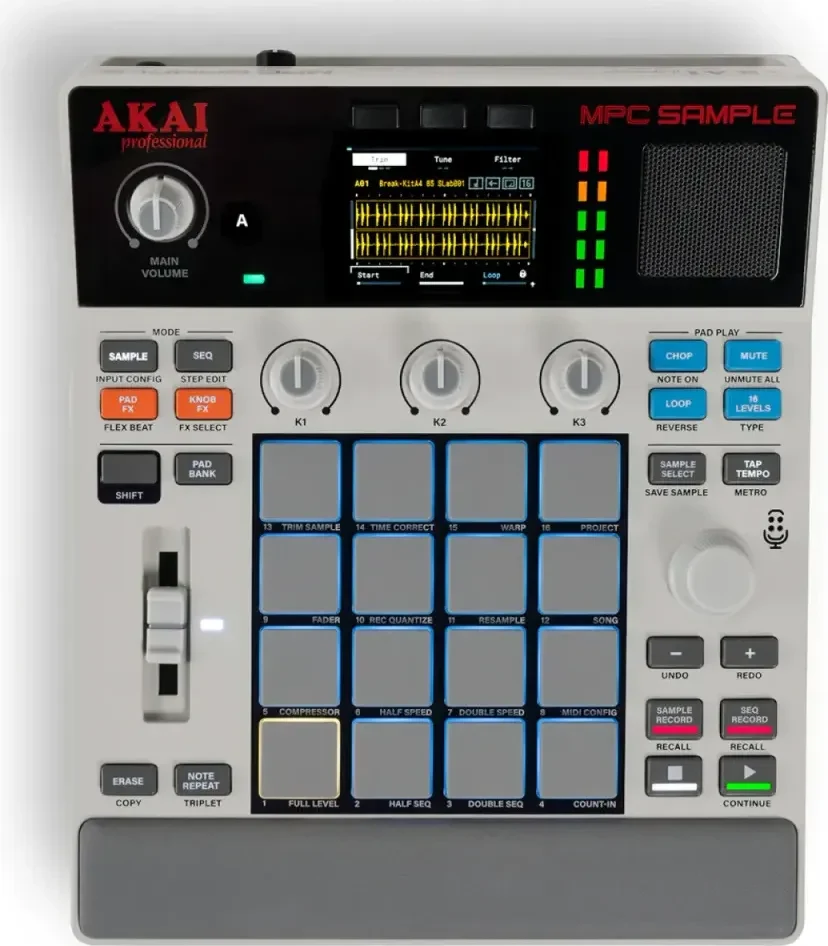
It has 16 RGB-backlit, velocity-sensitive pads with poly aftertouch, smaller than full-size MPC pads, a 2.4-inch colour screen, three effect knobs and a legacy MPC parameter fader. Sounds can come from the built-in microphone, the two 1/4-inch inputs, a computer or phone over USB-C, or by resampling, with up to 20 minutes per sample, a Chop mode, real-time timestretch and Sample Recall, which keeps the last 30 seconds of audio. The MPC sequencer runs at 960 PPQN with swing and has a Song mode, and 60 effect types sit across four engines, including Flex Beat and a Color Compressor. Over 100 factory kits are included.

Around the back are two 1/4-inch TRS inputs and outputs, a 1/8-inch headphone output, 1/8-inch TRS MIDI in and out (5-pin DIN adapters are not included), a sync out and a USB-C port that carries power, audio and MIDI. The 8 GB of internal storage holds about 2 GB of factory content, and a microSD slot adds more. Projects open on MPC hardware and software running MPC 3.8 or later.

It runs for about five hours on its internal battery and charges over USB-C, with any wall adapter sold separately. It measures 194 x 236 x 50 mm and weighs 0.92 kg.