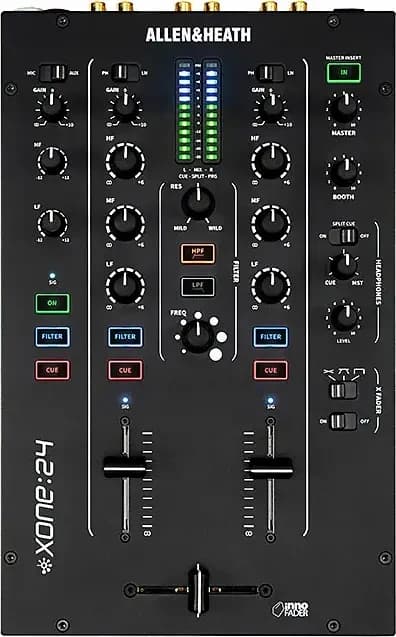
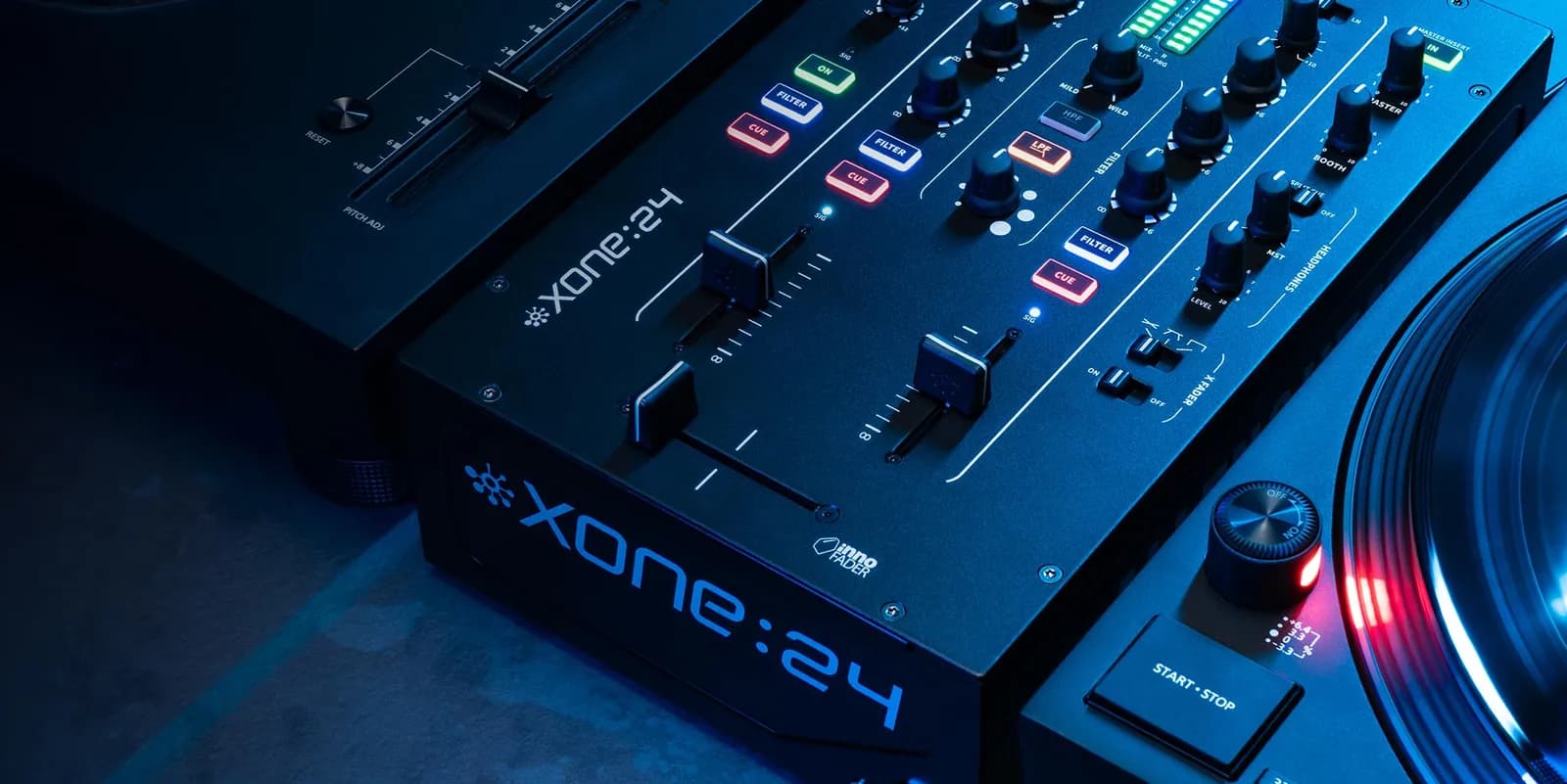

Allen & Heath built its reputation on analogue sound quality, and the Xone:24 — the October 2025 replacement for the decade-old Xone:23 — carries it at an entry-level price. At launch the mixer cost $389 / £345 / €398, which buys a compact 2+1 channel analogue signal path, the Xone:VCF filter with resonance, a full-kill isolator EQ and a Mini innoFADER as standard. It's the mixer to reach for when you care less about brand ecosystems and more about how the music actually sounds coming out of the box.
Build and design
The most visible change from the Xone:23 is the shape. The old hourglass waist is gone, replaced by straight sides that bring the entry model in line with the Xone:92 and Xone:96 further up the range. The footprint stays turntable-friendly: 190mm wide, 314mm deep and 108mm tall, at 2.7kg — light enough for a record bag, narrow enough to sit between two decks in a cramped booth.
Control feel is where the budget clearly wasn't cut. The pots are metal-mounted, and early reviews consistently note there's no play in them at all; the switches are illuminated so channel states stay readable in a dark room, and the channel faders are smooth 45mm VCA units. Nothing about the surface reads as a cost-reduced version of the bigger Xones.
Two caveats before you buy. Power comes from an external 12V DC supply rather than a built-in IEC inlet, which means one more wall-wart to lose or snag in a mobile rig. And several early reports mention the buttons feeling stiff out of the box — the kind of thing that loosens with use but is noticeable on day one.
Sound path, EQ and the VCF
Sound quality is the core criterion for any mixer, and it's where the Xone:24 justifies its existence. The signal path is all-analogue from input to output: low-noise RIAA phono preamps — improved over the Xone:23's, according to Allen & Heath — matched phono/line inputs on both channels, and a tuned analogue summing stage. Reviewers describe the result as warm, full and detailed, with more low-end weight than you'd expect from a mixer this size. For vinyl DJs in particular that phono stage matters: at this price many rivals treat the preamp as an afterthought, and a weak RIAA stage undoes whatever your cartridge is doing right.
The EQ is a 3-band isolator with full kill on every band. Roll a band fully off and it's gone, not merely attenuated — which is what makes bassline swaps between two records clean, and lets you carve space surgically rather than nudging tone controls. If you've only mixed on soft-knee EQs, our guide to using EQs on a DJ mixer covers why full kill changes how you structure a blend.
The VCF, though, is the point. It's a genuine voltage-controlled analogue filter — the same architecture that made the bigger Xones a fixture in house and techno booths — with a low-pass/high-pass mode switch, a frequency sweep and a resonance control that runs from mild to wild. With resonance backed off, reviewers note it behaves almost like a broad tone control, gently darkening or thinning a track; pushed hard, it rings and screams in the musical way Allen & Heath filters are known for, rather than the flatter, politer sweeps found on most entry-level rivals. Assign it to either channel or both and it becomes the transition tool: sweep a track out instead of fading it, or ride the resonance to build tension before a drop.
The honest limitation: there is one filter. Both channels share the same VCF, so you can't run channel A through a low-pass while channel B climbs a high-pass — a technique per-channel-filter rivals allow, though reviewers consistently rank those filters below the Xone VCF for character. Allen & Heath's own answer is the dual-filter Xone:96, at several times the price. On a two-channel mixer one shared filter is a workable compromise, but it's a real one.
Routing and connectivity
The 2+1 designation means two full channels plus a third input channel for a microphone or aux source, with its own two-band EQ. That third channel is what makes the Xone:24 more flexible than a plain two-channel box: a phone, media player or mic can come in without stealing a deck channel. Both main channels take switchable phono or line sources, so any combination of turntables, CDJs, players or synths works without repatching.
Outputs are unusually complete for the class: a balanced XLR master, an RCA booth output and a separate RCA record output. Compare the Pioneer DJM-250MK2, which our review dinged for having no booth output at all. There's also a master insert loop — a send/return across the main output for an external effects unit or compressor — which is Allen & Heath's answer to the complete absence of onboard FX. Most bedroom DJs will never patch it; for the analogue-purist buyer it's exactly right, keeping the box clean rather than bolting on effects. Headphone cueing covers both 3.5mm and 6.35mm jacks.
What's missing is the USB soundcard, and it shapes who this mixer is for. There's no way to run DVS or record a set to a laptop without a separate audio interface. For some setups that's a dealbreaker; for others it's irrelevant. Allen & Heath sells the fix in-house: the Xone:24C ($469 / £415 / €478 at launch) is the same analogue mixer with a 6-in/6-out 24-bit/96kHz USB-C interface, a powered USB hub, MIDI, and dedicated Stream, DVS Pro and DAW modes. If a laptop features anywhere in your plans, the roughly £70 premium is cheaper than any decent standalone interface.
In use
Everything reported from early owners and hands-on reviews points the same direction: this is a mixer built around feel. The Mini innoFADER crossfader — fitted as standard, where the Xone:23 shipped with a basic fader and left the Innofader as a paid upgrade — is described as smooth and precise, cutting in exactly where you'd expect, with three curve settings and an on/off switch so mix-style DJs can take it out of the equation entirely. That makes the Xone:24 a credible option for scratch DJs as well as blend-and-filter house sets, which the 23 never quite was out of the box.
The workflow the mixer encourages is a classic one: long EQ-led blends, kills to swap basslines, and the VCF doing the work a beat-FX section does on digital rivals. Owners running techno sets report the filter is the control they end up living on — sculpting transitions and building energy without touching a single effect. Two full channels is enough for that style; if your sets genuinely need four sources, that's a different conversation, and our two-channel versus four-channel explainer walks through it.
Alternatives
At this price the choice is between three philosophies. Pioneer's DJM-250MK2, launched at around £299, gives you a rekordbox-ready soundcard, DVS licences and the flagship Magvel crossfader — the stronger pick when laptop integration is the priority, with the trade-offs of rekordbox lock-in and that missing booth output. Reloop's budget mixers undercut both on price but compete on features rather than sound. And the Xone:24C exists for anyone who finishes this review wanting the Xone sound and the USB connectivity in one box.
The Xone:24 itself is for the buyer who has decided sound comes first. Nothing else at the entry level offers an all-analogue path, a full-kill isolator EQ and a resonant VCF together. See how it stacks up against the wider field in our best DJ mixers for beginners guide.


