
The Reloop RMX-10 BT is a straightforward two-channel mixer with one feature that punches above its price: Bluetooth input. Being able to pull audio wirelessly from a phone or laptop is genuinely useful for casual sets, warm-ups, and mobile gigs where hauling a second source or fiddling with cables isn't worth the bother. Reloop launched it in December 2019 at €119.99 / $129.99 / £99.99, and the price has barely moved since — Thomann UK listed it at £110 in August 2026, with the US store at $125. That keeps it in the cheapest tier of hardware mixers while doing one thing its obvious rivals don't.
Build and design
For the money, the RMX-10 BT is reassuringly solid. The casing is all metal, the footprint is a compact 180 × 260 × 70mm, and the whole unit weighs 1.72kg — small and light enough to share a record bag with a laptop sleeve. Owner feedback backs this up: across ten Thomann reviews the mixer averages 4.5/5 as of August 2026, with "good quality sound and robust" the recurring theme.
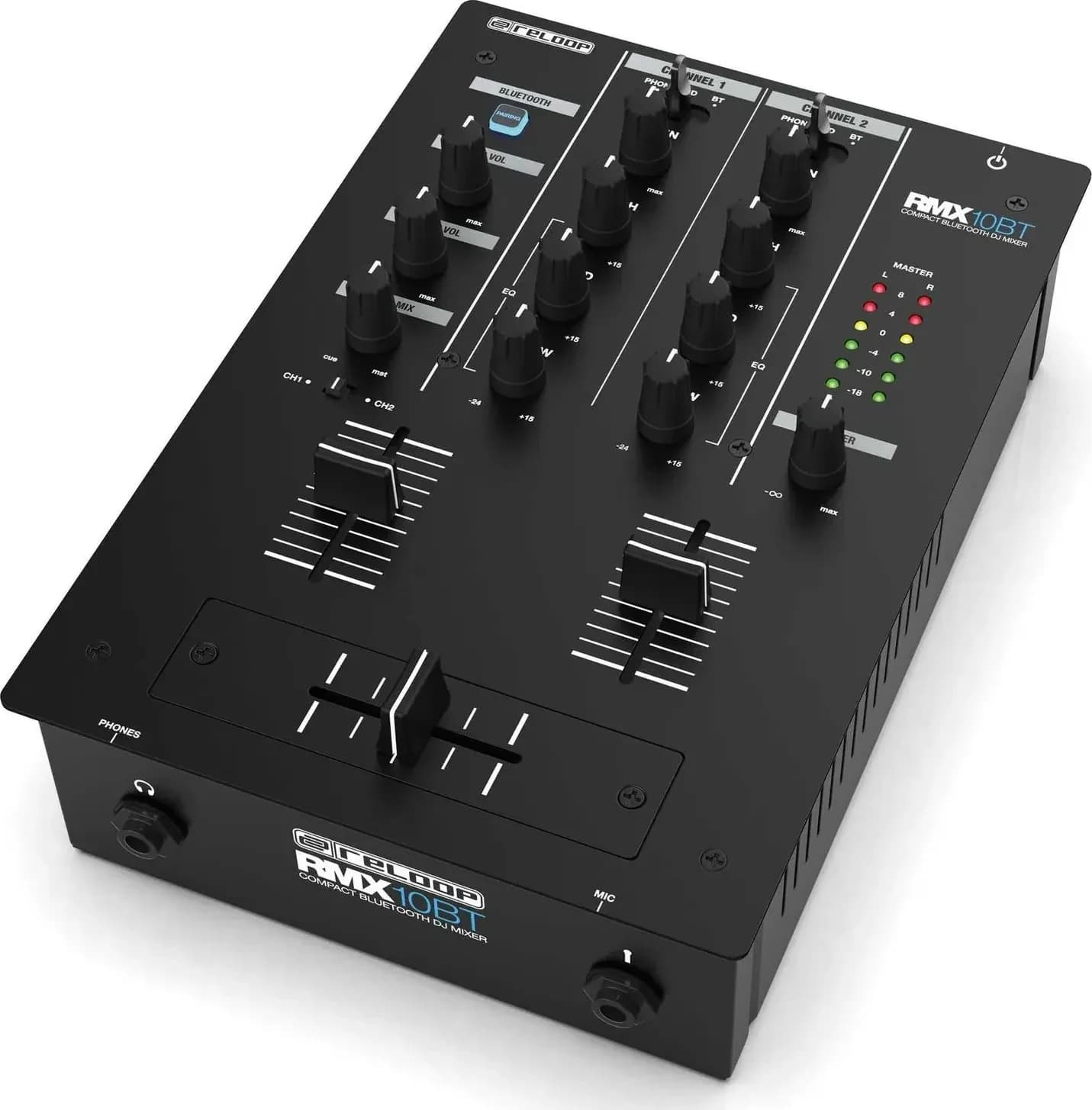
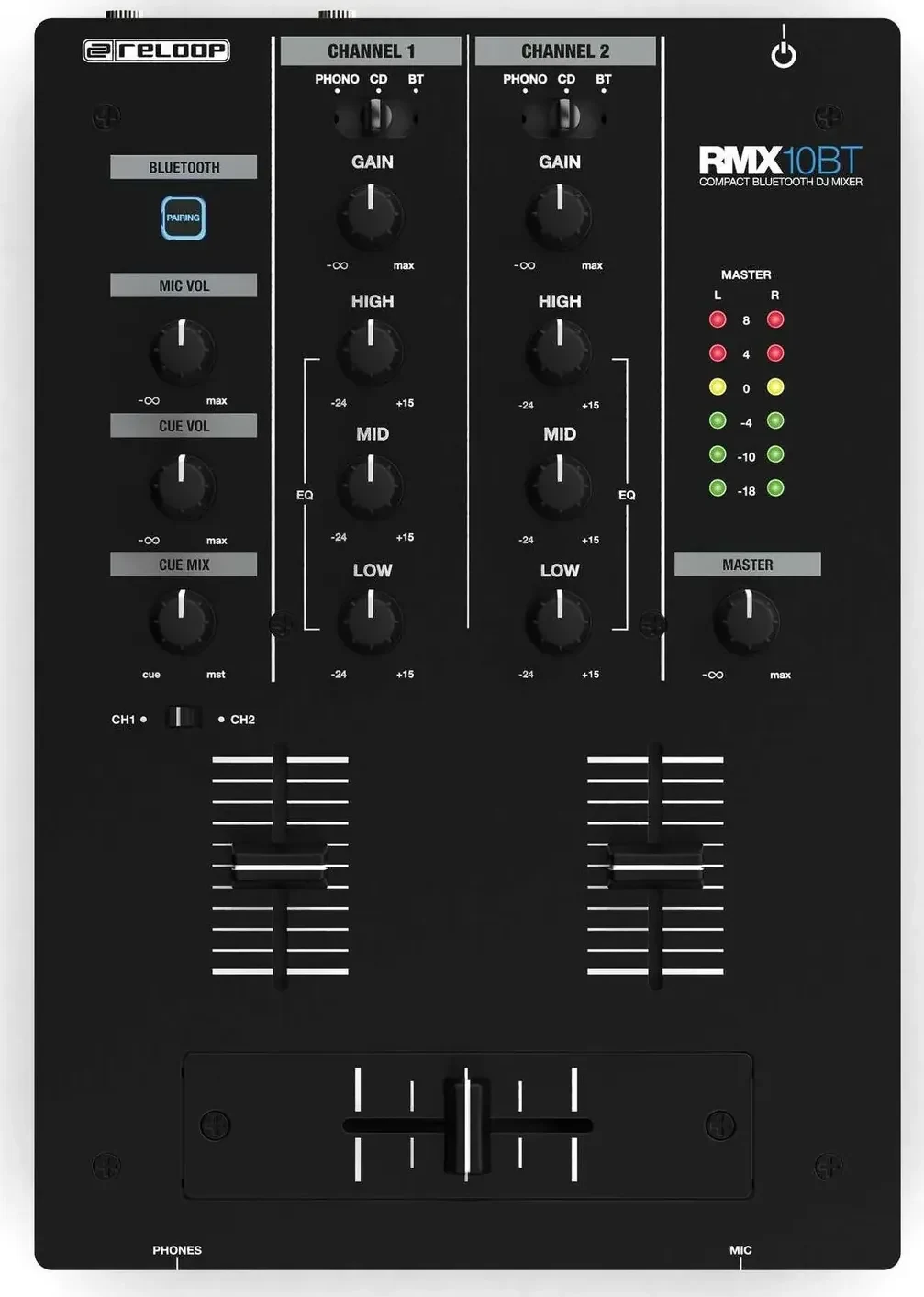
The layout is deliberately plain. Each channel gets a three-position input selector up top — phono, line, or Bluetooth — above a gain knob, a 3-band EQ, and a smooth-travel line fader. Master level shows on LED strips to the right, the Bluetooth pairing button sits in its own section on the front panel, and a 6.3mm mic input with a dedicated volume knob rounds things out alongside the headphone section with cue-mix control. Nothing here needs the manual, which matters for the audience Reloop is courting.
DJWORX likened the RMX-10 BT to Numark's long-discontinued Blue Dog — a no-frills box for people who need to blend two sources and nothing more — and that comparison sets expectations about right. There's no USB port, no effects section, and no booth output; the back panel is two phono pairs, two line pairs, RCA master and rec outs, and the mains inlet.
EQ, faders and the sound path
The signal path covers the fundamentals properly. Each channel runs its 3-band EQ at 100Hz, 1kHz and 10kHz — sensible band spacing that keeps bass swaps and vocal ducking predictable — with individual gain, and the quoted frequency response spans the full 20Hz–20kHz. Both channels accept genuine phono-level signal, so a pair of turntables plugs straight in without external preamps.
The fader hardware is the pleasant surprise at this price. The 45mm crossfader is user-replaceable, and Innofader lists fitting instructions for the RMX-10 BT among its supported mixers, so a worn or scratchy stock fader can be upgraded to a pro-grade part instead of writing off the unit. The line faders travel smoothly and the crossfader cuts cleanly enough for basic blends.
What you don't get is any control over the crossfader's response: there's no curve knob and no reverse switch — Reloop reserves adjustable curves for bigger mixers like its RMX-95 — so the cut profile is fixed. The cheaper Numark M2 offers both contour and reverse controls, which makes it the better pick if scratch practice is the goal.
On sound, owner reports are solid for the class. Thomann reviewers rate the output quality highly, though one noted slight background noise at idle — a fair reminder that a £110 mixer isn't chasing club-grade signal-to-noise figures. Output is RCA only, master plus a record tap; with no XLR and no booth send, long unbalanced cable runs to a distant PA are the one wiring scenario worth avoiding.
The Bluetooth input
The feature that names the mixer is implemented more thoughtfully than the price implies. Pairing happens from the dedicated front-panel button, and the input selector on either channel — or both — flicks over to Bluetooth. That routing is the clever part: the wireless source lands on a full channel strip, so a phone streaming a playlist gets the same gain, EQ, and fader treatment as a turntable, and can be cued in headphones before it touches the master. Party speakers and all-in-one units usually dump Bluetooth audio straight to the output; here it behaves like a proper input.
What it's genuinely for: taking a request from a guest's phone at a mobile gig without touching a cable, running background music from a tablet while you pack the rig down, or standing in for a second source during home practice. For those jobs it removes real friction, and it's the reason this mixer exists.
What it isn't for is anything timing-critical. Reloop doesn't publish the Bluetooth version or codec support, so assume a standard SBC-class link — the kind that adds a perceptible fraction of a second between phone and speakers. Beat-matching a wireless source against a turntable is off the table, and cueing it in headphones while it plays out will feel slightly disconnected. Owner reports add a reliability caveat too: one Thomann reviewer described a connection that "constantly breaks off", and others mention the link dropping after sitting idle. The practical rule for working DJs is simple — use Bluetooth for low-stakes stretches, and cable anything that can't be allowed to stutter. A first dance or a ceremony entrance belongs on the line input over a minijack-to-RCA lead, not on a wireless link.
In use
As the centre of a small mobile rig, the RMX-10 BT covers more ground than its size suggests. Mixer, two powered speakers, and a wired mic make a complete package for community events, bar sets, and family parties — the mic input has its own level control but no EQ or talkover, so it suits announcements rather than vocal performance. The rec output makes capturing a set easy with any standalone recorder. What's missing is a USB audio interface: there's no direct-to-laptop recording and no software or DVS integration of any kind. This is an analogue mixer with a wireless input, not a controller in disguise.
At home it's just as comfortable — two turntables into the phono inputs, or media players on line, with a phone over Bluetooth as the ever-ready extra source. If the plan is to build a fuller functions rig around it, our mobile DJ setup guide covers the speakers, stands, and redundancy planning that turn a box like this into a working system.
The alternatives
Two mixers frame the RMX-10 BT's position. The Numark M2 — around $119 as of mid-2026 — undercuts it slightly and beats it for scratch fundamentals with contour and reverse controls, but offers no Bluetooth and components that feel their price. The Pioneer DJM-250MK2, north of $400 as of mid-2026, is the serious step up: USB soundcard, rekordbox DVS support, and a Magvel crossfader with curve adjustment, at nearly four times the money. Between those poles the Reloop's pitch is clear — if wireless input solves a genuine problem in how you play, nothing else at this price does it with a proper channel strip attached. See where it lands in our best DJ mixers for beginners guide.


