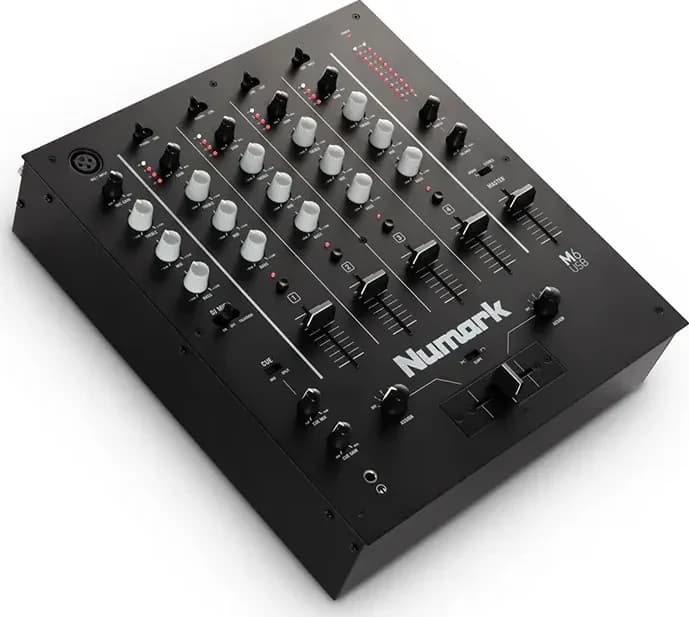

The Numark M6 USB is the most affordable way to get a genuine four-channel DJ mixer. Four independent channel strips with dedicated faders give you full hardware mixing for four sources at once — turntables, CDJs, media players, or a laptop feeding audio over USB. Numark lists it at $299, but the street price has sat around $219 as of mid-2026, and that number is the whole argument: every other new four-channel mixer costs at least twice as much.
Build and design
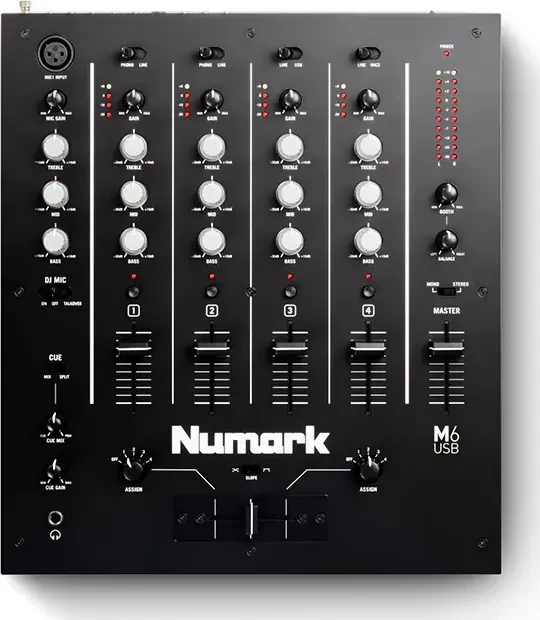
The M6 USB has been in Numark's line-up for well over a decade, and the design shows its priorities clearly. The layout is club-style — four vertical channel strips with gain, three-band EQ and LED metering on each, a crossfader below, and the mic section off to the side. Anyone who has stood behind a rental-rig mixer will find every control where they expect it.
At 321 × 362 × 102mm and 4.4kg, it is a bigger unit than its price suggests — noticeably deeper than compact two-channel boxes like Numark's own M2, and a recurring owner comment is that it takes up more table space than expected. That depth buys sensible control spacing, but plan your booth or desk around it.
The controls are where the budget shows. Owner reviews on retailer sites consistently describe the knobs and faders as serviceable rather than pleasant — they do the job without wobble, but there's none of the damping or resistance you get from a Pioneer DJ or Allen & Heath fader. Numark's one genuinely pro-minded build decision is the crossfader: it's user-replaceable and has an adjustable slope control, so when it wears out — and with heavy use it will — you swap a part rather than the mixer.
Sound quality, EQ and faders
For a mixer at this price, the signal path holds up better than the chassis. The line and phono paths are rated at 20Hz–20kHz, and the most consistent theme in owner feedback is noise — or the lack of it. Reviewers on retailer pages repeatedly describe the M6 USB as quiet in operation, with one owner who replaced a noisier budget mixer calling it "whisper quiet". For a box this cheap, a clean noise floor is not a given, and it's the main reason the M6 USB gets recommended over no-name four-channel alternatives.
Each channel gets a three-band rotary EQ, which is enough to carve bass out of an incoming track for a blend, and the per-channel LED metering makes gain-staging four sources practical rather than guesswork. There are no kill switches or filters — EQ work here is knob work, done a band at a time.
The faders are the honest weak point. Beyond the basic feel, a common owner complaint is the taper: the channel faders do most of their audible work in the last stretch of travel, which makes slow, gradual fade-ins harder to control than they should be. It's workable once you learn the response, but it's the clearest difference between this and a mixer costing three times more. The crossfader fares better — the slope control runs from a long blend curve to a sharp cut, and unusually for the price, any channel can be assigned to either side of the crossfader, so scratch practice with channels three and four is possible.
Routing, the mic channel and USB recording
The input pool is the reason to buy this mixer, so the exact provision matters. The M6 USB provides two switchable phono/line RCA inputs and four line-level RCA inputs — so all four channels accept line sources, and two of them can take turntables directly through the built-in phono preamps. That's two decks of vinyl plus two media players or CDJs running simultaneously, with no external phono stages. The one limit to note: you can't run four turntables, because only two channels switch to phono.
The mic provision is stronger than most compact mixers manage. There's a dedicated XLR microphone channel with its own gain control, plus a secondary mic input on channel four — so a mobile DJ can keep an announcement mic live all night and still hand a second mic to a speech-giver without repatching. This, more than anything, explains who actually buys the M6 USB: it's a working tool for wedding and party DJs who need channels and a mic more than they need effects.
Outputs cover every base a small rig needs: balanced XLR and unbalanced RCA master outputs, an RCA booth output, and an RCA record output, alongside the headphone cue. The USB connection is the other headline. The M6 USB is a class-compliant audio interface in both directions — it records your master mix straight to a Mac or PC with no drivers and no external interface, and it plays audio from your laptop back into the mixer as a source. For anyone building a mixtape or podcast habit alongside their DJing, that removes an entire box from the shopping list.
In use
The M6 USB's buyer profile is well established after this long on the market. Owner ratings sit at 4.5/5 across 14 reviews on Sweetwater as of August 2026, and the pattern in the feedback is consistent: mobile DJs running multi-source setups, beginners stepping up from two channels, and DJs building rehearsal or practice rigs where a club mixer's price can't be justified. If you're unsure whether you need the extra strips at all, our 2-channel vs 4-channel mixer explainer walks through the decision.
The limits are equally consistent. There's no DVS certification, so Serato or Traktor timecode setups are out — this is a hardware mixer for hardware sources plus a USB laptop feed. There are no onboard effects, so transitions rely on EQ and fader work alone. And nobody should confuse it with an installation mixer: the build is fine for a home setup or a padded case, but it isn't built for the nightly abuse a club install dishes out.
Alternatives and where it stands
At this price the alternatives each give something up. Behringer's DX2000USB offers seven channels and an Infinium crossfader for similar money, but its layout is closer to a DJ/PA hybrid than a club mixer, and user reports describe USB playback problems with missing channels on computer recording — the M6 USB's simpler, class-compliant implementation has the better reputation. A used club mixer from the same budget gets you better faders and effects, but with worn parts, no warranty and usually no USB recording. And if you honestly only need two channels, the Numark M2 does the scratch-mixer basics for roughly half the price.
None of those options does what the M6 USB does: four real channels, a proper mic section and USB recording, new, for around $219. For beginners who want the channels without the club-mixer outlay, it remains the clear choice — see how it compares in our best DJ mixers for beginners guide.


