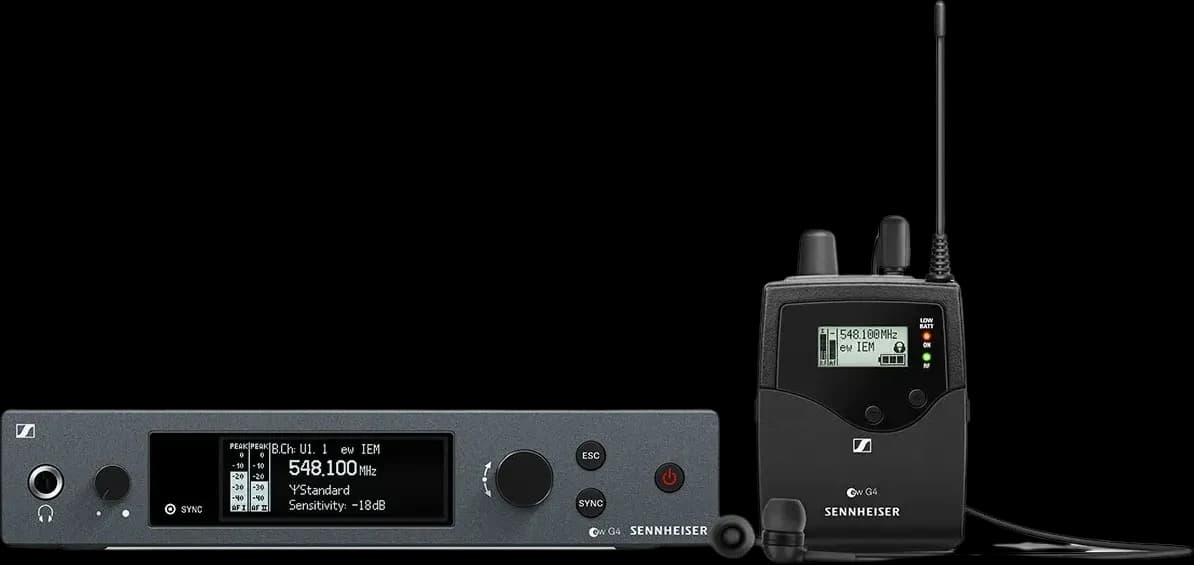

The Sennheiser EW IEM G4 is the other professional standard in wireless in-ear monitoring alongside the Shure PSM300, and it's the one to reach for when audio quality is the priority. Sennheiser's HDX companding keeps the analogue UHF link unusually transparent, with minimal compression artefacts — you hear the mix, not the system working on it. The trade-offs are just as clear: the steepest price in the pro wireless IEM bracket, bundled earphones that undersell the electronics, and a feature set most small-venue performers will never switch on.
Build and design
The set is three pieces. The SR IEM G4 transmitter is a half-rack unit in a full-metal housing, about 980g on the scales, with a bright OLED display showing frequency, bank and channel, AF metering and lock status. Sennheiser ships the GA 3 rack kit and a rod antenna in the box, so the transmitter goes straight into a 19-inch rack — alone, or two units side by side in a single rack space — without a separate accessory order. That detail signals who this is for: gear designed to live in a monitor rack, not sit on a table behind the booth.
The EK IEM G4 bodypack receiver is the piece that takes the abuse, and it's built for it — a rugged metal housing measuring roughly 82 × 64 × 24mm, powered by two AA cells or Sennheiser's BA 2015 rechargeable pack, with a claimed 4–6 hours per set. The volume control is smooth and precise, and the controls lock, so a knee or a cable snag can't change your mix mid-set.
The bundled IE 4 earphones are the weak point of an otherwise pro-grade package. They're single-driver dynamic earbuds that isolate adequately and survive as spares, but owner reviews consistently describe them as the first thing to replace — this transmitter deserves at least Sennheiser's own IE 100 Pro or a Shure SE215.
Audio quality and RF performance
This is where the G4 earns its price. Sennheiser's HDX compander squeezes the signal's dynamic range 2:1 before transmission and expands it back in the receiver, which pushes the noise floor down without the pumping that cheaper companders add. The published numbers support what owners report: signal-to-noise above 90dB, distortion under 0.9%, and audio response from 25Hz to 15kHz. That 15kHz ceiling is a property of analogue FM wireless as a class — the PSM300 rolls off in the same region — so what you actually gain over rivals is lower grain and a more open midrange, not extra treble.
The RF side is equally serious. Each version covers a wide UHF window — the A-band set spans 516–558MHz, a 42MHz range with 1,680 frequencies tunable in 25kHz steps — and transmit power is selectable up to 50mW where regulations allow. The EK IEM G4 uses adaptive diversity, treating the headphone cable as a second antenna and switching to whichever signal path is cleaner. On a festival stage crowded with wireless microphones, IEMs and comms, that combination — spare spectrum to retune into and diversity to ride out reflections — is why the G4 holds a stable signal at distances up to 100 metres line of sight.
One recurring owner complaint deserves context: a handful of retailer reviews mention audible hiss between songs. HDX expansion works best with a healthy input level, so the fix is usually gain staging — feed the transmitter a proper line-level send and the noise floor drops back below the room noise it competes with.
Setup and channel management
For a single system, setup is quicker than the spec sheet suggests. The bodypack can scan the band for clean spectrum, and settings move from transmitter to receiver over an infrared sync link — hold the pack up to the front panel, press sync, and frequency and audio settings transfer in a couple of seconds.
Multi-system coordination is where the G4 pulls away from simpler rivals. The frequency plan is organised into 20 fixed banks, each holding up to 16 factory-computed, intermodulation-free channels, plus six user banks for custom coordination — up to 16 systems running in parallel from one band. An Ethernet port on the transmitter connects to Sennheiser's Wireless Systems Manager software, so a monitor engineer can watch and retune a full rack of transmitters from a laptop instead of scrolling through front panels.
Two caveats. The menus run deep — output mode, HiBoost EQ, limiter, squelch and lock functions all live a few layers down — and owners moving up from simpler systems report spending an evening with the manual before the workflow feels fast. And the UHF ranges are region-locked by law, not just by SKU: in the UK, the GB-band version sits in Channel 38 (606–614MHz) and needs an Ofcom shared PMSE licence at £75 a year, and several other European ranges require registration or a licence, with only narrow slices licence-free. Buy the band that's legal where you actually gig.
In use
The G4 makes sense the moment monitoring becomes infrastructure rather than a gadget. On a touring or festival rig it does what the spec sheet promises: the transmitter disappears into the rack, the metal pack shrugs off nightly load-outs, and the RF stays solid while cheaper systems hunt for air. Feeding it AAs every night is the hidden cost owners mention most — the BA 2015 pack and charger are near-obligatory extras for full-time use. The receiver's adjustable limiter is worth setting on day one, too: in-ears at a fixed, controlled level are kinder to your ears than wedges, and our best DJ earplugs guide covers protecting your hearing for the rest of the night.
Price is the honest gatekeeper. Sennheiser launched the G4 generation in 2018 with the IEM set at $999; as of August 2026, US retail lists the A1-band set at $1,149 and the A- and G-band versions at $1,249, with the twin set (one transmitter, two packs) at $1,649. For a DJ monitoring alone in a small club, that buys headroom you'll never use — the Phenyx Pro PTM-10 covers small-venue and rehearsal duty at a fraction of the cost, and the XTUGA IEM1200 puts a whole band on in-ears for less than half of one G4 system.
How it compares to the Shure PSM300
The PSM300 remains the G4's only real rival at this level, and the choice splits cleanly. Shure's pro P3TRA215CL configuration — metal P3RA bodypack plus SE215 earphones — lists at $989 as of August 2026, so it's cheaper and ships with better earphones out of the box. It counters with MixMode, which blends two sources directly from the pack; the G4's Focus mode answers by letting you rebalance the two sides of the stereo feed. Where the Sennheiser wins is everything upstream: audibly lower noise and grain, a wider switching bandwidth with more coordinated channels per band, and the rack-and-Ethernet ecosystem a monitor engineer actually wants to manage. Pick the Shure for dependable simplicity on one or two mixes; pick the G4 when sound quality and multi-system scale justify the premium — and see how both rank in our best in-ear monitors guide.


