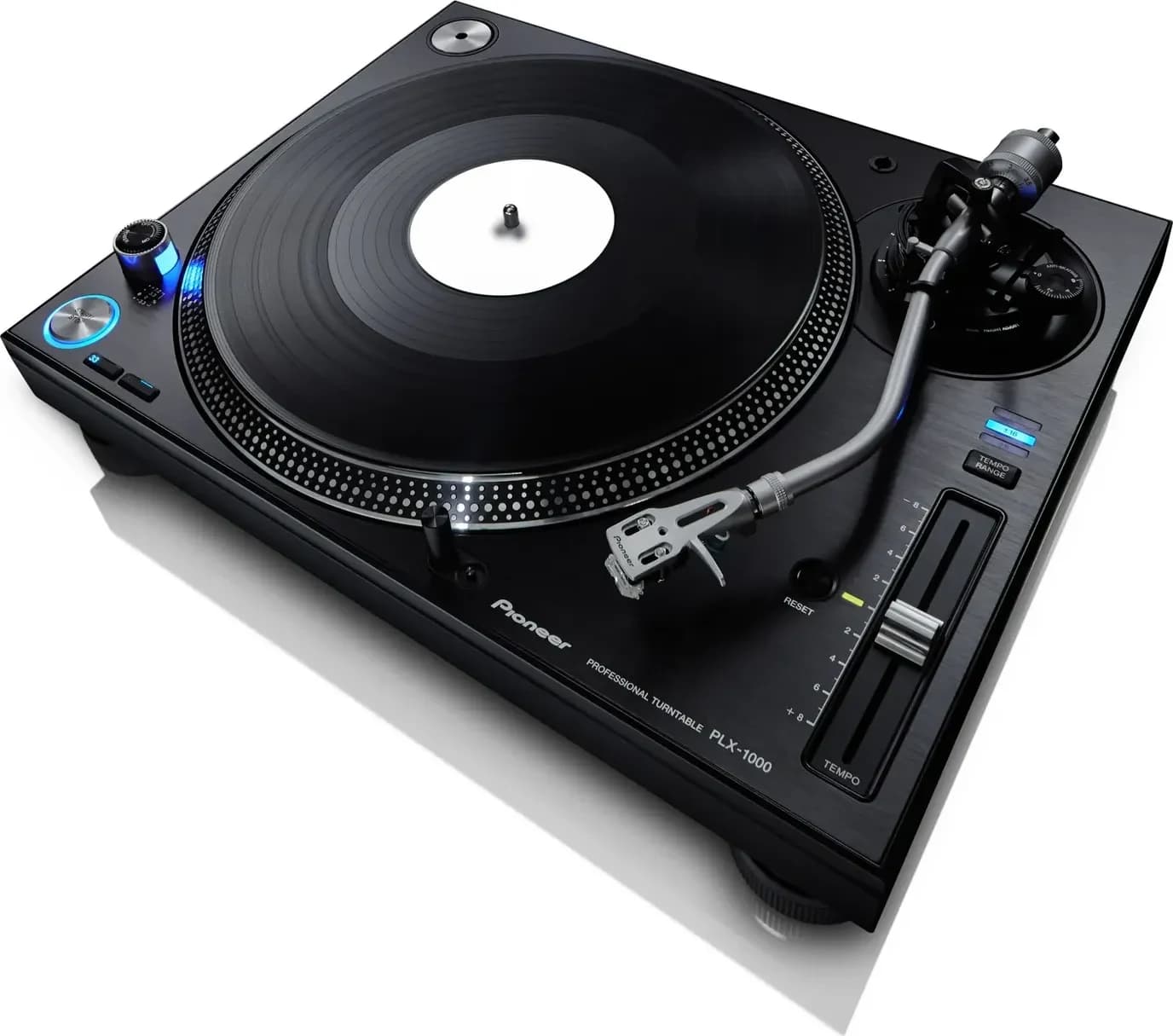
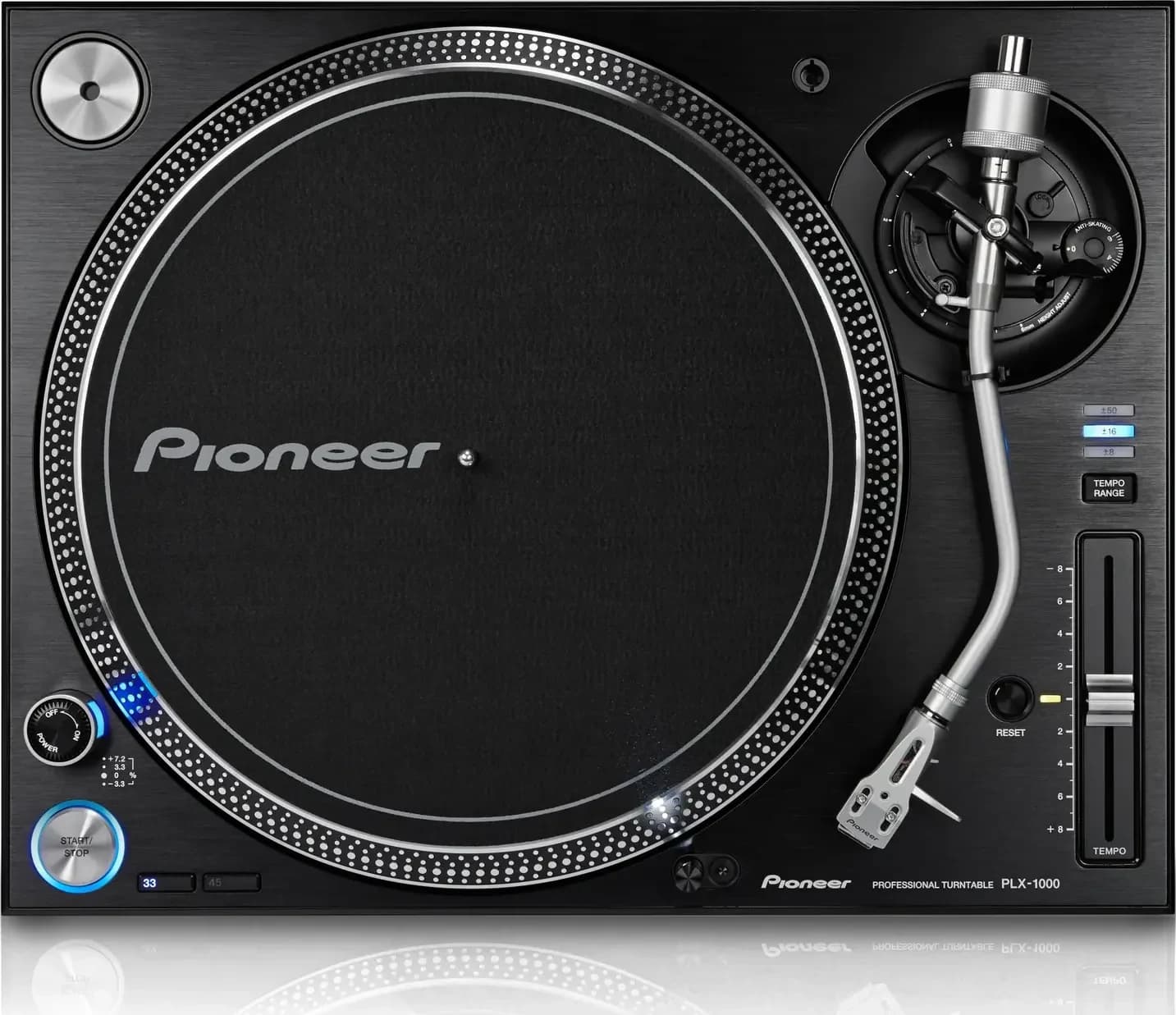

The Pioneer DJ PLX-1000 is Pioneer's take on the club standard, and it nails the fundamentals. Launched in September 2014 at $699 in the US, it's unapologetically modelled on the deck that has anchored club booths for four decades — and on paper it out-muscles the Technics SL-1200MK7, with two and a half times the quoted starting torque and an extra three and a half kilos of chassis mass. It's the deck to look at when you want serious club performance but the Technics is out of budget.
Build and design
At 13.1 kg, the PLX-1000 is a genuinely heavy turntable — around 3.5 kg more than the SL-1200MK7. That mass is deliberate. The top section is a die-cast zinc chassis, the bottom is 8 mm-thick resin, and Pioneer sandwiches a 9 mm layer of vibration-damping material into the base. The tonearm is isolated on the same principle, mounted with rubber and springs at its damping points. All of it exists for one reason: to keep low-frequency energy from a club system out of the stylus, where it becomes rumble and, at worst, howling feedback.
The arm itself is a universal S-shaped design with a gimbal bearing and static balance, plus the adjustments working DJs expect — height adjustment with a locking lever, anti-skate, and a removable headshell so cartridge swaps take seconds. No cartridge is included, which is normal at this level but does mean budgeting another chunk for a cart and stylus before the deck plays a note.
The most road-friendly detail sits round the back: both the power lead and the audio leads are detachable, terminating in an IEC socket and gold-plated RCA jacks with a separate ground wire. Hard-wired RCA tails are the classic failure point on gigging turntables — on most decks a crushed cable means a soldering iron, while on the PLX-1000 it means carrying a spare. It's a small decision that says a lot about who this deck was designed for.
Torque and pitch stability
The headline figure is torque. Pioneer quotes a starting torque of 4.5 kg/cm or more from the quartz-locked direct-drive motor, which spins the platter up to 33⅓ RPM in 0.3 seconds. For context, Technics quotes 1.8 kg/cm and 0.7 seconds for the SL-1200MK7 — the Pioneer has two and a half times the grip and reaches speed in under half the time. Among mainstream club decks, only Reloop's Power-Torque motors, adjustable up to 4.0 kg/cm, get close.
In practice that torque shows up everywhere. Drop the needle on a cue point and the platter is at pitch before the kick lands. Ride the vinyl with your fingertips and the motor pulls straight back to speed the moment you let go, so pitch bends land accurately instead of sagging. Digital DJ Tips' head-to-head against the Technics SL-1200 MK2 found exactly that: the stronger motor recovers faster during scratching and pitch riding, with shorter lag and more accurate bends.
There is a flip side. Some DJs raised on Technics decks find the harder platter grip takes adjustment — the 1200's gentler torque lets the record breathe a little under hand pressure, and plenty of scratch DJs prefer that feel. Neither approach is wrong; it's a real difference in character worth trying before committing to a pair. Our PLX-1000 vs Technics 1200 comparison goes deeper on how the two motors behave.
Features — and what's missing
The pitch section is the PLX-1000's most flexible feature. Three ranges — ±8%, ±16% and ±50% — run from beatmatching precision to halving a track's tempo outright, and a reset button snaps playback to true zero regardless of where the fader sits. The wider ranges are genuinely useful in multi-genre sets, bridging tempo gaps a ±8% deck simply can't reach.
Beyond pitch, though, the spec sheet goes quiet, and this is where the deck shows its age. There's no reverse play — the Reloop RP-7000 MK2 includes it, along with adjustable torque and an upright battle-style pitch fader, for less money, and even the current Technics offers it. There's no digital pitch readout, no USB output, and no built-in DVS hardware; this is a purely analogue instrument. Pioneer's own answer to that criticism is the PLX-CRSS12, which layers needle-free digital vinyl control and performance pads onto the same basic formula at a much higher price.
Whether any of that matters depends on how you play. For house and techno DJs mixing two copies of a record, reverse is a party trick and a pitch display is clutter. For turntablists and hybrid digital DJs, the gaps are real, and the Reloop's feature list reads better per pound spent.
In use
Owners and reviewers consistently describe the PLX-1000 at its best in the environment it was built for: loud rooms. On bass-heavy floors the mass and layered damping earn their keep, keeping the stylus tracking cleanly at monitor levels that unsettle lighter decks. For DVS users it pairs happily with Serato, Traktor or rekordbox through control vinyl and a suitable interface — our guide to digital vinyl systems covers how that chain fits together.
The picture isn't spotless. Owners comparing both platforms on enthusiast forums broadly agree the Technics tonearm is machined to tighter bearing tolerances, and the PLX-1000's arm — competent as it is — is the component most often named as the gap between the two decks. There are also scattered owner reports of hum and grounding niggles, with noise traced variously to the earthing arrangement, the phono ground or the headshell contacts. Those reports are a minority, and the fixes are usually simple, but it's sensible to test a new unit thoroughly inside the return window.
How it stacks up
Price is the PLX-1000's closing argument. It launched at $699 and, as of August 2026, typically lists around $850 in the US, while the SL-1200MK7 sits near $1,300 — a gap of roughly $450 per deck, or the better part of a grand across a pair. The Technics answers with tighter engineering, decades of proven longevity and unbeatable resale value; the Reloop RP-7000 MK2 undercuts both with a longer feature list; the PLX-CRSS12 adds the digital tricks this deck deliberately skips. As a straightforward, road-ready club deck, though, the PLX-1000 holds the middle ground with confidence — see where it lands against all three in our best DJ turntables guide.


