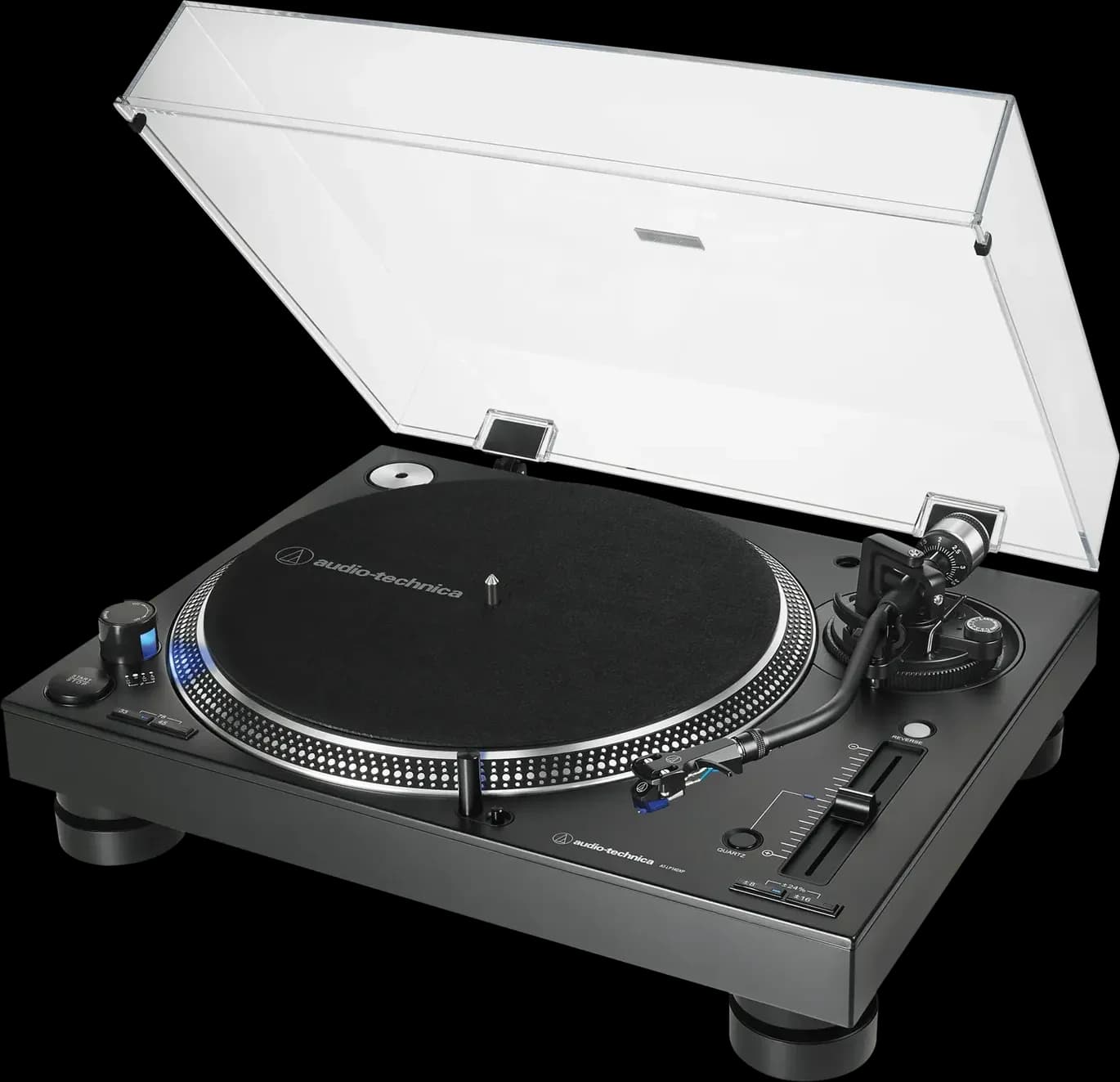

The Audio-Technica AT-LP140XP is the easiest way onto a proper direct-drive deck. Launched at $399 in 2019, it undercuts every club-standard rival, and it plays straight out of the box — an AT-XP3 cartridge arrives fitted to the headshell, so the first record can be spinning within minutes of unpacking rather than after a separate shopping trip for a cartridge and an alignment session.
Build and design
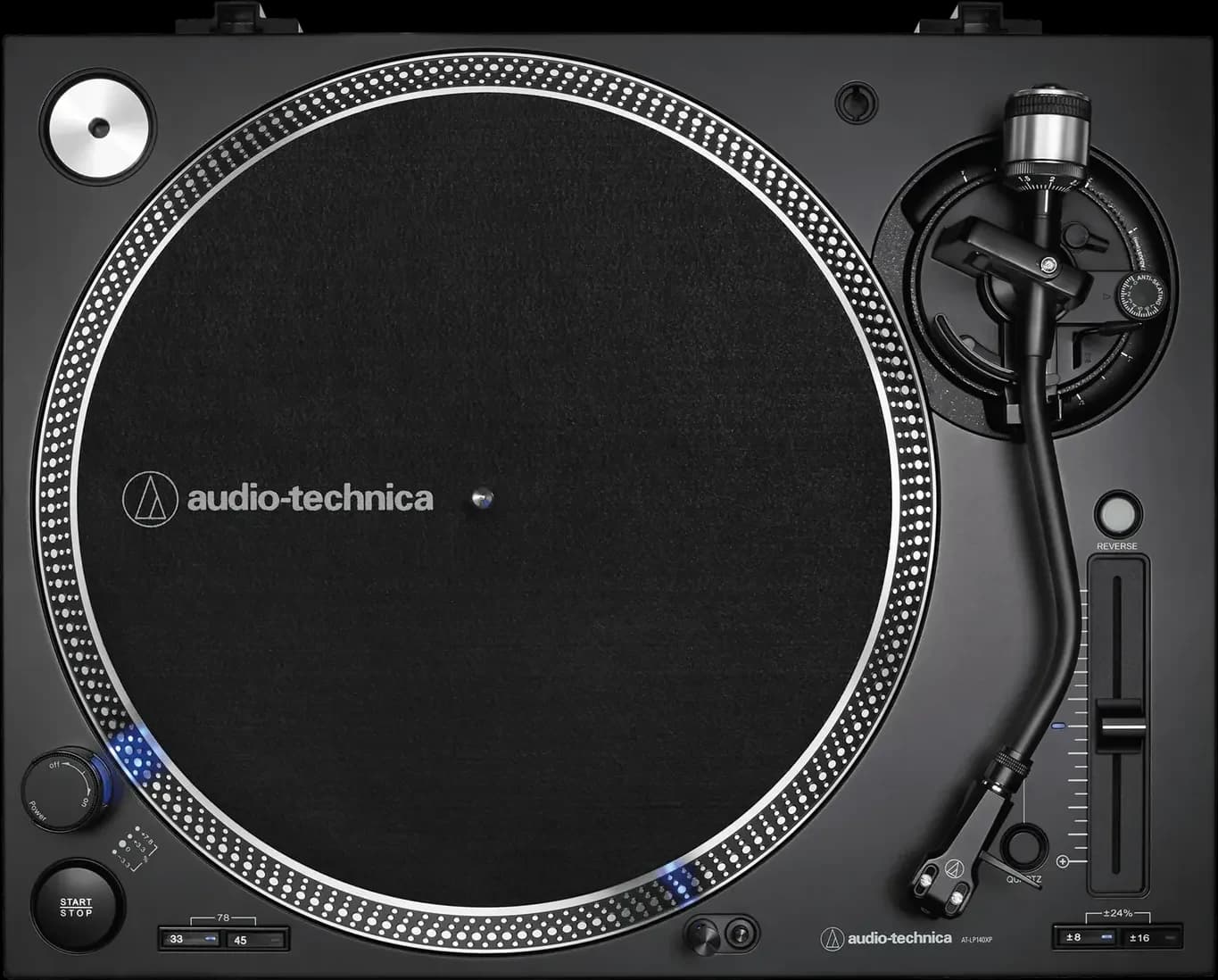
Audio-Technica builds the AT-LP140XP to the familiar club-deck template: a 452 × 352 × 159 mm chassis with a die-cast aluminium platter, an S-shaped tonearm at the right rear and a pitch fader along the right edge. Anyone who has stood in front of a Technics will find every control where muscle memory expects it, and that's a deliberate choice — habits learned on this deck transfer directly to whatever sits in a club booth.
At 10.0 kg without its dust cover it's a substantial unit — The Vinyl Factory's review measured the plinth as roughly 2 kg heavier than the cheaper AT-LP120X's — but it still gives up around 3 kg to the Pioneer DJ PLX-1000, and that missing mass is where the price difference shows first. Less weight means less inertia and less damping to soak up vibration, and owners running the deck close to loud monitors report it picks up low-end feedback sooner than the heavier club decks do. On a solid, isolated surface at home that rarely matters; wedged next to a bass-heavy PA, it does.
The detailing is better than the price suggests. The tonearm is height-adjustable with a hydraulically damped lift and a lockable rest, the platter carries a layer of dense felt-like damping material to cut ringing, and the RCA leads are detachable rather than captive — a serviceability win gigging DJs learn to appreciate the first time a cable fails. A dust cover comes in the box too, which sounds trivial until you price one separately for a deck that ships without.
Torque, pitch and speed stability
Audio-Technica quotes starting torque at better than 2.2 kg/cm. That's stronger on paper than the 1.5 kg/cm of the classic Technics SL-1200MK2 that defined the category, but roughly half of the Pioneer DJ PLX-1000's 4.5 kg/cm, and below the Reloop RP-7000 MK2's adjustable drive as well. In practice the gap shows in two places: the platter takes fractionally longer to reach full speed from a standing start, and it's easier to slow with a heavy hand on the vinyl. For beatmatching and cueing this is a non-issue; for aggressive, sustained scratching it's the deck's clearest performance ceiling.
Pitch control is a quiet strength. Where most decks in this class offer two ranges, the AT-LP140XP gives three — ±8%, ±16% and ±24% — so you get fine resolution for beatmatching at ±8% and plenty of throw for creative tempo moves at ±24%. Speed options are unusually complete as well: 33⅓, 45 and 78 RPM are all onboard, along with reverse play, so the deck can also spin an inherited shellac collection — something the 33/45-only PLX-1000 can't do.
The published wow and flutter figure of below 0.2% (WTD, JIS) reads conservative next to the club decks, but owner reports of audible speed drift are rare. The complaints that do recur in forum threads concern hum from a poorly seated ground lead rather than the motor losing time — a setup issue, not a drivetrain one.
Cartridge, connections and the preamp question
The fitted cartridge is Audio-Technica's AT-XP3, a DJ-voiced moving-magnet design on an AT-HS6 headshell tracking at a recommended 3 g. It's the right tool for mixing — it sits securely in the groove and takes back-cueing without complaint — but it's tuned for punch over finesse. The Vinyl Factory found the bass "brutal" at the full 3 g and audibly more refined backed off to 2 g, and the consistent owner consensus is that the XP3 is the first thing to upgrade if the deck doubles as a listening turntable. Plan that upgrade with care, though: threads on Vinyl Engine put the tonearm's effective mass at around 21 g, which rules out most high-compliance audiophile cartridges. The practical routes are Audio-Technica's own XP5 or XP7, or swapping the XP3's stylus for a Microline replacement.
Connectivity is where the spec sheet needs reading carefully, because this deck is often confused with its stablemate, the AT-LP120XUSB. The AT-LP140XP has no built-in phono preamp and no USB output: the detachable RCA leads carry a phono-level signal (5.5 mV nominal) and nothing else. Into a DJ mixer with phono inputs — which is exactly what it's designed for — that's no limitation, and arguably the cleaner signal path. Into powered speakers or a line-level input it won't work without a separate phono stage, and first-time buyers discovering that after unboxing is a recurring theme in retailer reviews. Budget for a mixer or an external preamp; the deck itself is only most of the out-of-box story.
In use
As a first real deck, the AT-LP140XP's case is practical rather than glamorous. Everything a beginner needs on day one is in the box — cartridge, headshell, slipmat, 45 adapter, counterweight and cables — and the remaining setup steps (balance the arm, dial in 3 g, attach the ground lead) take minutes. That last step matters: a skipped ground wire is behind most of the hum complaints owners post.
For learning fundamentals, the deck holds up well. The ±8% range gives fine-grained control for beatmatching practice, and the torque is sufficient for learning to scratch at a hobbyist level — owners consistently describe it as a dependable practice deck, with the caveat that DJs drilling battle-style routines tend to outgrow the motor and the lighter chassis. That matches how Audio-Technica positions it. This is the deck for the spare-room setup, for the record collector whose listening habit turned into a mixing habit, and for the controller DJ who wants real vinyl practice between gigs — not the deck being loaded into a van three nights a week.
As of August 2026 the AT-LP140XP retails for $549 in the US, and regular discounting keeps it the cheapest of the serious direct-drive options. If the budget stretches, the Reloop RP-7000 MK2 buys noticeably more torque and a battle-ready control layout, the Pioneer DJ PLX-1000 adds club-grade mass and damping, and the Technics SL-1200MK7 remains the benchmark the others chase. None of them, though, match the AT-LP140XP's out-of-box completeness at its price. See how it ranks against all three in our best DJ turntables guide.


