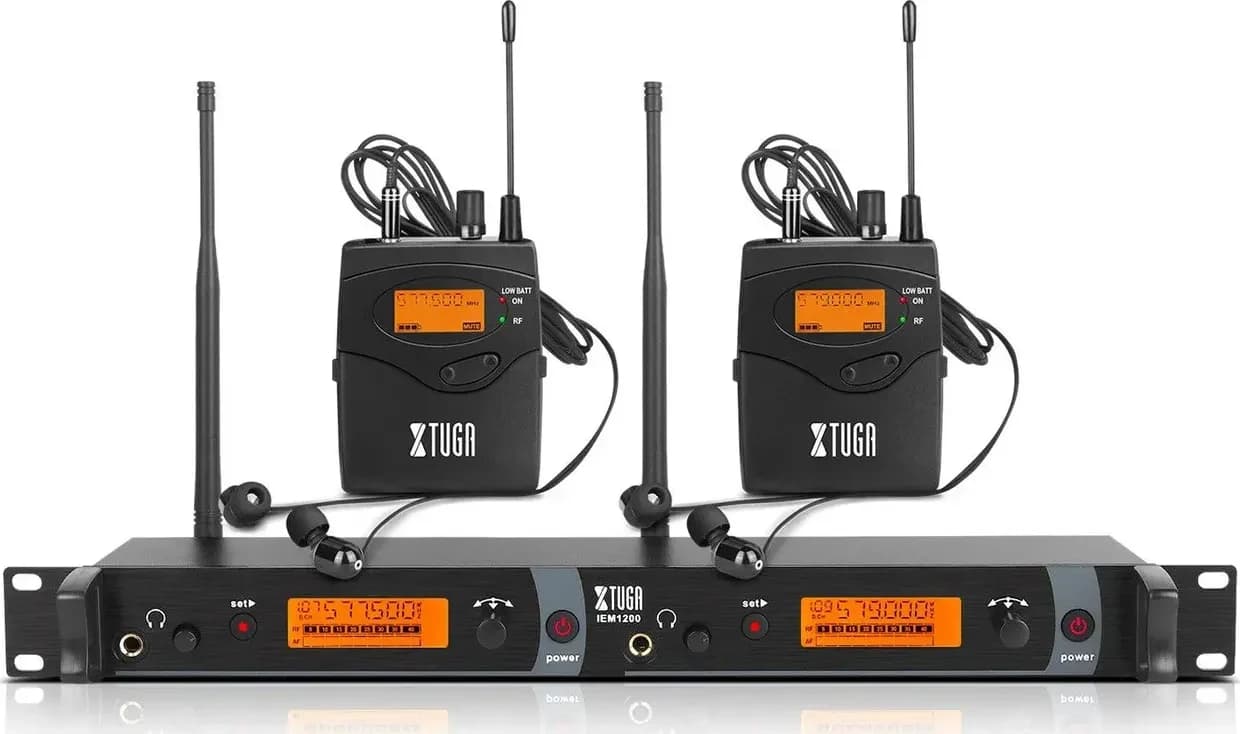

The XTUGA IEM1200 solves a specific problem cheaply: getting a whole band onto in-ears without spending pro money. Its signature move is the multi-receiver bundle — one rack transmitter feeding two, four, six, eight or ten bodypacks — which undercuts buying an individual system per player by a wide margin. XTUGA's own store sells the four-receiver bundle for $225.50 as of August 2026, and the ten-receiver kit for $419.90. It is hard to find a lower cost per musician anywhere in wireless monitoring. The compromises that make those numbers possible are baked into the architecture, and they decide who this system is actually for.
Build and design
The transmitter is a standard 1U rack unit with a metal front panel, an LCD showing channel and frequency status, combo XLR/6.35mm inputs fed from your desk's aux sends, and a loop output for chaining. It's rack-mountable out of the box, which most budget rivals aren't — the Phenyx Pro PTM-10 is a plastic desktop box by comparison.
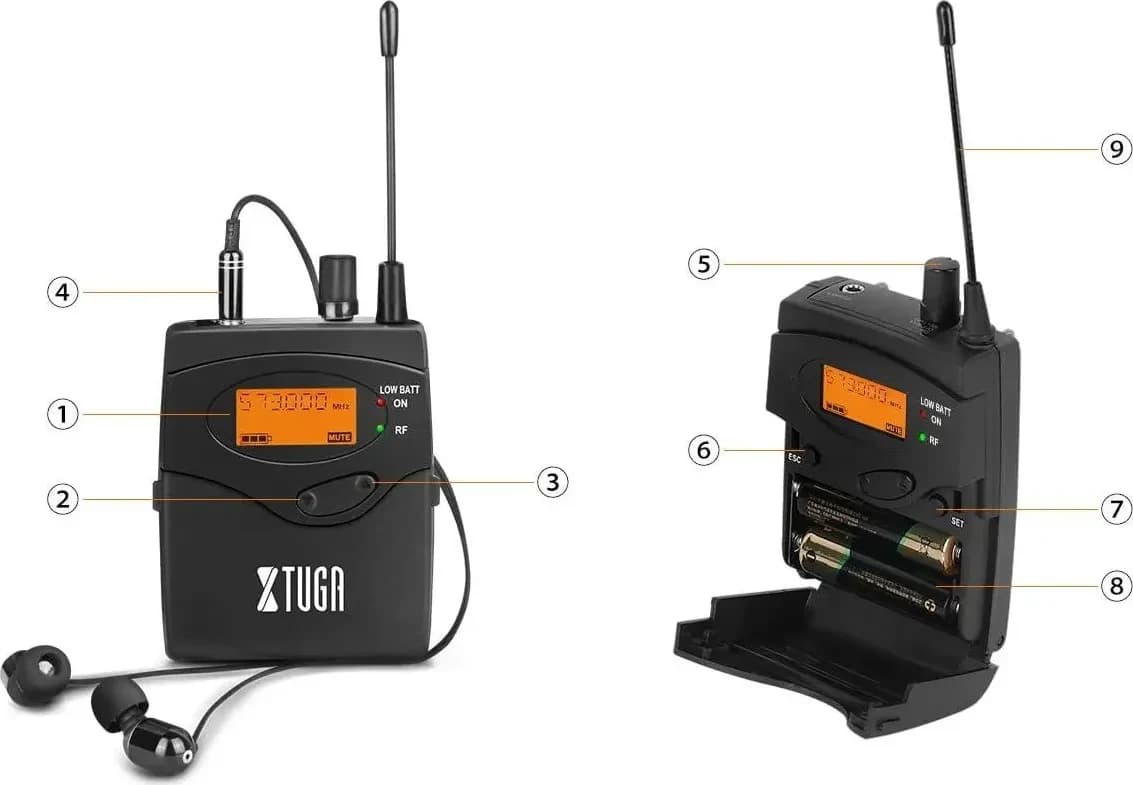
The bodypacks are the surprise on paper. XTUGA's listings describe metal receiver shells — at a price where plastic is the norm — with an LCD, a low-battery indicator and manual channel selection, all running off two AA batteries. That's the claim; with a marketplace brand, the spec sheet is where certainty ends. Quality control, warranty handling and long-term durability depend on the storefront you bought from, because XTUGA has no service network to fall back on, and there's no independent lab data on any of it.
Two details count in its favour. Spare bodypacks are cheap and genuinely available — $35 direct from XTUGA's store and $44.26 at Newegg as of August 2026 — so adding a musician or replacing a crushed pack is a small spend rather than a system swap. And XTUGA's store warns buyers to check that older bodypacks match the current 550–580 MHz band before ordering, which tells you hardware revisions exist: buy the transmitter and packs together rather than mixing generations.
One transmitter, two mixes: the architecture that defines it
The IEM1200 is sold as a "2-channel" system, and the wording matters. The rack unit contains two independent mono transmitters, each with 40 preset frequencies, and every bodypack tunes to one or the other. In practice, the entire band shares at most two mixes. A ten-receiver bundle is ten musicians listening to two blends — typically a vocal-forward mix on channel A and a rhythm-section or click-heavy mix on channel B.
For some groups that's genuinely enough. A covers band happy with one good front-of-house-style blend, or a worship team that wants the band on one channel and click-plus-cues on the other, gets the silent-stage benefits — no wedges, lower stage volume, a click everyone can actually hear — for a fraction of pro money.
But it rules out the thing in-ears are prized for: the personal mix. Nobody can ask for more of themselves without changing the blend for everyone else on that channel, and there's no control at the pack beyond volume. The Shure PSM300 attacks this from the opposite end — its MixMode lets each player blend two sources from the bodypack itself — and a Sennheiser EW IEM G4 per player is full personal-mix territory. Work out which side of that line your band sits on before the price tag does the deciding.
Audio and RF reality
Transmission is analogue FM in the 550–580 MHz UHF band, with PLL frequency stability quoted at ±0.005%. Analogue means no codec delay — a real advantage over the cheap 2.4 GHz digital systems where latency is the usual budget failure.
The published audio numbers are honest about the tier. XTUGA quotes a frequency response of 50 Hz–15 kHz (±3 dB) and a signal-to-noise ratio above 78 dB; the pro systems publish 90 dB-class figures, and that gap is audible as hiss in quiet passages. A built-in limiter and what XTUGA calls dynamic expansion circuitry — a compander, in practice — keep levels in check. Output is mono per channel, where the PSM300 runs stereo. The documentation itself wobbles: Newegg's spare-receiver listing quotes an 80 Hz floor where XTUGA's store says 50 Hz, so treat every figure from this brand as approximate.
Range claims are similarly elastic, from "up to 300 ft" on the Amazon listings down to the spare-receiver listing's more candid "generally within 80 m". Line of sight in a small venue, either is plenty; bodies, walls and a crowded RF environment will shrink it. The bigger caveat is the band itself. 550–580 MHz sits inside active TV broadcast spectrum — legal for wireless audio in the US below 608 MHz, but shared — so in a city, expect some of the 40 presets per channel to be unusable, and the 30 MHz window gives far less room to escape interference than the G4's wide switching bandwidth.
The bundled earbuds have no published specifications at all, and they're the first thing to replace. In-ears only protect your hearing and your mix if they seal, and loose generic buds do neither; even entry-level sealed IEMs transform what this system sounds like.
In use
Setup is two aux sends from the desk into channels A and B, then matching each bodypack to its channel on the LCD — manual, but a one-time job. Budget AA logistics into the running cost, too: XTUGA quotes a 120mA current drain, which makes a set of alkalines a gig-or-three proposition per pack. With ten packs that's twenty batteries in rotation, so rechargeables pay for themselves almost immediately.
The per-player maths is the whole argument. The four-receiver bundle at $225.50 works out to about $56 per musician, transmitter included; the ten-receiver kit drops that to roughly $42. Going the individual-system route — a PTM-10 per player, each with a genuinely personal mix — costs several times that per head and eats an aux send per musician. A single-player system from the pro brands costs more than the IEM1200's entire ten-receiver bundle. If the question is "can we all try in-ears this year", nothing else answers it at this price.
The upgrade path
Treat the IEM1200 as a group starter kit and it delivers; treat it as a destination and it will frustrate. The moment players start asking for their own mix, stereo monitoring, or RF that shrugs off a busy room, the Shure PSM300 is the natural next step, with the Sennheiser EW IEM G4 above it for sound quality and RF headroom — and the IEM1200 packs still earn their keep in the rehearsal room afterwards. See how all of these compare in our best in-ear monitors guide.


