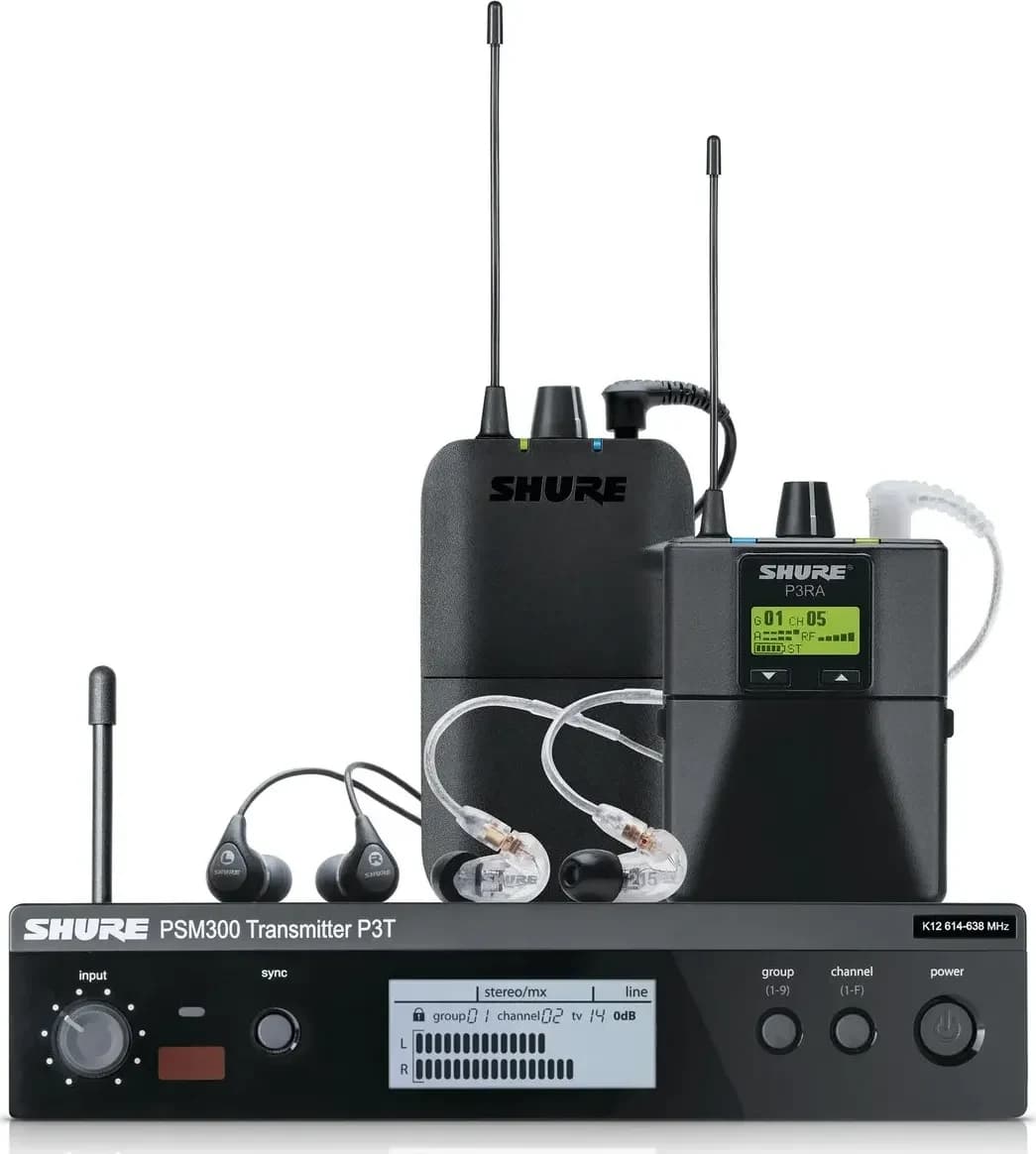

The Shure PSM300 is the professional standard for wireless in-ear monitoring, and it earns that reputation on the two things that matter most on stage: reliable RF and quiet audio. The UHF link holds out to Shure's rated 300 feet (90 metres), and the company's patented Audio Reference Companding keeps the noise floor genuinely low — up to 90 dB signal-to-noise — so what you hear is your mix, not hiss. More than a decade after launch it remains the default recommendation for performers coming off floor wedges, and the spec sheet still explains why.
Build and design
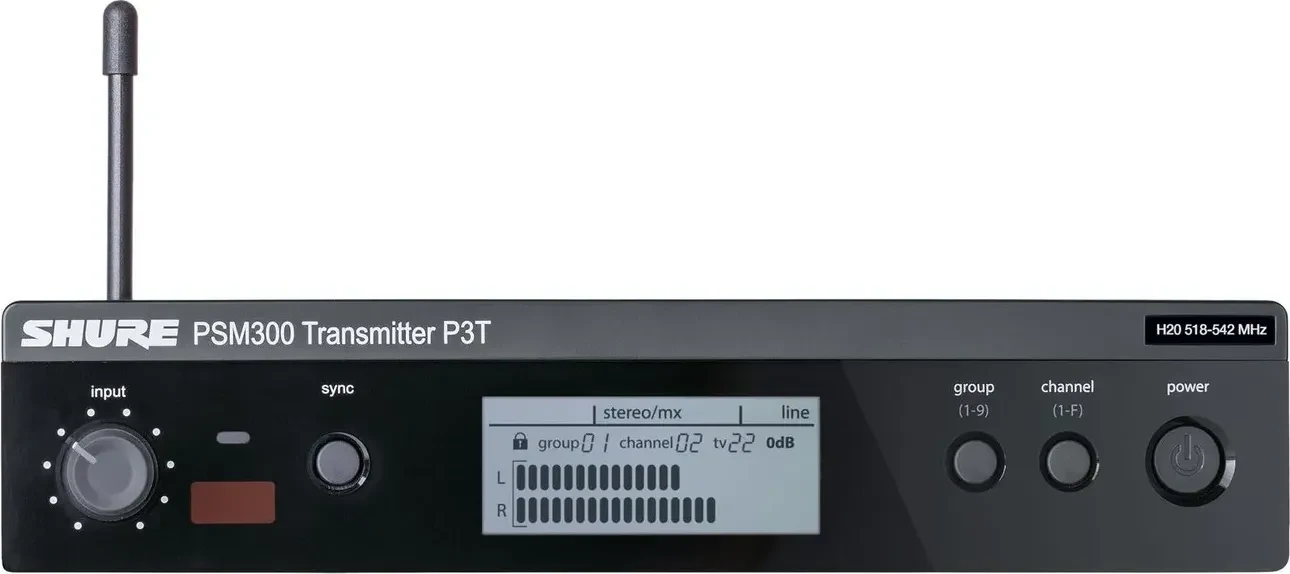
Everything Shure puts in the signal chain is made for the road; only the bundled earphones let the side down, and more on those later. The P3T transmitter is an all-metal half-rack unit with two balanced 1/4-inch inputs, front-panel gain control, a detachable BNC antenna and an infrared window that beams frequency settings to a bodypack in seconds. Two P3Ts sit side by side in a single rack space, and Shure's PA411 antenna and power distributor consolidates up to four of them for multi-mix rigs.
The decision that matters at checkout is the bodypack, because Shure sells two. The standard system, SKU P3TR112GR, ships with the P3R: a polycarbonate pack running on two AA batteries, with a power/volume knob, a blend knob and a seven-segment display — deliberately menu-free. The Pro system, P3TRA215CL, steps up to the P3RA: the same radio in an all-metal shell with a menu-driven LCD that adds high and low EQ boost, an adjustable volume limiter and support for Shure's SB900 rechargeable battery (about $150 more with a charger). Rental houses and weekly gigging owners consistently treat the P3RA as the pack this system deserves; the P3R works fine, but it is the one place the standard bundle is built to a price.
The pricing tracks the hardware. As of August 2026 the standard SE112 bundle sells for around $750 at US retail, while the Pro bundle runs $945–$989 in the US and carries a €1,039 recommended price in Europe.
Audio and RF performance
The PSM300 is an analogue FM system (MPX stereo) rather than a digital link, which buys it two quiet advantages: effectively zero codec latency, and graceful rather than cliff-edge behaviour at the limits of range. The audible signature comes from Audio Reference Companding, Shure's patented noise-reduction scheme, and it is the reason this system stays quiet where cheaper analogue rivals hiss. The published figures are a 38 Hz–15 kHz frequency response, under 0.5% total harmonic distortion and that 90 dB signal-to-noise ceiling. A 15 kHz top end reads modest next to digital competitors, but in monitoring practice the bundled earphones roll off before the transmitter does.
RF management is where the system earned its live reputation. One-touch scan finds the cleanest channel, a group scan finds the group with the most open channels, and IR sync pushes the result to each pack — no menus, no frequency charts. Up to 24 MHz of tuning bandwidth supports as many as 15 compatible systems per band, region dependent; the US G20 band, for example, spans 488–512 MHz. On range, Shure rates 300 ft (90 m) and flags it as environment dependent, and owner reports back that up: the full figure is achievable with line of sight, while walls, bodies and crowded spectrum trim it in practice. What owners on live-sound forums almost never report is the one failure a monitor rig cannot survive — dropouts mid-song. That consistency, more than any single spec, is what the money buys.
MixMode and the monitoring workflow
The P3T carries two audio channels, and the bodypack treats them one of two ways. In stereo mode, the pack's second knob is a left/right balance on a conventional stereo mix. Switch to MixMode and the two channels become independent mono sources — say, the full band mix on channel one and a click track or your own vocal on channel two — and the knob becomes a blend control between them. Every performer on the same transmitter can dial a different blend, which is the closest thing to "more me" control that doesn't involve signalling the engineer mid-set.
The catch sits in Shure's own user guide: MixMode blends the two channels into a single mono feed, heard identically in both ears. You trade the stereo image for blend control. Owner threads on The Gear Page and TalkBass frame that as a fair trade for click-dependent drummers and lead vocalists, and a real loss for players who monitor stereo keys or effects returns — you get blend control or stereo, never both at once.
The hearing-safety story is stronger than most rivals'. Every pack includes a volume limiter, and on the P3RA it is adjustable from the menu; TalkBass owners note it behaves as a hard ceiling on the volume knob rather than a compressor, so nothing squashes the mix on the way in. Combined with sealed in-ears doing the isolating — the same principle behind musicians' earplugs — it is a system you can hand to a volunteer or a first-timer without worrying.
In use
One PSM300 is one stereo mix — that is the constraint to plan around. A single P3T will feed any number of receivers, so getting a whole band onto ears with a shared mix only costs extra bodypacks. Individual mixes are another matter: each performer needs a full system, and at standard-bundle prices a four-piece runs roughly $3,000 before anyone upgrades an earphone. The sticker price of one system understates the cost of the platform. Bands that simply need everyone on ears with a shared feed can get there for far less with a multi-receiver budget system like the XTUGA IEM1200, accepting real compromises in RF stability and build to do it.
Battery life is a working-band detail worth planning for: Shure's own runtime table puts a fresh pair of AAs at five to seven hours, so a rehearsal plus a two-set night means one battery change. The P3RA's rechargeable option earns its cost quickly at that rate.
Then there are the SE112s. The consensus across professional reviews and owner threads is blunt: they are the weak link — a single-driver earphone whose seal and detail don't do the transmitter justice. Shure's own Pro bundle concedes the point by stepping up to SE215s. Budget for SE215s or better from day one; the difference is bigger than any transmitter spec on this page.
How it compares
The system to cross-shop is the Sennheiser EW IEM G4, the other professional standard at this level. The G4 sounds noticeably better — wider switching bandwidth, more transparent transmission — and scales further, with up to 16 usable channels for dense multi-system stages. It also costs more: $999–$1,249 depending on frequency band at US retail as of early 2026, against the PSM300's $750 entry point. The split is clean. Choose the G4 when audio quality and RF headroom on big stages justify the premium; choose the PSM300 when you want maximum dependability per dollar and a rig a non-engineer can run. That balance is why it leads our best in-ear monitors guide: not the best-sounding system you can buy, but the one you stop thinking about the moment the downbeat lands.


