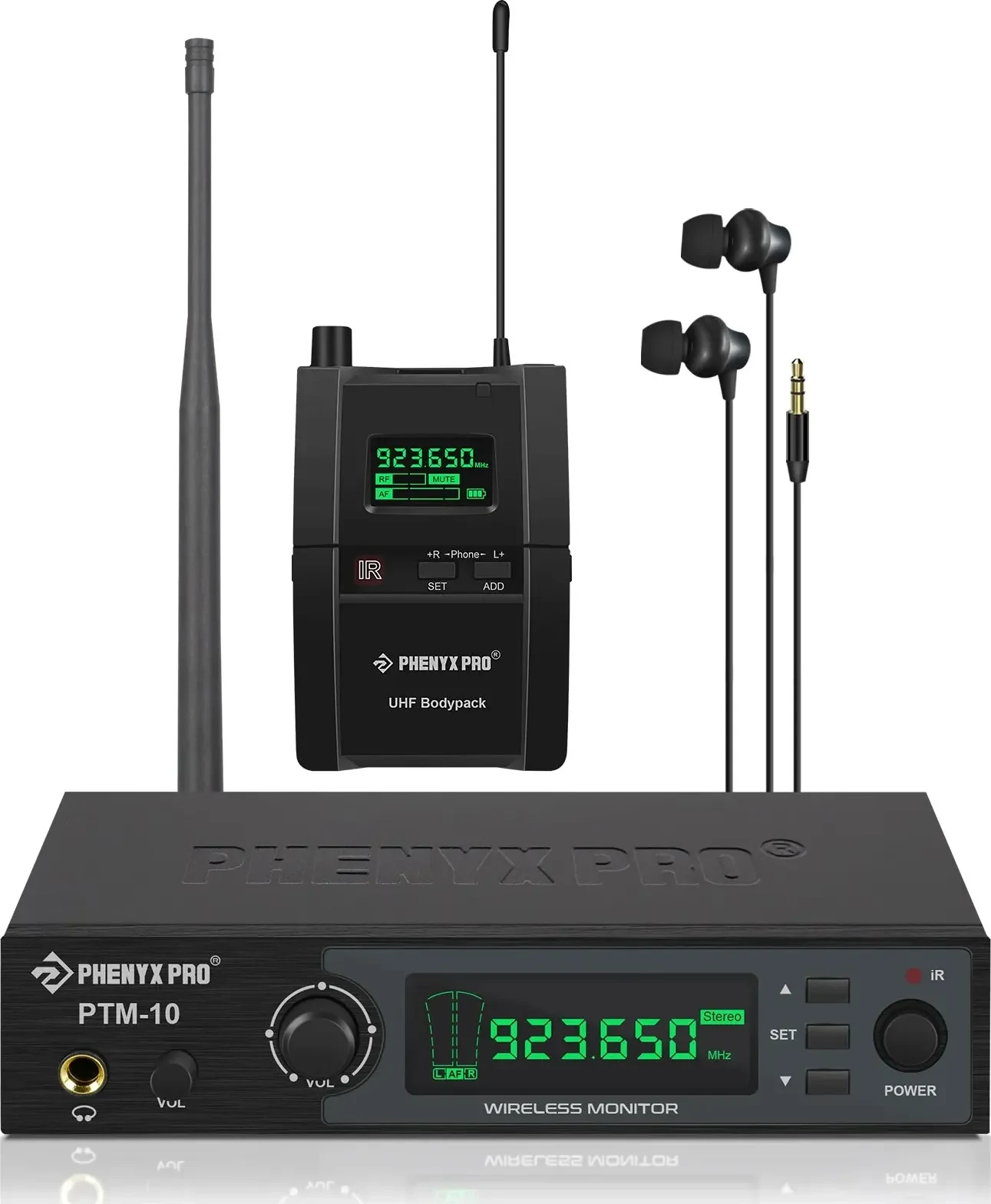
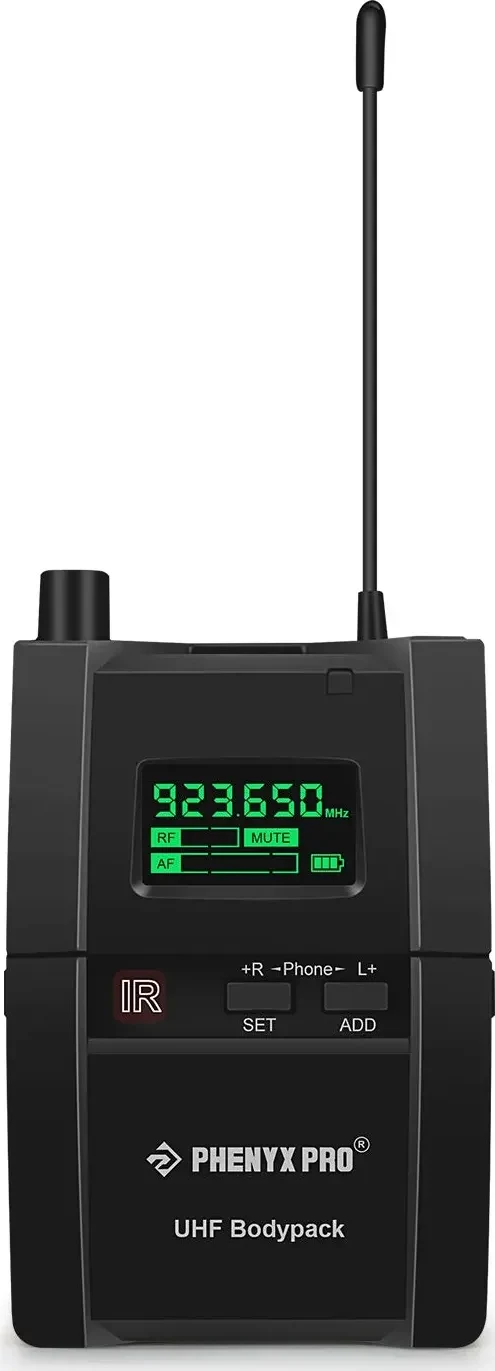

The Phenyx Pro PTM-10 delivers wireless monitoring at a fraction of the price of the pro systems, and for small venues and rehearsals it genuinely does the job. Phenyx Pro lists the single-receiver PTM-10-1B at $228.99 as of August 2026, and extra bodypacks cost less than half that again — a whole band gets on in-ears here for roughly the price of one pro-tier system. Selectable frequencies let it run alongside other wireless gear, and the LCD displays on both transmitter and receiver make it easy to check channel and volume in low-light stage conditions. The compromises are real, but they're predictable — and most of them can be planned around.
Build and design
The transmitter is the surprise at this price: a metal-cased unit with a detachable antenna, a clear LCD and an included metal rackmount kit, powered by an external 12–18V adapter. Around the back sit two balanced combo inputs (XLR or 6.35mm TRS) for a stereo feed, and a PAD switch attenuates hot signals by up to 12dB — useful when you're feeding it from a mixer's line-level aux sends. Racked next to real stage gear, it doesn't look out of place.
The bodypack receiver is where the budget shows. It's plastic and light, and runs on two AA batteries with a claimed life of at least 8 hours; the battery door and belt clip are the parts owners handle gently. The control set goes beyond the basics, though: stereo/mono selection, left/right balance, an EQ toggle, a limiter, and a frequency lock so a knocked button can't silently move you off-channel mid-set. Earphones connect via a standard 3.5mm socket, so swapping the supplied pair needs no adapters.
Phenyx Pro rounds out the box with basic earbuds, a PVC carrying case and the power adapter. The earbuds are serviceable for checking signal and not much more — treat them as packaging.
Noise floor, range and RF congestion
Audio and RF performance is where a $229 system has to be judged honestly. The quoted frequency response of 60Hz–16kHz tells you a lot before you power it on: sub-bass and the top octave simply aren't transmitted. For vocalists, guitarists and keys players monitoring their own part, that window is workable. For bassists and DJs monitoring a full mix, the truncated low end is audible — a Gearspace thread complaining of "horrible hiss" and poor sound quality, specifically with bass guitar, is the sharp end of a pattern that recurs across owner reports.
The hiss is the bigger everyday issue. Budget companding is the tax every cheap wireless system pays, and the PTM-10's noise floor sits noticeably higher than the Shure PSM300's, whose companding is the main thing the extra money buys. With a full band playing, the hiss disappears under programme material; in exposed moments — a quiet intro, a spoken section, an acoustic number — it's audibly there. Careful gain staging helps (run the transmitter inputs hot and use the PAD rather than starving them), but it never fully goes away.
Range is claimed at up to 160 ft / 50 m line of sight — and be suspicious of listings quoting far bigger figures for this system, because that 50m number comes from Phenyx Pro's own manual, alongside a modest 10dBm RF output. Owner reports track the honest figure: TalkBass users describe dropout-free sets at around 50 feet in small venues, with walls and bodies between transmitter and pack eating into that quickly.
Congestion is the other caveat. The 89 selectable frequencies sound generous, but Phenyx Pro rates the system for up to five simultaneous PTM-10 rigs in the 900 MHz band, and the 905–925 MHz slice it occupies is spectrum shared with plenty of unlicensed devices. The consensus from working owners is consistent: reliable in rehearsal rooms, churches and small-town venues, less predictable on dense urban stages surrounded by other RF.
Setup, batteries and adding receivers
Getting a channel up is a matter of stepping through group and channel on the two LCDs until transmitter and bodypack agree — a manual process, without the auto-scan-and-sync flow pricier systems use, but one that takes a couple of minutes rather than a soundcheck. Once matched, the lock function keeps the pack there. If a frequency turns noisy in a new room, moving both ends to a clean one is quick enough to do between songs.
The stereo feed doubles as the PTM-10's cleverest feature. Send two different mono mixes into the left and right inputs, switch a bodypack to mono, and its balance control becomes a mix selector — pan hard one way for the first mix, hard the other for the second, or sit between them for a blend. Phenyx Pro documents this officially, and it means two performers on one transmitter can each hear a different mix — a budget echo of the PSM300's MixMode.
Expansion is where the pricing gets properly aggressive. One transmitter can feed as many receivers as you like on the same frequency; the PMR-1 add-on bodypack costs $90.99 as of August 2026, and factory bundles run up to the four-receiver PTM-10-4B at $483.99. Everyone on one transmitter shares the same feed — the same catch as the XTUGA IEM1200's band bundles, though the PTM-10's two-mixes-via-panning trick softens it in a way the XTUGA can't match. Budget for AA batteries in bulk: owners note that RF stability starts to wobble as cells fade, well before the pack actually shuts off, so fresh batteries per gig is the safe habit.
In use
In the rooms it was built for, the PTM-10 does what it promises. A covers band in a rehearsal space, a worship team spread across a small stage, a DJ monitoring in a bar booth — at 30 to 50 feet with a healthy input signal, owners report clean, dropout-free performance, and the limiter provides a layer of hearing protection that wedges never will. For a first-time in-ear user, the whole experience — packs on belts, mix in ears, stage volume down — arrives for less than the cost of a single pro bodypack.
The single most effective upgrade is the one nearly every owner makes: replace the bundled earbuds. Pairs like the KZ ZS10 Pro or Shure SE215 show up constantly in owner threads, and with foam tips they improve both tone and isolation far beyond what the stock set manages. It's the same advice that applies to far pricier systems, but here the gap between stock and upgraded earphones is widest.
Push the PTM-10 outside its lane and the limits appear on schedule: quiet, dynamic material exposes the hiss, long throws and obstructed sightlines invite dropouts, and busy urban RF makes channel choice a nightly chore.
None of that makes it a bad buy — it makes it a specific one. If you're monitoring in a small room, rehearsing, or trying in-ears for the first time without spending much, the PTM-10 is a reasonable pick. When reliability starts paying your rent, the Shure PSM300 is the step up for RF discipline and a genuinely quiet noise floor, and the Sennheiser EW IEM G4 beyond that for audio quality. See how it compares in our best in-ear monitors guide.


