Few makers of musical instruments become household names. Yamaha, based in Hamamatsu, Japan, is one of them, and one of the oldest: its history begins in 1887, when its founder, Torakusu Yamaha, repaired a reed organ at a local school and went on to build one of his own (Yamaha corporate history).
The company made its name with organs and pianos, starting upright piano production in 1900. That is only part of the story. Yamaha made its first audio product, a hi-fi player, in 1954, its first PA equipment in 1969, and today sells everything from digital instruments to mixing desks, PA speakers and studio monitors.
For DJs and producers, the speakers are what matter: powered PA speakers for gigs, and near-field studio monitors whose white woofers Yamaha has made since the 1970s. This piece looks at how Yamaha got there, then at the kinds of speakers it makes today.
The History Of Yamaha Speakers
Yamaha has been in the music industry for well over a century, and in speakers for almost sixty years. Its speaker history, which Yamaha publishes itself (Yamaha, History of Speaker), runs from hi-fi into studios and live sound. Unless another source is linked, the dates and details below come from that page.
1967: The Year Of The HiFi Speakers
Yamaha had paused its hi-fi launches from the late 1950s into the 1960s to concentrate on the Electone, its electronic organ (Yamaha corporate history). In 1967 it entered the hi-fi speaker business by adapting the Electone's NS (Natural Sound) speaker for home audio.
The first two models, the NS-30 and NS-20, used large Styrofoam diaphragms developed for the Electone's speaker units. They were big: the NS-30 was more than a metre tall. They sold respectably in North America but struggled in Japan, where few rooms had space for them. They also gave Yamaha the "natural sound" slogan it still uses. The NS-690 followed in 1973 and became a hit for what Yamaha calls its "European sound".
The 1970s: The NS-1000M & The NS-10M
In 1974 Yamaha released the NS-1000 and NS-1000M, the first speakers with a pure beryllium diaphragm. Beryllium is light and rigid, ideal for a speaker diaphragm, but brittle and hard to work, and Yamaha was the first to bring it to market, in the NS-1000M's midrange and tweeter.
The NS-1000M was acclaimed abroad as well as at home. In 1976 Sweden's state broadcaster chose it as its official monitor and ordered 1,000 units, and more than 200,000 were sold before Yamaha stopped making beryllium drivers in 1997.
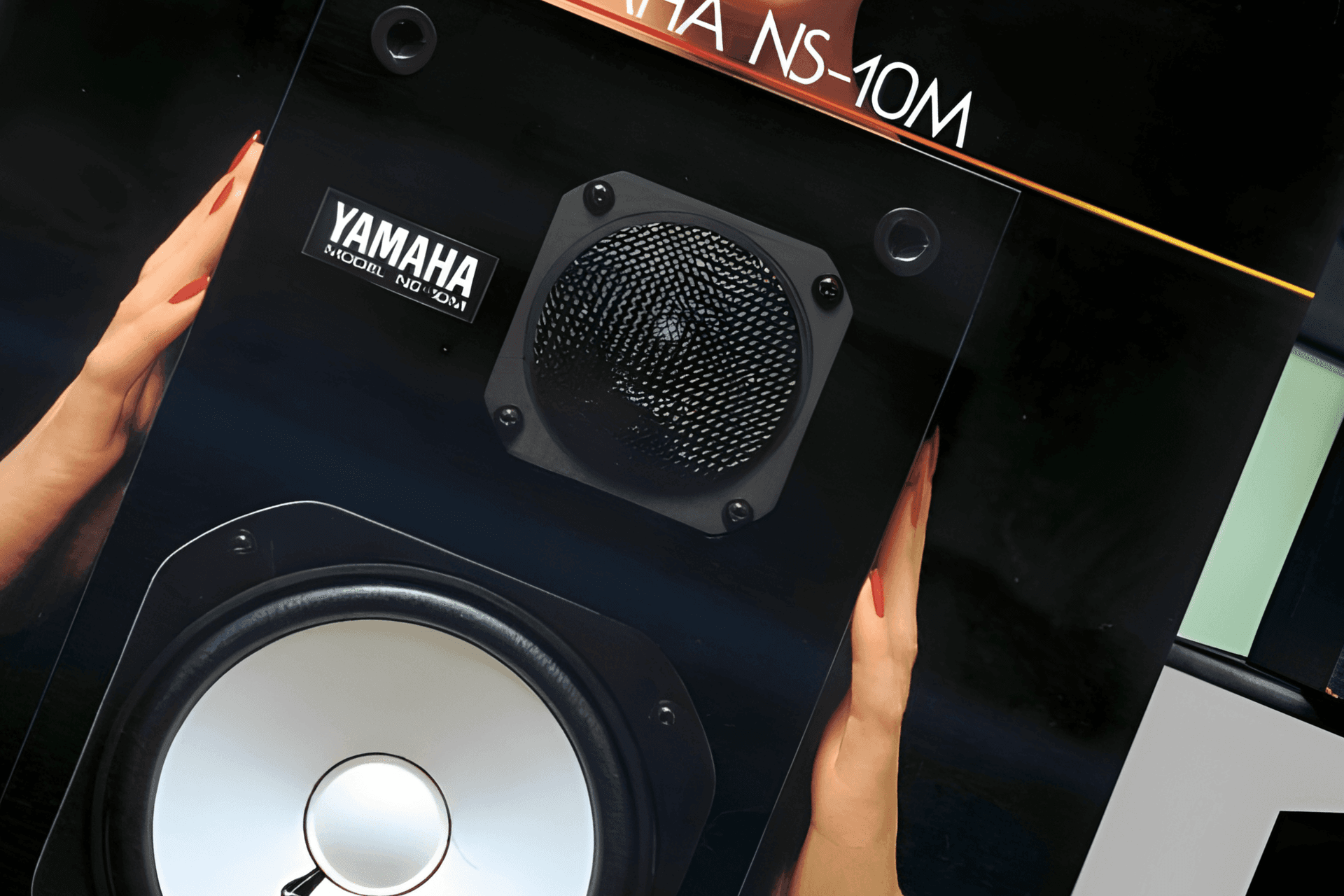
In 1978 came the NS-10M, a small, sealed bookshelf speaker meant for home listening. Engineers took it into studios instead, and it became one of the most widely used studio monitors in the world. Yamaha says more than 300,000 were sold across the series, and in 1987 it added an NS-10M Studio version for professional use.
From The AST-1 To The HS Series
In 1989 Yamaha released the AST-1, the first active servo speaker system. It combined a speaker tuned to push more air through its port with an amplifier that drove the speaker so as to cancel out the impedance of its voice coil, so a small box could play deeper bass. The technology was later renamed YST (Yamaha Active Servo Technology) and is used in Yamaha's subwoofers and home theatre products.
In 2003 the NS-pf7, a small speaker designed for near-field listening, introduced the first practical magnesium speaker cone. In 2006 Yamaha launched the HS series of studio monitors, and in 2013 it replaced them with today's HS5, HS7 and HS8, plus the HS8S subwoofer (Yamaha, April 2013). Yamaha traces the HS series' white woofer back to its near-field monitors of the 1970s (Yamaha HS series).
The Sheet Method: Part Of Yamaha's Success
Yamaha built its reputation partly on good sound at reasonable prices, and its history page credits one manufacturing idea for much of that: the sheet method.
Most paper speaker cones were moulded directly into a 3D cone shape. Yamaha's sheet method cut a round piece from a flat paperboard sheet and formed it into a cone. Yamaha's catalogues of the time claimed fewer variations in thickness and density, and cones that were strong despite being light. The method gave Yamaha a steady supply of large, efficient and cheap paper cones.
It first appeared in the white woofer of the NS-451, an inexpensive two-way speaker aimed at younger buyers, and then in the NS-10M. The white colour was partly practical: it hid the seam where the cone was joined.
Yamaha’s Success Into The Future
Yamaha's speaker range has grown well beyond hi-fi. In 2008 it bought NEXO, the French loudspeaker maker (Yamaha corporate history), and its pro audio catalogue now runs from studio monitors and portable PA to installation speakers. In April 2026 it launched the DXR mk3 powered speakers and DXS mk3 subwoofers, the third generation of a range Yamaha calls one of its most celebrated (Yamaha, April 2026).
The Different Types Of DJ Speakers Yamaha Produce
A speaker's size, type and how it is powered decide what it is good for. Whether you're a casual listener, a producer or a performing DJ, knowing what kind of speaker you need matters more than any single specification.
Below are the types Yamaha makes, with the ranges listed on its pro audio site as of October 2026 (Yamaha speakers).
Powered PA Speaker Systems
Powered (or active) PA speakers have the amplifier built in. You plug a mixer or controller straight into each speaker and plug each speaker into the mains, with no separate amplifier to carry or wire up. That simplicity is why so many mobile DJs use them.
Yamaha's powered ranges include the DBR, which Yamaha calls its most portable, and the DXR. The new DXR mk3 adds feedback suppression for handheld and fixed microphones, which helps if you also run speeches or an MC. For picks across brands, see the best powered PA speakers and the best portable PA systems.
Passive PA Speaker Systems
Passive PA speakers have no amplifier inside, so they need an external power amplifier. That means more equipment, but it also means no mains power is needed at each speaker, which suits installations and venues where power points are scarce. Yamaha's passive ranges include the CBR and CZR, and the new CXR mk3, the unpowered counterpart of the DXR mk3, which takes dedicated tuning settings on Yamaha's PX and PC-D amplifiers. To wire passive speakers, see the best speaker wire.
Subwoofers
Subwoofers handle only the lowest frequencies. Paired with the main speakers, they take over the deep bass that smaller cabinets can't reproduce.
How much you need one depends on the main speakers and the room. Small speakers usually benefit most; large full-range speakers may only need one for bass-heavy music or bigger crowds. Yamaha's powered subwoofers include the DXS series, now in its mk3 generation, and the HS8S partners its studio monitors. For picks, see the best powered subwoofers.
Studio Monitor Speaker Systems
Studio monitors are built to sound as flat and accurate as possible rather than flattering, which is what producers need to hear their mixes clearly. Yamaha's HS series is designed for near-field listening, close to the listener, and is one of the best-known monitor ranges at home and in studios.
The current range is the HS5 (5-inch woofer), HS7 (6.5-inch) and HS8 (8-inch). Each takes a balanced XLR or a 1/4-inch jack input, and none has an RCA input, so a DJ controller with RCA outputs needs adapter cables. All three have rear ports, so leave a gap behind them; see front vs rear ported speakers. For more options, see the best 5-inch studio monitors and the best studio monitors for home DJs.
What To Consider When Choosing Your Speaker Type
Each type has its own strengths. Before buying any speaker system, for yourself or for gigs, answer these:
- Where will you play? A bedroom or studio calls for monitors; a hall or a party calls for PA speakers.
- How many people, and how big is the room? That decides the size and number of speakers.
- Is there power at each speaker position? If not, passive speakers and an amplifier may be easier.
- Does the music need deep bass? If so, plan for a subwoofer.
- What does your mixer or controller output? Match its RCA, jack or XLR outputs to the speakers' inputs; see which cables your DJ setup needs.
Getting A Set Of Yamaha Speakers: What You Can Expect
Speakers that suit one person can be wrong for another. Beginner DJs in particular often buy what looks good rather than what fits the room and the setup. Before buying, particularly from Yamaha, check the following.
It may not be the most exciting part of choosing a speaker, but check the warranty first. Yamaha's terms vary by product and country. In the United States, Yamaha's warranty only covers products bought new from a Yamaha Authorized Dealer, so a bargain from an unauthorised seller may come with no manufacturer cover at all (Yamaha USA warranty information).
Quality Over Time
Next is longevity. It is hard to judge from the outside, but Yamaha's designs do tend to last a long time in its catalogue: the NS-1000M line sold for 23 years, and the current HS monitors have been on sale since 2013. For how owners rate a particular model over time, see what they report on its product page, such as the HS5.
Value For Money
Finally, work out which speaker gives you the best value for your budget. Spending more usually buys more, but don't write off the cheaper options. Yamaha's reputation for value goes back decades, to the NS-451 and NS-10M, which Yamaha itself credits with good sound at a reasonable price.
Yamaha Speakers: Final Thoughts
Yamaha has made speakers since 1967, and its record is a long list of firsts: the first pure beryllium diaphragm, the first active servo speaker system and the first practical magnesium speaker cone, alongside the NS-10M, which became a studio standard. In my view that history, and the range it sells now, is why the brand is still a sensible place to start when you're choosing speakers.
Updated October 2026: facts checked against the sources linked in the text; the AST-1 moved to its real date of 1989, the sheet method described from Yamaha's own account, unsourced claims about guitarists, warranties and durability removed, and Yamaha's current ranges added.