
Whether you DJ professionally, have just started mixing, or simply enjoy hearing a remix or two, a fair share of gratitude is owed to the Technics SL-1200.
It is the Ford of the DJ world: the machine that made turntable mixing standard equipment in clubs. Technics says the series shipped about 3.5 million units between the first SL-1200 in 1972 and the MK6 in 2008 (Technics SL-1200 history).
This piece goes through the versions of the SL-1200, how it changed over the years, what made each one different, and why the deck is still held in such high esteem more than 50 years after the first one. Unless another source is linked, the model years and features below come from Technics' own history of the series, which is written for the Japanese market and dates each model by its Japanese release.
Technics SL-1200MK1
Released: 1972
The first SL-1200 was a direct-drive turntable, a design Technics had first brought to market with the SP-10 in 1970 (Technics). There is no belt: the platter sits on the motor itself. Technics says it reached full speed within half a turn, had a heavy platter with little speed fluctuation, and sat in a rigid die-cast aluminium cabinet that stood up to the vibration of loud rooms.
That combination suited the disco and club scene growing in the United States at the time. Quick starts made cueing easy, and the sturdy cabinet held up against feedback. The pitch control was a knob, meant for correcting small errors in motor speed, and DJs found a new use for it: matching the tempo of one record to another. Technics credits that habit with leading directly to the MK2.
Many of these features are now commonplace on turntables and controllers, but the SL-1200 was ahead of its time, and DJing still works the way it allowed.
Technics SL-1200MK2
Released: 1979
The MK2 is the most widely known SL-1200. Technics calls it the first turntable designed for DJ use in discos and clubs.
Two changes defined it. A quartz-locked motor made the speed far more accurate, so the pitch control was no longer needed to correct errors. Because DJs were using pitch to match tempo, Technics replaced the knob with a sliding pitch fader, the layout most DJ turntables have followed since.
The cabinet was also built for loud rooms: die-cast aluminium on top, a moulded rubber base below, and four large insulating feet to resist vibration and feedback. The DJ models of the next three decades refined the MK2 rather than replacing it.
The Technics 1200 vs. 1210 Comparison
There is some confusion about the SL-1200MK2 and the SL-1210MK2: which came first, and how they differ.
In practice they are the same turntable. The 1200 is best known in silver and the 1210 in black, and the 1210 was the version commonly sold with a mains voltage selector under the platter. Owners report exceptions both ways, so if you are buying one secondhand for a country with different mains voltage, lift the platter and check for the selector rather than trusting the model number.
Technics SL-1200MK3
Released: 1989
Ten years after the MK2, Technics released the MK3 for the Japanese market, where demand for DJ turntables was growing in the late 1980s. It was black, and its structure was almost identical to the MK2's. Technics added T.N.R.C. (Technics Non Resonance Compound), a damping filler inside the body, and for the first time a slipmat came in the box. Until then, DJs who scratched or back-cued had been making their own to replace the rubber mat.
Technics SL-1200LTD
Released: 1995
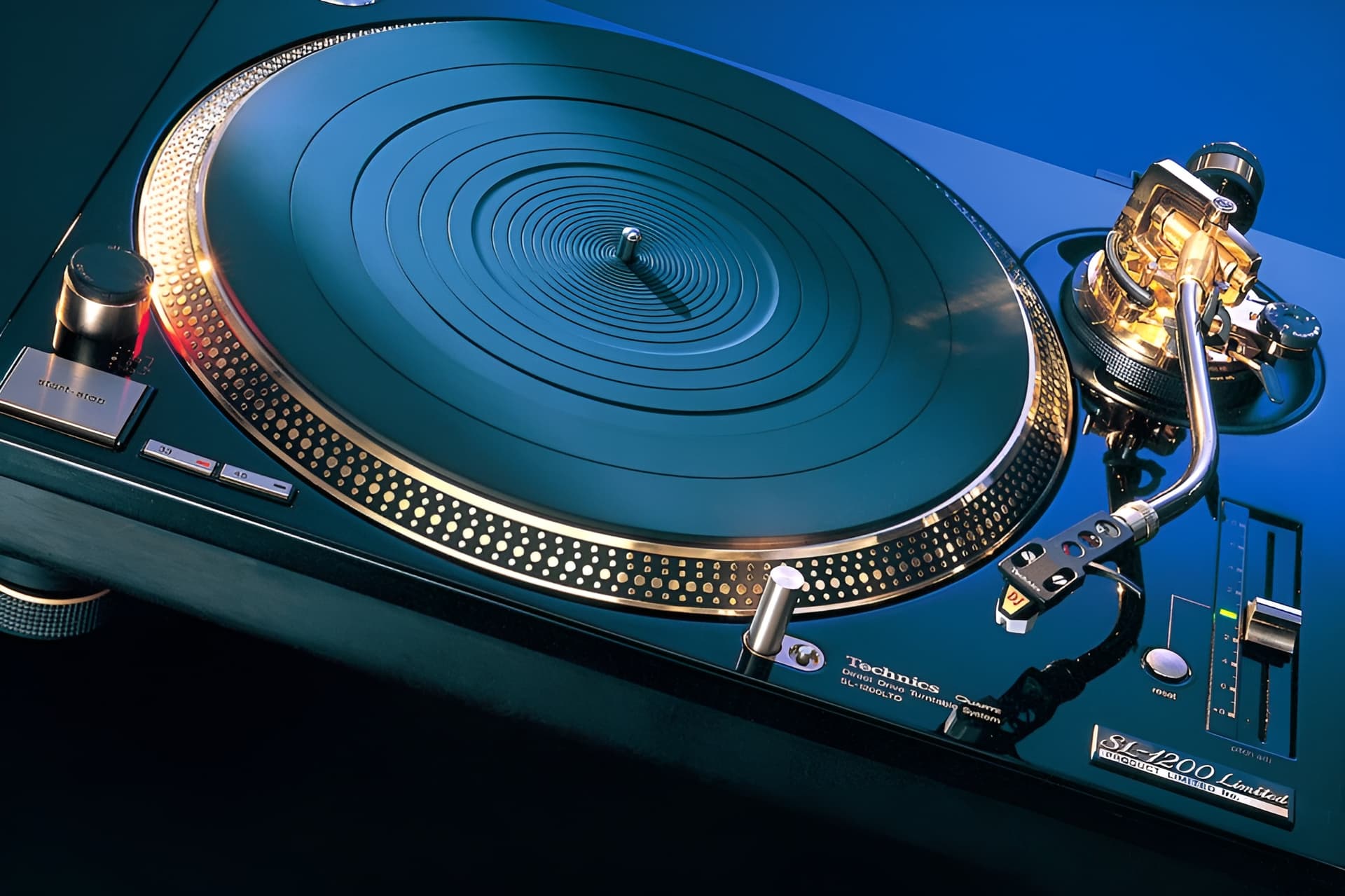
The LTD marked two million SL-1200s sold worldwide. Production was limited to 5,000, each with a serial-numbered plate. Based on the MK3, it had 24-carat gold plating on the platter, tonearm and arm base, which Technics compares to the gold turntables given to DMC World DJ Championship winners.
It also introduced the pitch reset button: press it, and the pitch returns to zero wherever the fader sits. Later models kept it.
Technics SL-1200MK4
Released: 1997
The MK4 leaned towards listening rather than DJing. It added 78 rpm playback for shellac records, detachable phono cables, and oxygen-free copper (OFC) wiring inside the tonearm for better sound quality. Panasonic's manual for it is in Japanese (PDF). For what the speeds mean, see 33 vs 45 RPM vinyl.
Technics SL-1200M3D
Released: 1997
Sold in Japan as the SL-1200MK3D, this was a revision of the MK3 that brought back the silver cabinet. It kept the LTD's pitch reset button and removed the centre click at zero on the pitch fader, so fine adjustments around zero became easier. It also added a stand for a spare headshell, and the power switch was redesigned so that it couldn't be knocked off by accident mid-set. A black version followed in 2000.
Technics SL-1200MK5
Released: 2002
The MK5 marked the series' 30th anniversary. Technics describes it as a model that refined existing parts rather than adding big features: the brake could be adjusted without removing the platter, the stylus light changed to a brighter, longer-lasting white LED, and markings were added to the counterweight mount to make tracking force easier to set.
Technics SL-1200 M5G
Released: 2002
Launched alongside the MK5 as a higher-end version, the MK5G (sold outside Japan as the M5G) brought more changes. Its S-shaped tonearm gained a horizontal load adjustment to reduce skipping, and the pitch fader gained a ±16% range alongside the usual ±8%. OFC wiring in the arm improved the sound, high-brightness blue LEDs lit the stylus and pitch display, and the top panel was metallic black.
Technics SL-1200GLD
Released: 2004
The GLD marked three million SL-1200s produced worldwide. Based on the MK5G, it had 24-carat gold plating on the tonearm and other parts, a gloss black top, and a plate engraved with its limited serial number. Production figures for the GLD vary between sources, and Technics doesn't give one.
Technics SL-1200MK6
Released: February 2008
The MK6 went on sale in Japan on 1 February 2008, for the series' 35th anniversary (Phile-web, December 2007). It was a set of smaller improvements rather than one headline feature: a new higher-torque motor, a three-layer chassis to absorb vibration, damping at the tonearm and platter bearing, a new control circuit for more precise pitch, brighter LED indicators and OFC signal wiring.
Technics SL-1200MK6K1
Released: December 2007
The MK6K1 was a limited black edition of the MK6 for the 35th anniversary, released in Japan on 12 December 2007, ahead of the standard MK6. Phile-web reported a run of 1,000 units, each with a commemorative gold disc and a 55-page hardcover booklet on the history of the series (Phile-web).
It was among the last SL-1200s before Panasonic ended production of Technics analogue turntables in autumn 2010, citing the market's move to digital and the difficulty of getting parts (Resident Advisor).
Technics SL-1200GAE/SL-1200G
Released: 2016
Technics announced a return to turntables in January 2016, with two hi-fi models aimed at listeners rediscovering vinyl rather than at DJs (Technics press release, CES 2016). The SL-1200GAE marked Technics' 50th anniversary and was limited to 1,200 units worldwide, 300 of them for Japan. The SL-1200G was the regular-production version with the same core design.
Both use a new coreless direct-drive motor, which removes the iron core that causes cogging (the slight jerkiness in direct-drive rotation), a magnesium tonearm pipe, a three-layer platter of brass and die-cast aluminium, and a four-layer cabinet. They are hi-fi turntables, not DJ decks; for DJ use, see the best DJ turntables.
Technics SL-1200GR
Released: 2017
Technics positioned the GR as the series' new standard hi-fi model, carrying over technology from the G. Some corners were cut: it uses a single-rotor coreless motor instead of the G's twin rotor, an aluminium tonearm pipe, and a two-layer platter.
The GR weighs about 11.5 kg to the G's 18 kg, and its starting torque is 2.2 kg·cm to the G's 3.3 kg·cm (Technics SL-1200GR; Technics SL-1200G). Like the G, it was designed for home listening rather than the booth. It has since been joined by the SL-1200GR2, which adds Technics' ΔΣ-Drive motor control (Technics).
Technics SL-1200MK7
Released: 2019
Announced in January 2019 and released in Japan on 24 May 2019 (Panasonic press release), the MK7 was the first new DJ model in the MK line since the MK6. It is matte black, and a switch changes the colour of its LED lighting between red and blue.
It uses a coreless direct-drive motor with stronger magnets than the MK6's, giving more torque, and keeps the MK series' button layout and platter inertia so that it feels like earlier models. New features let DJs adjust starting torque and brake speed in four steps, and play records in reverse. A silver version followed in 2021. For the full specification, see the Technics SL-1200MK7 product page.
Its reception was mixed at first. DJWORX, which handled it at its launch in 2019, praised the motor and pitch fader but found the plastic base hollow-feeling and the finish cheap (DJWORX). Most later reviews recommended it; Bonedo, for example, called it the turntable DJs had waited years for (Bonedo). For how it compares with its main rival, see Pioneer DJ PLX-1000 vs Technics SL-1200MK7.
As of October 2026 the MK7 is still Technics' DJ turntable. For the series' 50th anniversary in 2022, Technics released the SL-1200M7L, a limited MK7 in seven colours with a gold tonearm. In Japan, the SL-1200MK7W went on sale in June 2026, carrying over the MK7's motor, platter and chassis and running on 100–240 V mains (Technics; Phile-web). In September 2026 Technics followed with a 55th anniversary edition, again based on the MK7, limited to 12,000 units in seven colours (MusicTech).
Buyer’s Guide: What to Look Out For
If you're thinking of buying a pair for home, a radio station or a venue, these are the things to check before you buy, whatever the model year.
Arm Bearings
Check that the tonearm moves freely and shows no excessive wear. Look at the arm's bearings, lift mechanism and counterweight to make sure everything moves properly and feels solid.
On a used deck, check the phono cables too. You want a strong connection and a clean signal into the mixer, especially if you plan to use the turntables with DVS.
Missing screws are an easy sign of poor repairs and maintenance, so check the underside of the turntable before buying.
Play in Motor/Platter
With the power off, spin the platter by hand and feel for any wobble, shake or resistance. If you feel any, something is damaged and needs fixing before you use it.
Pitch Control
Make sure the motor and pitch fader are calibrated so the speed is accurate. Set the pitch to zero (or press the reset button on models that have one) and watch the strobe dots on the platter's edge: the row for zero should look as if it is standing still. If it drifts, the speed needs adjusting.
Needle and Cartridges
Finally, buy a good-quality cartridge and stylus. A poor or worn one sounds bad and wears your records, much like driving a sports car on bald tyres. Get some decent slipmats as well. If you plan to scratch, how to scratch as a DJ covers the basics, and how to clean vinyl records covers looking after the records themselves.
Conclusion
That is the long history of the Technics SL-1200 and its many versions. Whether you think it lives up to its reputation or is remembered too fondly for past achievements, DJing would not be where it is today without it. If you're a DJ, or getting interested in DJing, the SL-1200 is probably part of the reason.
Updated October 2026: facts checked against the sources linked in the text; model years, limited-edition figures and features corrected against Technics' own history, unsourced claims about the MK7's reception and manufacture removed, and models released since 2019 added.