
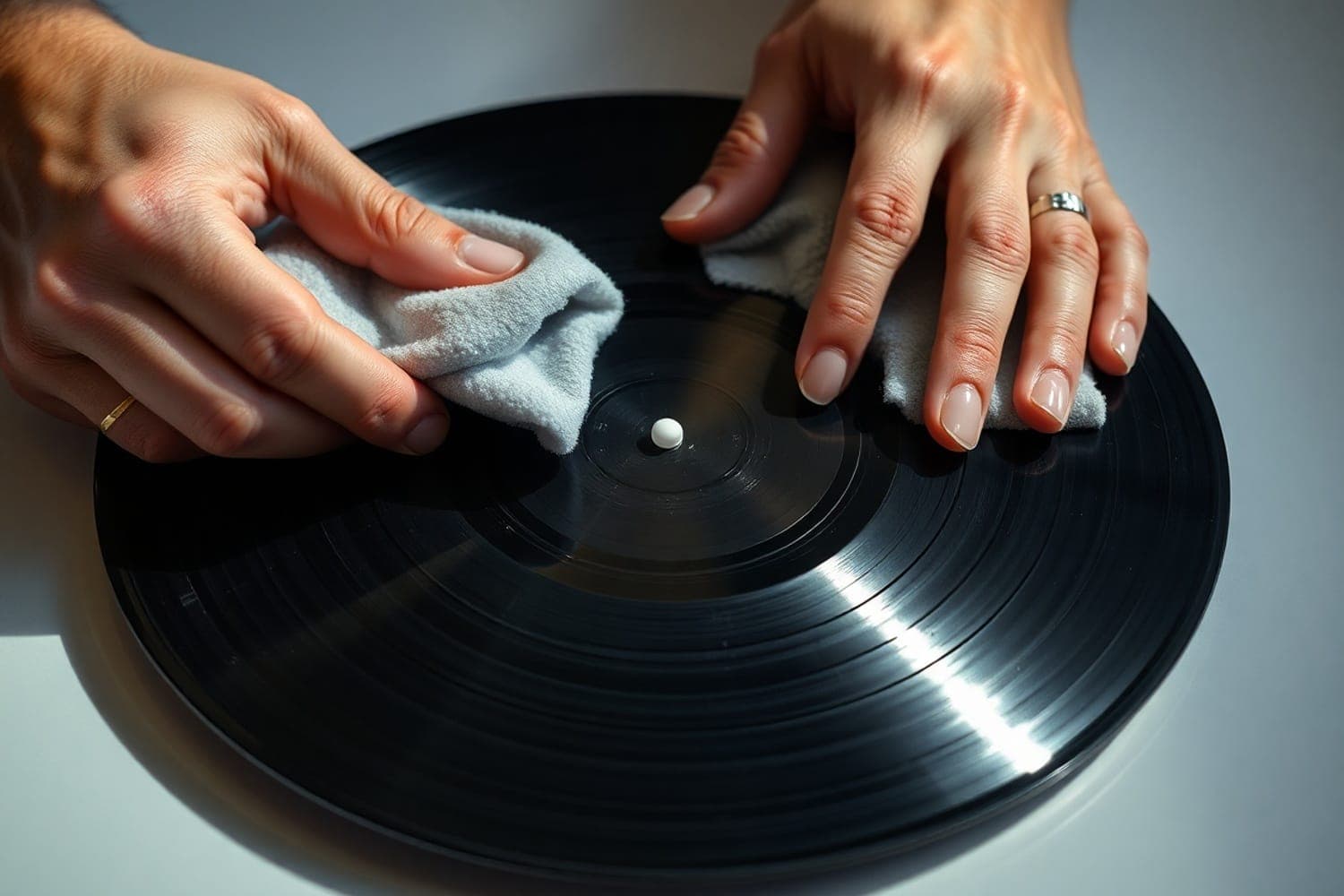
Brush loose dust off a record before each play with a dry anti-static brush held on the spinning record, and for grime and fingerprints use a wet cleaning kit or a record-cleaning machine with the fluid its maker specifies, letting the record dry before you play or sleeve it. Keep the stylus clean too, handle records by the edge and label only, and store them upright in a cool, dry place.
Dust and other contaminants on a record can reduce sound quality, wear the record early and damage the stylus, Audio-Technica says. The steps below use its hand cleaners and a Pro-Ject record-cleaning machine as worked examples. Other makers' products may differ, so follow the instructions that come with yours.
Before every play: a dry brush
A dry brush lifts surface dust out of the grooves. Audio-Technica's instructions for its AT6011a anti-static brush:
- Start the record spinning on the turntable.
- Hold the brush perpendicular to the record's surface and lower it gently onto the spinning record, letting the fibres wipe the grooves.
- When you've finished, touch the brush to the centre spindle to discharge static.
- Clean the brush on its cover and store it covered.
Use no liquid on a dry brush. A cleaner with a velvet pad between two rows of carbon-fibre bristles, such as the AT6013a, works the same way with minimal pressure, and you finish by sweeping it upward off the record so the dust stays on the pad. Audio-Technica lists both for regular use, including before every play.
Deeper cleaning by hand: a wet kit
For dirty, old or second-hand records, a wet kit dissolves fingerprints and fine dust that a dry brush leaves behind. With Audio-Technica's AT6012 Record Care Kit:
- Remove the inner lid under the fluid bottle's cap.
- Put about five drops of the fluid into each of the small holes on top of the brush pad, and wait a few minutes for it to moisten the velvet.
- Start the record spinning, and lower the pad onto it with its arrow pointing in the direction the instructions show. The pad is made to clean in one direction.
- Wipe gently for several revolutions without pressing hard.
- Clean the pad on the wiper in its storage base.
The AT6012 is for LP and EP vinyl only. Audio-Technica says not to use it on 78 RPM shellac records.
Deep cleaning with a record-cleaning machine
A vacuum record-cleaning machine washes the record with fluid and then vacuums the fluid and the dissolved dirt off. The steps for the Pro-Ject VC-E2, from its October 2025 manual:
- Put the record on the platter and fit the magnetic clamp.
- With the record turning, apply just enough cleaning fluid to cover it, about 3ml a side, and spread it with the brush held flat and pressed gently against the record. Brush in both directions.
- Wait a few seconds, longer for a very dirty record, so the fluid can dissolve the dirt.
- Lower the vacuum arm onto the record and switch on the vacuum at the same time. Pro-Ject recommends one rotation in each direction.
- Switch off the vacuum and then the motor, return the arm to its rest, and wait a few seconds for the record to dry.
- Turn the record over and repeat.
Pro-Ject says to use only its own Wash it 2 fluid in the machine, and only enough to cover the record, not the machine. It recommends hearing protection for long cleaning sessions, and running the vacuum for 15 to 30 seconds with the arm off afterwards to blow the remaining liquid out of the system. The VC-E2 is for non-commercial use.
Whichever method you use, use the fluid the maker of your kit or machine specifies. Neither Audio-Technica nor Pro-Ject gives a home-made alternative.
Clean the stylus too
Audio-Technica notes that some people clean their records and stylus before and after every use. Its routine:
- Between records: dip the stylus tip once or twice into a stylus-cleaning gel such as the AT617a.
- When vinyl residue builds up: playing the same record several times in a row warms the grooves and softens the vinyl, and some of it can stick to the stylus and harden. Let a record cool for about 30 minutes between plays, and use a stylus-cleaning fluid to remove residue that has already hardened.
The Library of Congress adds that playback equipment should be kept clean following the manufacturer's instructions. The guide to the best DJ turntables covers the decks themselves.
Older and fragile records
For 78s, lacquer discs and acetates, follow archive practice rather than a vinyl routine. For all grooved discs, the Library of Congress's own advice is to blow dust away with canned air, and it points to the Northeast Document Conservation Center's guidance on cleaning lacquer discs if mould or waxy deposits need removing. Audio-Technica's wet kit isn't for shellac 78s.
Handling and storage
From the Library of Congress's guidance on audio-visual materials:
- Hands: wash and dry your hands first, hold records by the edge and label only, and keep food and drink away.
- Upright: store records on edge, with sturdy dividers every 4 to 6 inches that support the whole face of the record in its sleeve. Don't store records of different diameters together.
- Sleeves: where possible, replace paper inner sleeves with high-density polyethylene ones. Thin sleeves such as Nagaoka's can fit inside an original paper sleeve you want to keep.
- Room: cool (room temperature or below), dry (about 35 to 40% relative humidity for a home collection), clean and stable. Avoid attics, basements, radiators, vents, direct light and vibration.
- Shelves: records are heavy, so check that the shelving can take the weight, which concentrates along the middle of each shelf.
For telling records apart by speed and size, see 33 vs 45 vinyl.
How this page is made
The steps come from the makers' and an archive's own instructions, read on 13 October 2026: Audio-Technica's support articles on using its record cleaning products and how often to clean records and stylus, Pro-Ject's VC-E2 manual (revision 2025.10.22), and the Library of Congress's care, handling and storage of audio-visual materials. The earlier version of this page recommended and warned against home remedies, such as dish soap, tap water and alcohol, without a source; those claims are gone. Products are named as examples, not recommendations, and we haven't tested them. The methodology explains how the site works.