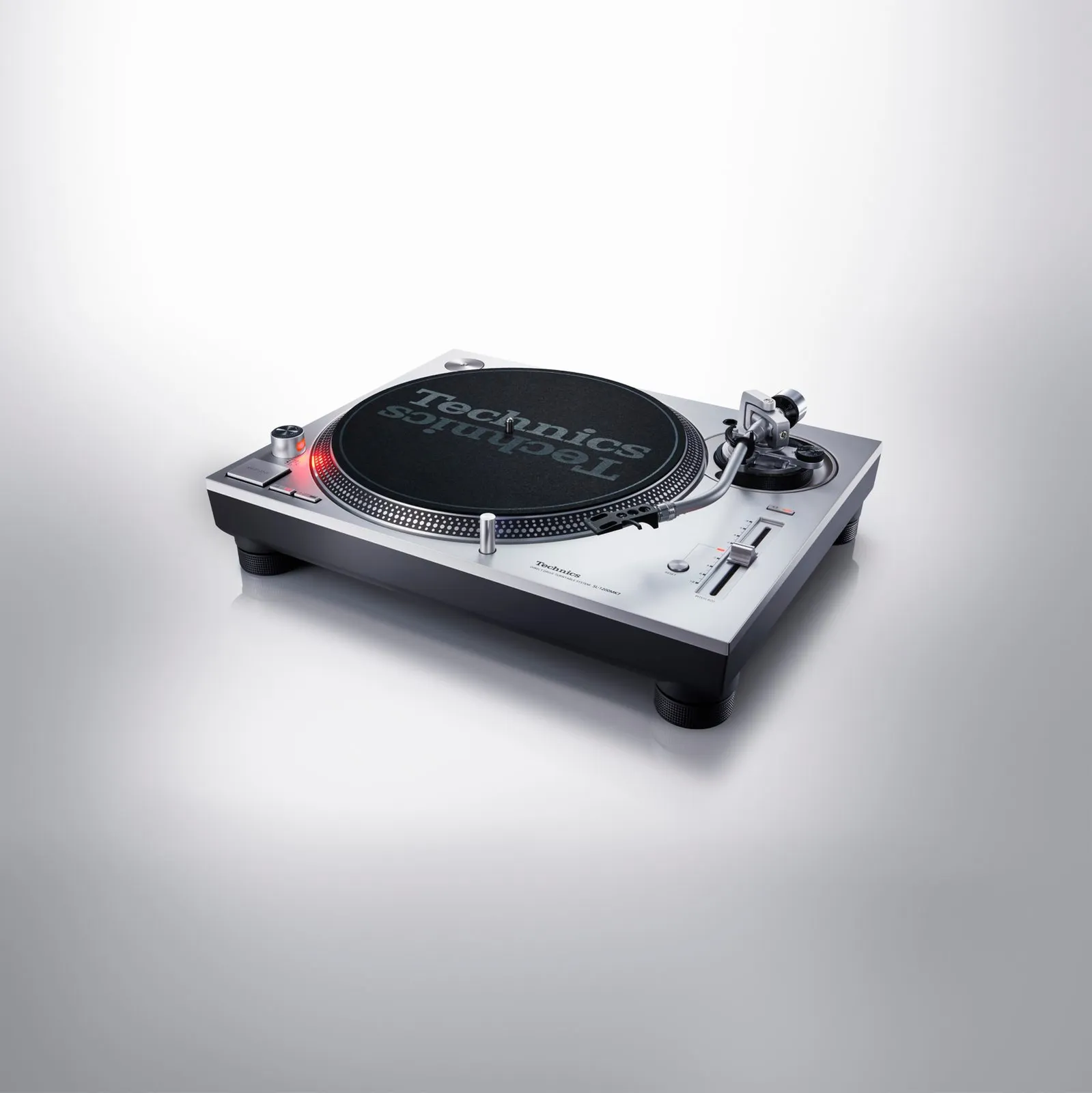
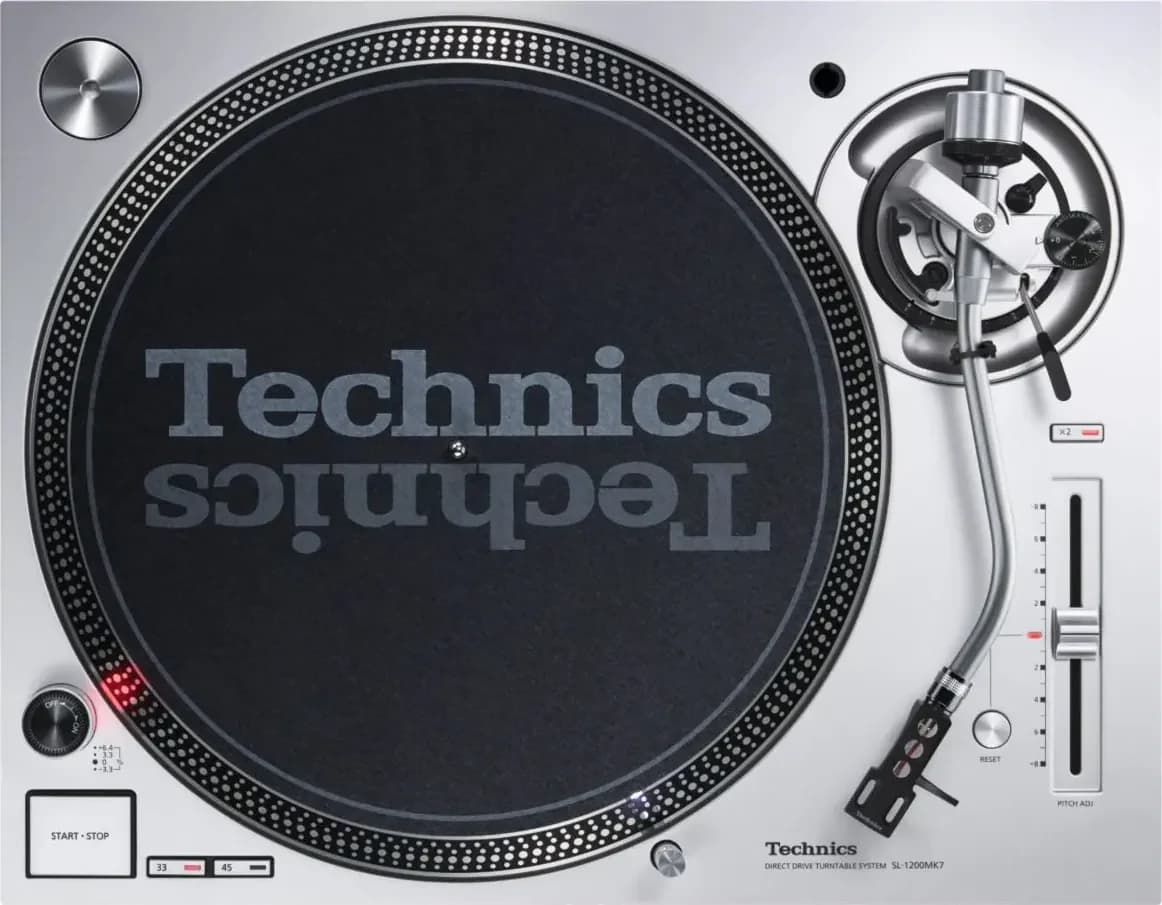

The Technics SL-1200MK7 is the deck every other turntable is measured against, and it earns that status honestly. It's the standard fixture in club booths worldwide, so the muscle memory you build on one transfers everywhere. Unveiled at CES in January 2019, the MK7 was the first 1200 built for DJs since the classic line left production in 2010 — the familiar control layout rebuilt around a coreless direct-drive motor developed for Technics' audiophile Grand Class decks. Early reports put the price near $1,200, but it shipped in the US at $999, and that gap between expectation and sticker has shaped the argument around this deck ever since.
Build and design
The 1200's lineage explains most of the MK7's decisions. The original SL-1200 arrived in 1972, and the 1979 MK2 added quartz-locked direct drive and the long-throw pitch fader — the combination that became the global club standard and stayed there for three decades. The MK5 of 2002 refined the formula, the MK6 of 2008 never left Japan, and Panasonic ended production in 2010 after an estimated 3.5 million units across the series. When the brand returned in 2016 it was with the hi-fi SL-1200G and SL-1200GR at audiophile prices; the MK7 is the model that finally brought the line back to working DJs.
Most of what changed sits under the skin. The old single-piece aluminium die-cast cabinet with its heavyweight rubber base gave way to a two-layer chassis: an aluminium die-cast top plate rigidly bonded to a base moulded from ABS mixed with glass fibre. The whole deck now weighs about 9.6kg — roughly 2.5kg lighter than a MK5 — and that number is the most argued-over spec on the machine. A vocal contingent of longtime owners, across multi-page threads on Vinyl Engine and Gearspace, reads lighter as cheaper, and it's true the MK7 lacks the dead, planted mass of a MK2 when you pick it up. The counterargument is that the damping is engineered rather than simply heavy: the die-cast platter carries vibration-absorbing rubber across its entire rear surface, the glass-fibre composite base exists to kill resonance, and a deck that gets carried to gigs benefits from every kilogram it sheds. Published reviews haven't surfaced any audible cost to the lighter plinth — the trade-off lives in the hand, not under the needle.
Torque, pitch and the coreless motor
The motor is the MK7's real news. Conventional direct-drive motors use an iron-core stator, and iron cores produce cogging — a tiny magnetic stutter as the rotor passes each pole, felt as micro-variations in platter speed. For the 2016 SL-1200G, Technics developed a twin-rotor coreless motor that removes the iron core entirely, and the MK7 inherits the single-rotor version of that design from the SL-1200GR. No core, no cogging: rotation stays smooth down to the spec sheet's quoted wow and flutter of 0.025% W.R.M.S., so platter speed holds rock-steady whether you're riding the pitch fader through a long blend or dropping the needle mid-set.
Starting torque is 0.18 N·m (1.8 kg·cm), spinning the platter from standstill to 33⅓ RPM in 0.7 seconds and holding firm against a hand resting on the record. That's the classic 1200 figure rather than an arms-race number — Pioneer's PLX-1000 quotes a higher 4.5 kg·cm — but peak torque matters less than consistency once the platter is up to speed, and consistency is where the coreless design pays off. The MK7 also adds something no MK2 ever had: digital motor control, with starting torque and brake speed each adjustable through four steps, so turntablists can loosen the platter's response or slow the stop to taste.
Pitch control runs at ±8% or ±16%, and because the fader position is read digitally, calibration doesn't drift the way worn analogue pitch controls eventually did on hard-gigged older decks. For beatmatching, the digital read-out plus the cog-free motor is the whole argument: the deck responds to a nudge predictably and then holds the correction. That's what "club standard" means in engineering terms rather than nostalgia.
Reverse play, 78 RPM and the unchanged tonearm
The MK7 is the first 1200 in the series' history with reverse play — a feature rivals had offered for years while Technics held out. Holding both speed buttons together unlocks 78 RPM, a quiet nod to shellac collectors. Detachable phono and power cables with gold-plated terminals replace the captive leads that turned a damaged cable into a soldering job on every older 1200, and the stylus illuminator is now a long-life LED rather than a bulb you'd eventually replace. None of these is dramatic on its own; together they fix most of the practical complaints three decades of owners actually logged.
What hasn't changed is the tonearm: an S-shaped, universal static-balance arm with gimbal suspension and a 230mm effective length — fundamentally the design the MK2 carried in 1979. Critics have a point here. Digital DJ Tips headlined its launch reaction "too little, too late, and for too much", and the untouched arm is the core of that charge. There's also nothing digital on board: no USB output, no DVS hardware, no MIDI. Where Reloop's RP-8000 MK2 straps performance pads to its deck and Pioneer's PLX-CRSS12 offers needle-free digital control, the MK7 is a record player, full stop. Technics' bet is that DJs paying a premium for a turntable want fewer failure modes rather than more features — and the second-hand market suggests plenty agree — but if you want a deck that doubles as a controller, this isn't it.
In use
The case for the MK7 in day-to-day use is standardisation. The control layout, start/stop position and pitch-fader throw are identical to the decks installed in booths on every continent, so hours practised at home transfer one-to-one to any club you play. No other turntable manufacturer can offer that; it's a network effect built over fifty years, not a line on a spec sheet.
The other argument is economic. Original 1200s from the 1980s remain in nightly service, and clean used MK2s still change hands for serious money four decades on. A track record like that changes what the sticker means: a well-kept 1200 holds its price for years, which quietly offsets the cost of entry in a way no other deck in the category matches. Positive Feedback's review reached a similar conclusion from the hi-fi side, finding the MK7 performs in important respects like turntables priced two or three times higher. Technics' US store lists the deck at $1,299.99 as of August 2026 — up from its $999 launch — which puts it at the top of the DJ turntable bracket, but on a cost-per-year-of-service basis the maths still favours the Technics over nearly anything else with a platter.
How it compares
The Pioneer DJ PLX-1000 offers higher torque, the same road-ready intent and a wider ±50% pitch range for substantially less, and it's the obvious pick when the Technics premium doesn't fit the budget. The Reloop RP-7000 MK2 undercuts both while matching the feature list — reverse included — and remains the best-performing deck per pound we've reviewed. What neither offers is the coreless motor, the resale record or the universal booth familiarity; our PLX-1000 vs Technics 1200 comparison breaks that decision down in full. See how the MK7 leads the field in our best DJ turntables guide, and note you'll need a mixer with phono inputs to run a pair.


