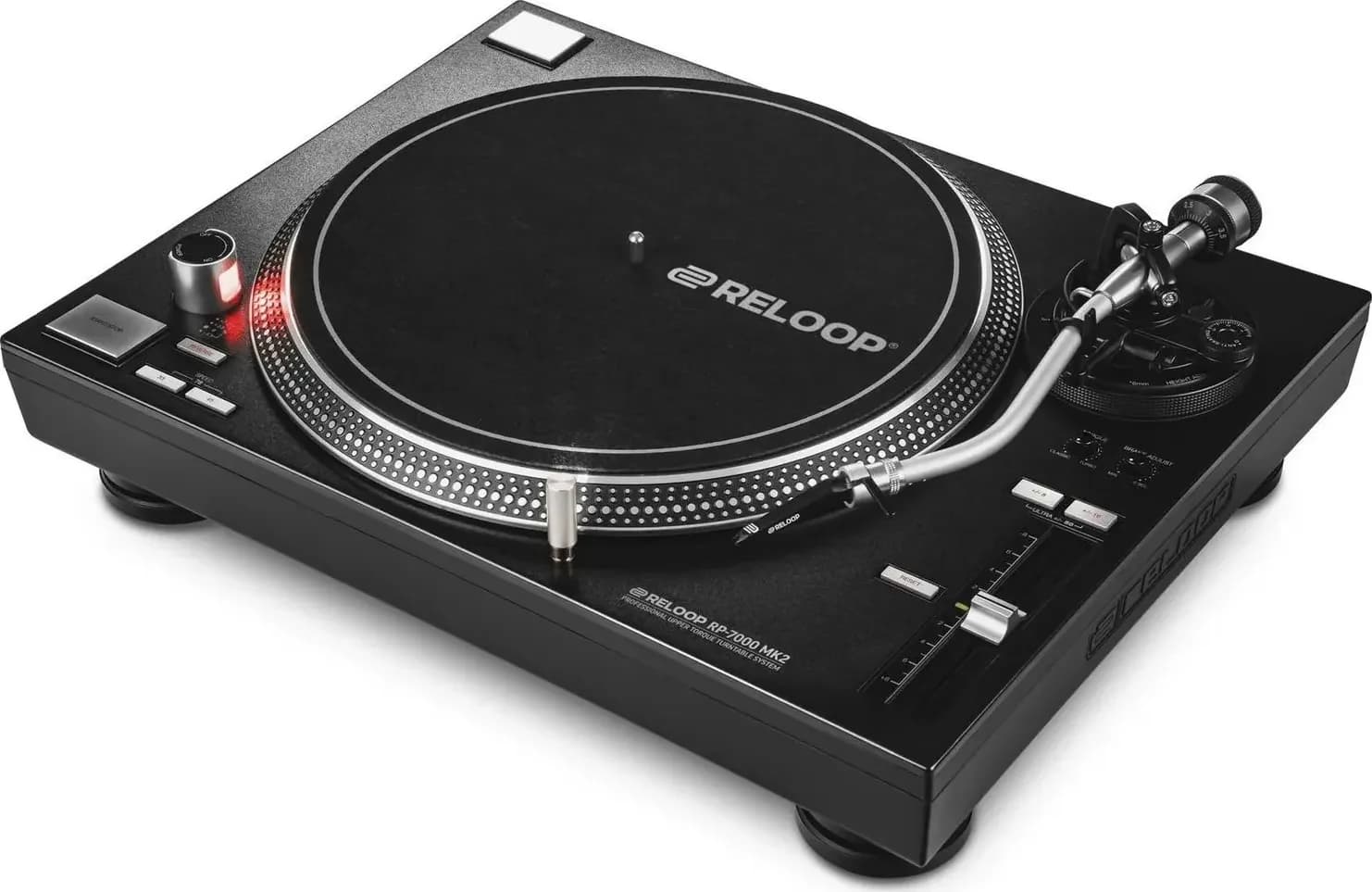

The Reloop RP-7000 MK2 punches well above its price. If you want serious direct-drive performance without paying Technics money, this is the deck that gets you closest — a quartz-locked turntable whose motor out-muscles the SL-1200MK7 on paper for roughly half the cost. Reloop launched it in 2018 at $680 / £549 / €649, and as of August 2026 the US list price sits at $649.99. For DJs building a first proper vinyl setup, or adding a pair of battle decks without flagship spend, it is the obvious place to start looking.
Build and design
The RP-7000 MK2 comes out of the so-called Super OEM stable — the family of high-torque direct-drive decks built on a shared manufacturing platform that also underpins turntables from Stanton and Audio-Technica. Resident Advisor called it "a strong contender in the crowded Super OEM market", and the spec sheet explains why. At approximately 11.7 kg it sits between the 9.6 kg Technics SL-1200MK7 and the 13.1 kg Pioneer DJ PLX-1000, with a metal chassis on shock-absorbing feet and a 332 mm die-cast aluminium platter damped with rubber on the underside to keep resonance out of the signal.
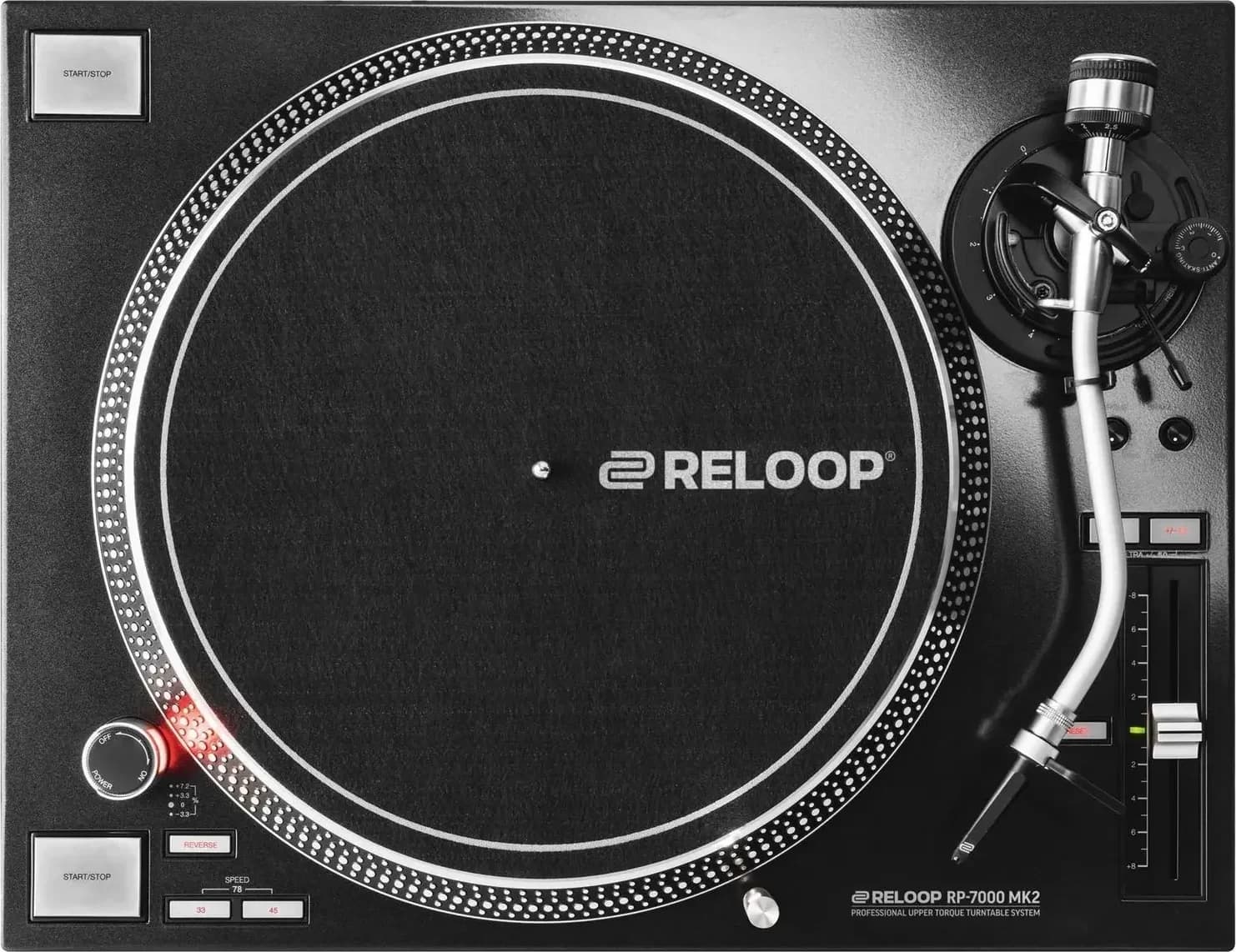
The tonearm is a static-balanced S-shape with height adjustment across a 0–6 mm range and anti-skating up to 3 g, so it takes everything from conical DJ styli to fussier elliptical carts without drama. Reloop also fits a switchable phono/line output with a built-in preamp and gold-plated RCAs, which means the deck plugs straight into a booth mixer, a controller's line input, or powered monitors with no external phono stage. Both the RCA and power cables detach — a practical win over the Technics' hard-wired leads that Digital DJ Tips singled out in its 2018 review, since a torn cable becomes a two-minute swap instead of a soldering job.
Where the savings show is in the details. The finish is functional rather than luxurious, there is no dust cover in the box, and the tonearm assembly is the most commonly criticised component: owners on the AudioKarma and Vinyl Engine forums have reported play in the tonearm bearings on some units, the kind of quality-control variance Technics simply does not ship. Check the arm carefully on arrival. None of this affects how the deck performs day to day, but it is the honest gap between a $650 turntable and a $1,200 one.
Torque, brake, and pitch stability
The motor is the reason this deck exists. It is a 16-pole, three-phase brushless direct drive under quartz lock, reaching full speed in under 0.2 seconds, with claimed wow and flutter of 0.01% WRMS. More interesting than the raw numbers is that the starting torque is adjustable from 2.8 to 4.5 kg/cm. At its maximum it matches the PLX-1000's fixed 4.5 kg/cm and delivers two and a half times the SL-1200MK7's 1.8 kg/cm; at its minimum it still starts harder than a classic 1200.
What that dial actually changes is how the platter behaves under your hands. Torque up, and the record snaps to speed the instant you release it, shrugs off stylus drag, and recovers immediately from hand pressure — exactly what you want for beat juggling, backspins, and aggressive scratch work where a sluggish platter smears your timing. Torque down, and the platter takes on the softer, more compliant feel of a vintage Technics: it yields slightly under your fingertips, which makes riding the pitch by touch and doing subtle mid-mix nudges feel less like fighting a machine. Resident Advisor's Mark Smith noted he kept the deck on its weakest, so-called Classic setting throughout testing — a useful data point, because it means even the floor of the range is strong enough for normal mixing, and everything above it is headroom for turntablists.
The brake is adjustable too, from a 0.2-second dead stop to a lazy six-second wind-down, so you can choose between a battle-style instant cut and the dramatic power-off spin-down effect without touching a service menu. Pitch control runs through a digital fader with three ranges — ±8% for fine beatmatching resolution, ±16% for bigger tempo moves, and a ±50% ultra-pitch for tempo-as-effect tricks — plus a quartz-lock reset that returns the platter to a true 0% at the press of a button. Digital pitch faders on budget decks have a patchy reputation, but RA's review found the RP-7000 MK2's performed well, and Reloop ships the fader with the centre click removed from the factory, so there is no dead zone to jump across right where beatmatching happens.
Built for the battle position
Reloop clearly designed this deck to be turned sideways. A second start/stop button sits on the corner specifically to support a vertical, battle-style setup, and with the deck rotated 90 degrees the upright pitch fader ends up along the top edge — clear of your scratch hand instead of underneath it, which is precisely where scratch DJs want it. Combined with the torque and brake adjustment, that makes the RP-7000 MK2 one of the most scratch-ready decks anywhere near its price.
There are dedicated forward and reverse controls as well, which open up reverse-spin tricks the PLX-1000 simply cannot do — Pioneer's deck has no reverse at all. A third speed adds 78 RPM for archival records alongside 33⅓ and 45, and the removable LED needle light handles dark booths. None of these are exotic features individually, but at this price the combination is unusually complete.
In use
Synthesising the professional reviews and several years of owner reports, the picture is consistent: speed stability and pitch accuracy draw very few complaints, and the deck holds tempo reliably over long mixes. The caveats cluster elsewhere. In Resident Advisor's controlled test, the RP-7000 MK2 began feeding back at +1 dB where a Technics SL-1210 MK2 held out to +8 dB — a meaningful gap for anyone playing bass-heavy music in loud rooms, and worth planning around with careful placement or isolation, especially since the feet are non-adjustable. Digital DJ Tips landed on it being "a decent turntable for both beginner and intermediate DJs on a budget", which matches the community consensus: strong performer, unglamorous details.
The other long-term consideration is resale. Used Technics decks famously hold — and sometimes gain — value, while Super OEM decks like this one depreciate the way most electronics do. That cuts both ways: it makes the RP-7000 MK2 a weaker store of value than an SL-1200, and it also makes clean used pairs a genuine bargain.
How it compares
The SL-1200MK7 remains the better turntable — tighter tolerances, better feedback rejection, a finer tonearm, and resale value the Reloop cannot match — but it costs roughly twice as much and offers a fraction of the creative feature set. The PLX-1000 splits the difference: club-standard styling, the same 4.5 kg/cm grunt, and a heavier chassis, but its torque is fixed, and there is no reverse and no ultra-pitch. If the motor matters more to you than the badge, the Reloop gives up very little to either.
Direct drive is non-negotiable for DJ use, and if you want the background on why, our direct drive vs belt drive explainer covers it. For the full field — including the digital-vinyl hybrid options — see how the RP-7000 MK2 ranks in our best DJ turntables guide.


