
DJ Tech Reviews

Pioneer DJ DJM-350

A discontinued two-channel Pioneer mixer that records mixes to USB, with master-only effects and no balanced output.

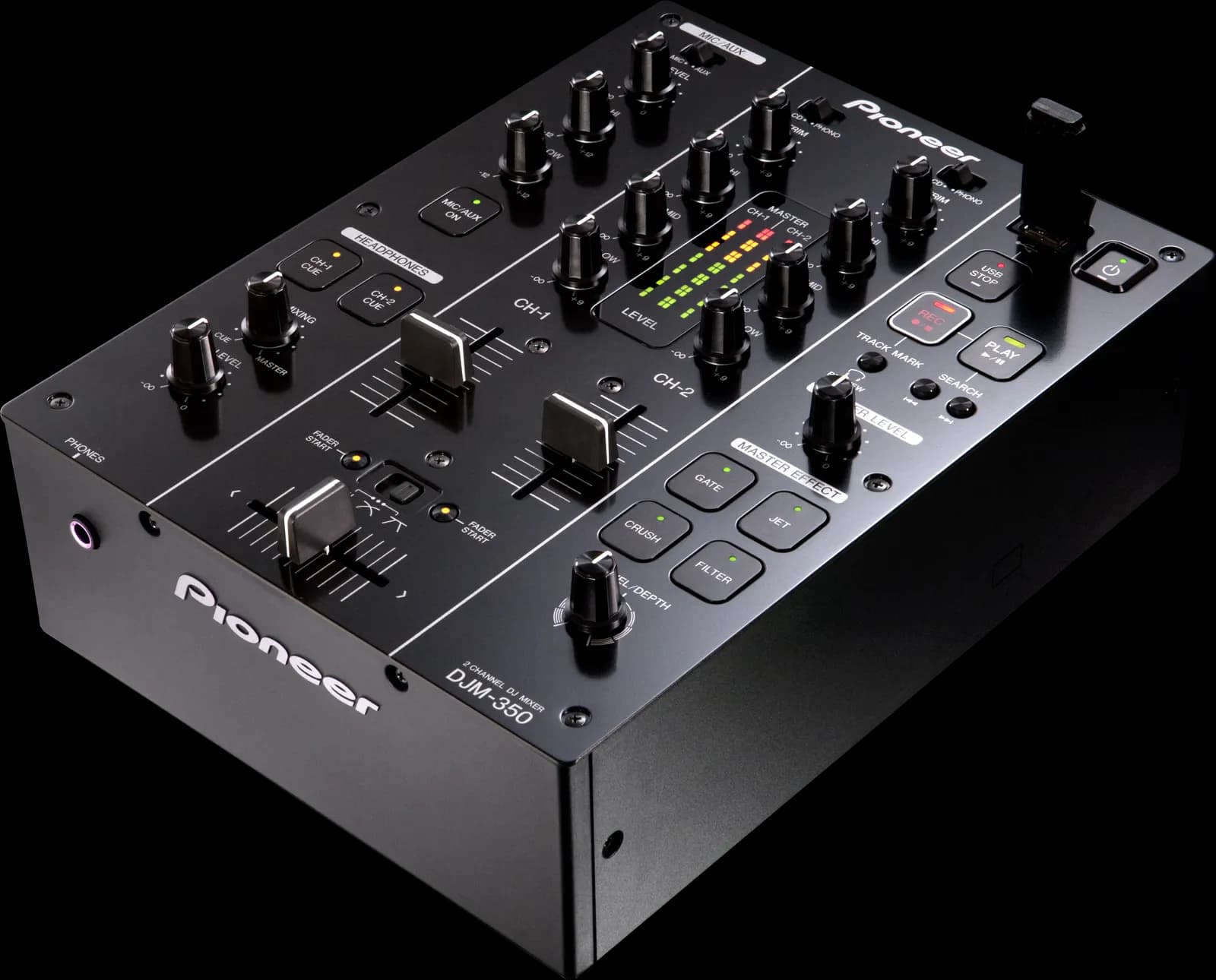
Pioneer DJM-350 at an angle with a USB stick plugged in

Photos: Pioneer DJ / AlphaTheta Corporation

All retailers and the price history

We may earn commission from links on this page. This does not affect our editorial independence.

80%

of 5 reviews recommend it

See reviews
Best for
A used home setup that records mixes straight to a USB stick.
Skip it if
You need balanced or booth outputs, per-channel effects or a scratch mixer.

The Internet’s Opinion

From 5 professional reviews: a fair amount of evidence.

Four of five reviews, all written between 2010 and 2012, recommend it for its DJM-series build, isolator EQs, simple master effects and one-button recording of mixes to a USB stick. The same reviews fault master-only effects that can't be layered, the lack of balanced or booth outputs, and a high price for two channels.

4 recommend1 mixed0 avoid

What people praise

  • Records mixes straight to a USB stick as WAV files, with track marks
  • Solid DJM-series build, faders and controls
  • Simple, good-sounding master effects
Show 5 more
  • Three-band isolator EQ with full kills
  • Adjustable crossfader curve, plus fader start with Pioneer players
  • Large cue buttons and a cue/master blend knob make headphone monitoring easy
  • Mic/aux channel has its own two-band EQ
  • Clean, strong sound, including the phono preamps

What to know first

  • Effects work on the master only, one at a time
  • No balanced master or separate booth output, only linked RCA outs
  • Expensive for a two-channel mixer
Show 1 more
  • Controls crowd the crossfader, so it is a weak scratch mixer
See the 5 reviews behind this

5 professional reviews (4 recommend, 1 mixed, 0 avoid); no owner reviews read: Thomann's DJM-350 review page is gone and Guitar Center lists it only as used stockCompiled 2026-10-11How this is compiled

Prices

Before you buy

Released
March 2010
Status
Discontinued

Works with

  • TurntablesTwo phono inputs

    Each channel has an RCA phono input for an analogue player with an MM cartridge, switchable against the CD line input, plus a signal ground terminal. Manufacturer spec sheet (Pioneer DJ (operating instructions)), checked 2026-10-11

  • CD and media playersTwo line inputs

    Each channel has an RCA CD (line) input for DJ players or other line-level sources. Manufacturer spec sheet (Pioneer DJ (operating instructions)), checked 2026-10-11

  • Pioneer DJ players: Fader StartControl cord

    Fader Start Play works only with a Pioneer DJ player connected by a control cord, which comes with Pioneer DJ players. Manufacturer spec sheet (Pioneer DJ (operating instructions)), checked 2026-10-11

  • Microphone or portable playerShared MIC/AUX channel

    A third MIC/AUX channel takes a microphone on a 6.3 mm jack or an external device on RCA, with its own two-band EQ. Manufacturer spec sheet (Pioneer DJ (operating instructions)), checked 2026-10-11

  • DJ software and DVSSeparate interface needed

    The USB port is a Type A port for storage, not an audio interface; a DVS setup connects a computer's separate audio interface to the mixer's inputs. Manufacturer spec sheet (Pioneer DJ (operating instructions)), checked 2026-10-11

You’ll also need

  • Powered speakers or an amplifierNot in the box

    Master output is two sets of RCA jacks; the box holds only the mixer, a power cable and the operating instructions. Manufacturer spec sheet (Pioneer DJ (operating instructions)), checked 2026-10-11

  • Players or turntablesNot in the box

    A mixer only, with no built-in decks: sources plug into the CD, phono and AUX inputs. Manufacturer spec sheet (Pioneer DJ (operating instructions)), checked 2026-10-11

  • USB drive for recordingFAT, FAT32 or HFS+

    Records and plays 16-bit, 44.1 kHz WAV files on USB mass-storage devices formatted FAT, FAT32 or HFS+; optical drives are not supported. Manufacturer spec sheet (Pioneer DJ (operating instructions)), checked 2026-10-11

  • Headphones6.3 mm jack

    The headphone output is a 6.3 mm stereo phone jack. Manufacturer spec sheet (Pioneer DJ (operating instructions)), checked 2026-10-11

Our take

Rory TassellWritten from the sources on this page, not from a loan unit.

Only five reviews exist, all from 2010 to 2012, and four recommend it for its DJM-series build, isolator EQs, simple effects and one-button recording of mixes to a USB stick. Bonedo's 4/5 comes with a warning that the missing balanced and booth outputs limit it for professional use, and the effects work on the master only. Pioneer has archived it without naming a successor, so buy it only used, for home mixing.

What it is

Status, October 2026: discontinued. Pioneer DJ has archived it without naming a direct successor.

What it is

The DJM-350 is a two-channel DJ mixer from Pioneer DJ, introduced at Musikmesse in March 2010 alongside the CDJ-350 player and on sale from June 2010 (launch report, Synthtopia). Pioneer DJ no longer has a product page for it; its operating instructions are still online.

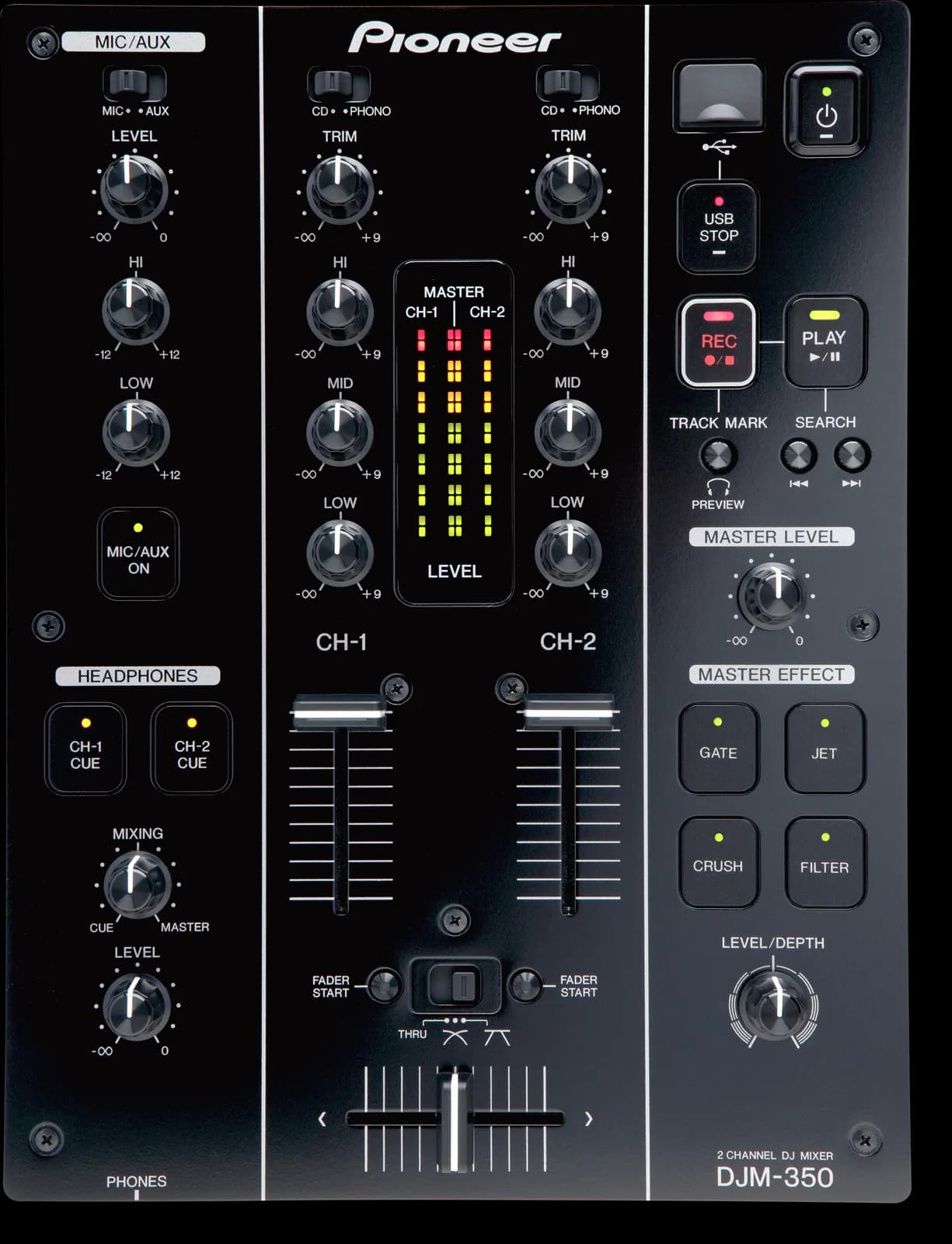
Each channel has an RCA CD (line) input and an RCA phono input for a turntable with an MM cartridge, switched per channel, plus a signal ground terminal. A third MIC/AUX channel takes a microphone on a 6.3 mm jack or a portable player or sampler on RCA, with its own two-band EQ. The two main channels have three-band EQs that cut fully when turned down (isolator function), and the crossfader has a three-position curve switch. Fader Start Play starts a Pioneer DJ player connected with a control cord.

Four master effect buttons, Gate, Crush, Jet and Filter, act on the master output with one Level/Depth control, and Pioneer DJ offered firmware that swapped in other effect types. A USB-A port on the front records the mix as 16-bit, 44.1 kHz WAV files to a drive formatted FAT, FAT32 or HFS+, and plays the recordings back. The port is not an audio interface, so DJ software and DVS setups need a separate interface.

Outputs are two pairs of RCA master outputs and a 6.3 mm headphone jack, with no balanced or booth output. Conversion is 24-bit at 48 kHz. It measures 218 x 107 x 301 mm and weighs 3.3 kg. The box holds the mixer, a power cable and the operating instructions.