
DJ Tech Reviews

Korg volca drum

A battery percussion synth with six two-layer parts and a resonator; slow to edit, light on classic punch.

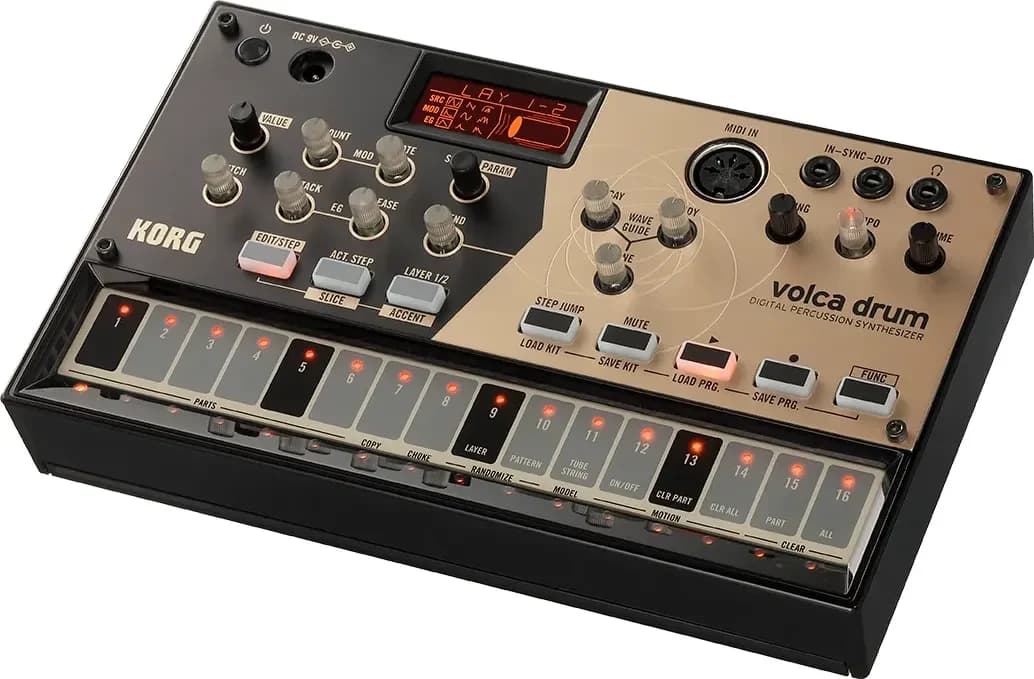
Korg volca drum at an angle

Photos: Korg

All retailers and the price history

We may earn commission from links on this page. This does not affect our editorial independence.

89%

of 9 reviews recommend it

See reviews
Best for
Synthesised, experimental percussion on a small budget.
Skip it if
You want classic, punchy 808-style kits or a USB connection.

The Internet’s Opinion

From 9 professional reviews and 85 owner reviews: plenty of evidence.

Eight of nine professional reviews recommend it as a deep, unusual percussion synth for the price, and most of the 85 owners read agree on the range of sounds and how much fun it is to play. The repeated catch is editing: one encoder and sub-menus make sound design slow to learn, and it is not the box for classic, punchy 808-style kits.

8 recommend1 mixed0 avoid

What people praise

  • A wide, unusual range of synthesized percussion, well beyond classic drum kits
  • Fun to play, and easy to lose hours in
  • Strong value for the price
Show 5 more
  • A deep sequencer for its size: motion sequencing and parameter locks, slice rolls, active step and probability
  • The waveguide resonator adds distinctive metallic and delay-like effects
  • A clear, readable display
  • Small, light and runs on batteries
  • Syncs easily with other volcas over one cable

What to know first

  • Sound editing takes time to learn: one encoder and sub-menus handle many settings
  • Small, closely packed knobs and a touch keypad that some find awkward
  • No power adapter in the box
Show 5 more
  • Not a classic drum machine: kicks and snares can lack punch, and 808-style kits are not its strength
  • No MIDI out and no USB, so it can't send its patterns or connect to a computer directly
  • No way to back up kits and patterns
  • One stereo mini-jack serves as both line and headphone output, with no individual outputs
  • The built-in speaker is weak
See the 9 reviews behind this

9 professional reviews (8 recommend, 1 mixed, 0 avoid; 3 of them YouTube); 85 owner reviews read at Thomann (91 posted across nine language pages, 10 under 20 words and 1 about a different volca skipped) and Guitar Center (7 posted, 2 under 20 words skipped)Compiled 2026-11-01How this is compiled

Video reviews

  • Woochia - Charly SauretJul 2019Recommends

    The BEST Volca yet? (Volca Drum review)

    The BEST Volca yet? (Volca Drum review)

    Woochia - Charly SauretJul 2019Recommends
  • Pete MidiApr 2019Recommends

    Hard to beat: KORG volca drum – review & jam

    Hard to beat: KORG volca drum – review & jam

    Pete MidiApr 2019Recommends

Plays from YouTube when you press play. Picked from the reviews counted above, including one that disagrees where there is one.

Prices

Before you buy

Released
March 2019
Status
Current

Works with

  • Other volcas, electribe and SQ-1Sync jack

    The sync in and out jacks connect it to another volca, an electribe or the SQ-1 for synchronized playback; a sync cable is in the box Manufacturer spec sheet (Korg), checked 2026-11-01

  • A DAW as a sound moduleMIDI In

    By default parts 1 to 6 answer MIDI channels 1 to 6 (not chromatically, and without velocity), and almost every parameter, the resonator included, has a MIDI CC Sound On Sound, checked 2026-11-01

  • External sequencers and MIDI clockFollows MIDI clock

    It syncs to incoming MIDI clock automatically (this can be switched off), and MIDI program changes switch its programs Sound On Sound, checked 2026-11-01

  • Synthmata volca drum editorFree, in a browser

    A free WebMIDI page (Chrome or Opera) that shows every parameter and saves, recalls and shares patches by link Gearnews, checked 2026-11-01

You’ll also need

  • KA-350 AC adapter or six AA batteriesAdapter sold separately

    It runs on six AA alkaline or NiMH batteries or the KA-350 adapter, which is sold separately; only a sync cable is in the box Manufacturer spec sheet (Korg), checked 2026-11-01

  • Headphones, or a cable to a mixer or interface3.5 mm out only

    The only audio output is a 3.5 mm stereo headphone jack; beyond the built-in speaker, it needs headphones or a 3.5 mm stereo cable into a mixer or interface Manufacturer spec sheet (Korg), checked 2026-11-01

  • A USB-MIDI interface to play it from a computerNo USB

    MIDI In is a single 5-pin DIN socket and there is no USB, so a computer reaches it through a MIDI interface Sound On Sound, checked 2026-11-01

  • A computer or audio player for firmware updatesUpdates by audio

    Korg's system updater (1.14, September 2019) is played to it as audio from a computer or audio player over a stereo mini-jack cable Firmware release notes, checked 2026-11-01

Key specs

Sound engine
Digital (DSP) percussion synthesis modelled on analogue, not samples: each layer picks one of 5 oscillator waveforms (including sine, sawtooth and HPF noise), one of 3 pitch modulators and one of 3 amp EGs, with bit reduction, wave folder and overdrive
Parts
6 identical parts with 2 layers each and 6-voice polyphony; any sound can sit on any part
Effect
Waveguide resonator (physical modelling) in tube or strings mode, with Decay, Body and Tune knobs
Sequencer
16 steps per part, 16 patterns; chain up to 16 patterns (256 steps); motion sequence of up to 69 parameters; active step, step jump, slice rolls, 16-level accent, choke and two randomize functions
Memory
16 kits and 16 programs (pattern, motion sequence and kit number); 10 of each are factory presets
Keys
16 multi-touch trigger pads / step keys
All 12 specifications
Sampling
None: every sound is synthesized, with no sample playback
Outputs
One 3.5 mm stereo mini-jack headphone output, no individual outputs; built-in speaker
MIDI and sync
MIDI In (no MIDI out); Sync In (3.5 mm, max 20 V) and Sync Out (3.5 mm, max 5 V)
USB
None: no USB audio or USB MIDI
Power
6 x AA batteries (about 10 hours on alkalines) or the KA-350 AC adapter, sold separately
Size and weight
193 x 115 x 39 mm (7.61 x 4.54 x 1.54 in); 370 g (0.75 lb) without batteries

12 of 12 figures sourced; hover one for its source

Our take

Rory TassellWritten from the sources on this page, not from a loan unit.

Eight of nine professional reviews recommend it as a deep, unusual percussion synth for the price, and most of the 85 owners read agree on the range of sounds and how much fun it is to play. The repeated catch is editing: one encoder and sub-menus make sound design slow to learn, and it is not the box for punchy 808-style kits. Buy it for experimental percussion on batteries; for classic kits, choose something else.

What it is

Status, November 2026: current. Korg still lists the volca drum.

What it is

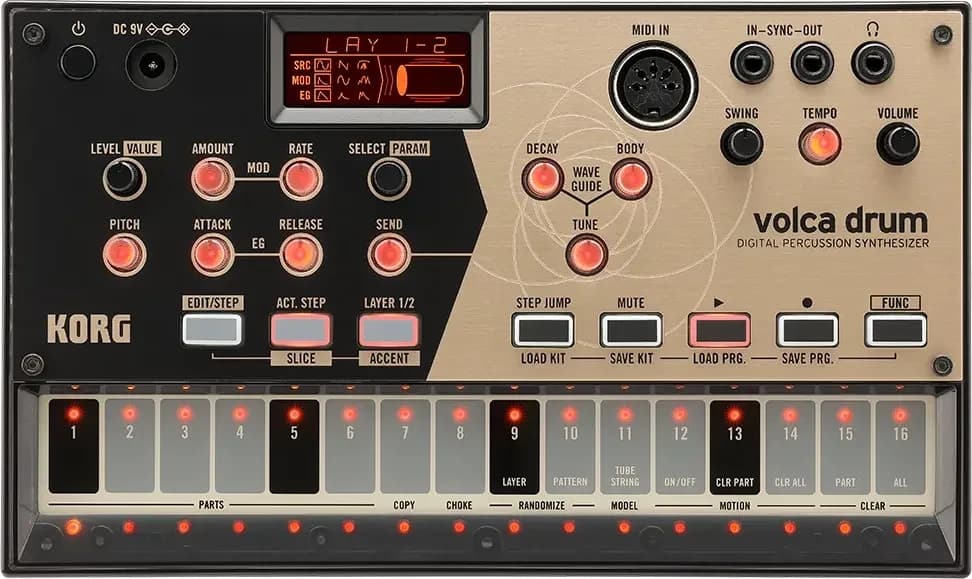
The volca drum is a digital percussion synthesizer from Korg's volca range, announced in early 2019 (MusicRadar). It plays no samples: every sound is synthesised from six identical parts with two layers each, and each layer picks one of five waveforms, a pitch modulator and an amp envelope, with bit reduction, a wave folder and overdrive (Korg). A waveguide resonator in tube or strings mode adds metallic and string-like tones.

The sequencer has 16 steps per part and 16 patterns, which chain to 256 steps, with motion sequencing of up to 69 parameters, slice rolls, accents, choke and two randomize functions. It stores 16 kits and 16 programs and is played from 16 touch pads (Korg specifications). There is MIDI in but no MIDI out, sync in and out, no USB, and one 3.5 mm stereo output that serves as line and headphone out, plus a built-in speaker.

It runs on six AA batteries, for about ten hours on alkalines, or on Korg's KA-350 adapter, sold separately. It measures 193 x 115 x 39 mm and weighs 370 g without batteries. It is in the drum machines guide.