
DJ Tech Reviews

Elektron Digitakt II

A 16-track stereo sampler with Elektron's sequencer and 400 MB per project; a learning curve, mains power only.

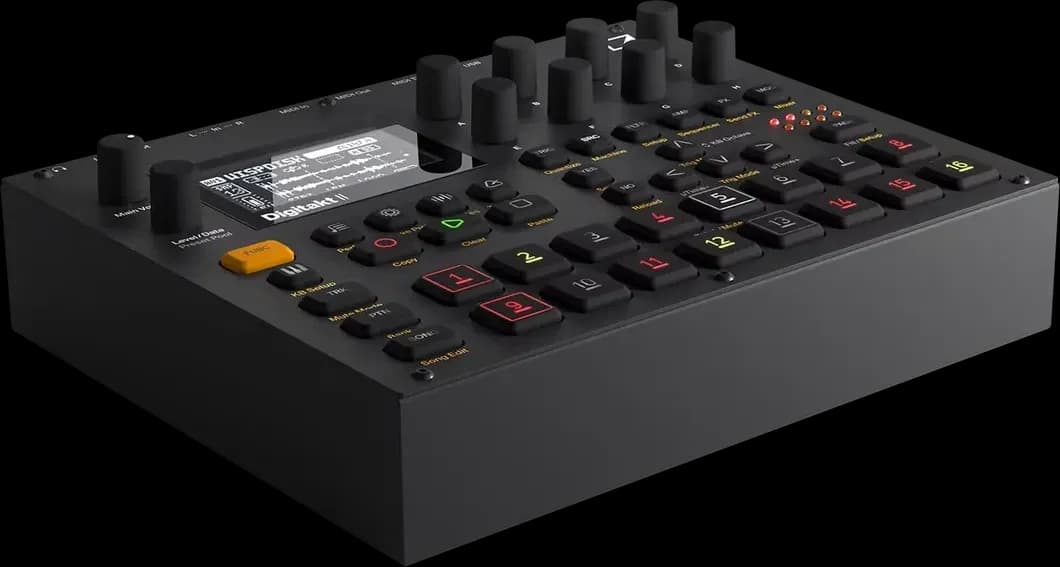
Elektron Digitakt II at an angle

Photos: Elektron

All retailers and the price history

We may earn commission from links on this page. This does not affect our editorial independence.

89%

of 9 reviews recommend it

See reviews
Best for
Producers whose setup centres on sampling and sequencing.
Skip it if
You want battery power or individual outputs.

The Internet’s Opinion

From 9 professional reviews and 50 owner reviews: a fair amount of evidence.

Eight of nine professional reviews recommend it as a big, well-built upgrade to the original Digitakt that sounds excellent, and nearly all of the 50 owners read agree. The reservations are a learning curve, one stereo output pair, limited polyphony and slow sample loading; the launch firmware gaps, Overbridge and manual slicing, have since been filled.

8 recommend1 mixed0 avoid

What people praise

  • A big step up from the original: 16 stereo tracks and far more sample memory
  • Sounds excellent, with strong effects, filters and compression
  • The Elektron sequencer: parameter locks, conditional trigs and 128 steps
Show 3 more
  • Fast, fun and addictive to make music on
  • Solid, well-made metal build
  • A capable MIDI sequencer for other gear

What to know first

  • A learning curve: menus, key combinations and parameter locks take time
  • Launched with unfinished firmware: no Overbridge, no manual slicing and some bugsFixed
  • Limited polyphony and no chord or multisample tools
Show 5 more
  • Only one stereo output pair, with no individual outputs
  • Loading samples from a computer is slowStill present
  • No battery, so it needs mains power
  • Expensive, close to a larger Elektron machine
  • For some, not a big enough change from the original Digitakt
See the 9 reviews behind this

9 professional reviews (8 recommend, 1 mixed, 0 avoid; 3 of them YouTube); 50 owner reviews read at Thomann (59 posted across eight language pages, 9 under 20 words skipped, 1 posted twice counted once) and Guitar Center (1 posted)Compiled 2026-11-01How this is compiled

Video reviews

  • loopopApr 2024Recommends

    Review: DIGITAKT II vs OG Digitakt // Everything new in Digitakt 2 // Detailed tutorial

    Review: DIGITAKT II vs OG Digitakt // Everything new in Digitakt 2 // Detailed tutorial

    loopopApr 2024Recommends
  • BoBeatsMay 2024Mixed

    DIGITAKT 2 — Should you buy it?! // review & tutorial by a long-time Digitakt user

    DIGITAKT 2 — Should you buy it?! // review & tutorial by a long-time Digitakt user

    BoBeatsMay 2024Mixed

Plays from YouTube when you press play. Picked from the reviews counted above, including one that disagrees where there is one.

Prices

Before you buy

Released
April 2024
Status
Current

Works with

  • Any DAWUSB audio and MIDI

    A class-compliant device: it streams audio and MIDI over USB to and from computers without extra drivers, so it can be recorded straight into a DAW User manual (Elektron (user manual, OS 1.17)), checked 2026-11-01

  • OverbridgeFree plug-in

    Elektron's free Overbridge suite opens the Digitakt II as a VST, AU or AAX plug-in in a DAW, to edit and automate its sound parameters and stream multichannel audio Manufacturer spec sheet (Elektron (Overbridge)), checked 2026-11-01

  • Phones and tabletsClass-compliant USB

    Streams audio and MIDI over USB to and from supported phones and tablets as well as computers User manual (Elektron (user manual, OS 1.17)), checked 2026-11-01

  • Synths and drum machinesMIDI and DIN Sync

    MIDI In, Out and Thru with DIN Sync out; any of the 16 tracks can be a MIDI track sequencing another instrument with up to 4 notes per step and 16 assignable CCs Manufacturer spec sheet (Elektron), checked 2026-11-01

  • Elektron Outbox 8More outputs

    Elektron's Outbox 8 breakout box adds analogue outputs to Overbridge-enabled units such as the Digitakt II (sold separately) User manual (Elektron (user manual, OS 1.17)), checked 2026-11-01

You’ll also need

  • Speakers, a mixer or headphonesNo built-in speaker

    Sound comes out of the two 1/4-inch main outputs, which Elektron says to connect to a mixer or amplifier, and a 1/4-inch stereo headphone jack User manual (Elektron (user manual, OS 1.17)), checked 2026-11-01

  • A computer to load samplesElektron Transfer, free

    Samples, backups and OS updates go to and from the unit with Elektron's free Transfer application on a computer over USB User manual (Elektron (user manual, OS 1.17)), checked 2026-11-01

  • A power socketNo battery

    It runs from the included PSU-3c adapter through a 12 V DC inlet; Elektron lists no battery option User manual (Elektron (user manual, OS 1.17)), checked 2026-11-01

  • A preamp for mic or vinylLine inputs

    The two 1/4-inch inputs take balanced or unbalanced jacks at up to +18 dBu; Elektron lists no mic or phono preamp, so a microphone or turntable needs one in between User manual (Elektron (user manual, OS 1.17)), checked 2026-11-01

Key specs

Sound engine
Sample-based, 16 stereo voices; 6 sample machines (Oneshot, Werp, Stretch, Repitch, Slice, Grid)
Tracks
16, each a stereo or mono audio track or a MIDI track
Sequencer
128 steps per pattern and track; 128 patterns per project (8 banks of 16); parameter locks, trig conditions, micro timing, a Euclidean generator per track and Song mode
Controls
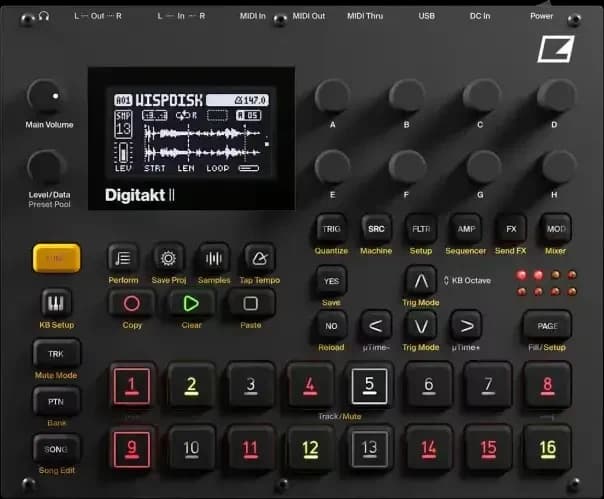
16 trig keys, 8 data entry knobs (A to H) and a 128 x 64 pixel OLED screen; a keyboard mode plays a track chromatically from the trig keys
Sampling
Yes, in stereo, from the inputs, from its own output or over USB; up to 66 seconds per recording, at 48 kHz, 24-bit
Sample memory
400 MB per project (about 36 minutes stereo or 72 minutes mono) in up to 1016 sample slots; 20 GB +Drive storage
All 12 specifications
Effects
Per track: a base-width filter, overdrive, bit and sample rate reduction and 3 LFOs; send chorus, delay and reverb; master overdrive and stereo compressor
Audio inputs and outputs
2 balanced 1/4" main outputs, 2 balanced 1/4" inputs and a 1/4" stereo headphone output; no individual outputs
MIDI and sync
5-pin DIN MIDI In, Out and Thru, with DIN Sync out; MIDI tracks send 16 assignable CCs and up to 4 notes per step
USB
Hi-Speed USB 2.0 (USB-B): class-compliant audio and MIDI, or Overbridge
Power
12 V DC barrel inlet; PSU-3c adapter in the box; no battery; 7 W typical
Size and weight
215 x 176 x 63 mm including knobs and feet; about 1.48 kg; steel case

12 of 12 figures sourced; hover one for its source

Our take

Rory TassellWritten from the sources on this page, not from a loan unit.

Eight of nine professional reviews recommend it as a big, well-built upgrade to the original Digitakt that sounds excellent, and nearly all of the 50 owners read agree. The reservations are a learning curve, one stereo output pair, limited polyphony and slow sample loading; the launch firmware gaps, Overbridge and manual slicing, have since been filled. Buy it if sampling and sequencing are the centre of your setup and you will take the time to learn it.

What it is

Status, November 2026: current. Elektron still lists the Digitakt II.

What it is

The Digitakt II is a sampler and drum machine from Elektron, announced in April 2024 as the successor to the Digitakt (Sound On Sound). It has 16 tracks, each a stereo or mono audio track or a MIDI track for other gear, 16 stereo voices, and six sample machines for one-shots, slicing, time-stretching and repitching (Elektron). It samples in stereo at 48 kHz and 24-bit from its inputs, its own output or USB, up to 66 seconds per recording, with 400 MB of sample memory per project on 20 GB of storage (Digitakt II user manual).

The sequencer runs to 128 steps per pattern and track, with parameter locks, trig conditions, micro timing, a Euclidean generator per track and a song mode. Each track has a filter, overdrive, bit and sample-rate reduction and three LFOs, with send chorus, delay and reverb and a master compressor. It is played from 16 trig keys, which also play a track chromatically, and eight knobs beside a small OLED screen.

Connections are two balanced 1/4" main outputs, two balanced inputs and a headphone jack, with no individual outputs; 5-pin MIDI in, out and thru with DIN sync out; and USB for class-compliant audio and MIDI or Elektron's Overbridge, which streams separate tracks to a computer. It runs from the included 12 V adapter, has a steel case, and weighs about 1.48 kg. It is in the drum machines guide.