A drum machine is a dedicated hardware device that generates percussion sounds and sequences them into patterns. Unlike software drum plugins, hardware drum machines give you tactile, hands-on control — knobs for tweaking sounds, pads for finger drumming, and step sequencers for programming beats in real time.
The modern drum machine landscape ranges from pocket-sized units under $100 to professional rhythm performers that can anchor a live performance. For DJs, producers, and beat-makers just starting out, the right drum machine should be intuitive enough to make beats quickly while offering enough depth to grow into.
What to Look For
Sound engine type. Analogue drum machines generate sounds through electronic circuits, producing warm, organic tones prized in house, techno, and hip-hop. Digital/PCM machines use sampled sounds, offering more variety but sometimes less character. Hybrid units combine both approaches.
Sequencer. The built-in sequencer is where you program drum patterns. Step sequencers (like Roland's classic 16-step design) let you place hits on a grid — intuitive for beginners and fast for live programming. Look for pattern chaining to build complete songs from individual patterns.
Sound editing. At minimum, you want per-sound controls for pitch/tuning and decay/length. More advanced machines offer filter, distortion, and effect parameters per voice. The deeper the editing, the more unique your beats can sound beyond the factory presets.
Connectivity. MIDI (USB or 5-pin DIN) lets your drum machine sync with other hardware and DAW software. Audio outputs (ideally individual outs per sound) enable separate processing and recording. Some machines include line inputs for external audio or syncing with other gear.
Portability. Battery-powered options with built-in speakers (like the Korg Volca series) let you make beats anywhere. Larger desktop units require mains power but offer more hands-on controls and better build quality.
1. Roland AIRA TR-8S Rhythm Performer
Editor's Choice
| Spec | Detail |
|---|---|
| Sound Engine | ACB (Analog Circuit Behaviour) + samples |
| Sounds | All TR-808, 909, 707, 606, 626 + user samples |
| Sequencer | 16-step, 128 patterns |
| Effects | Per-instrument effects, master FX |
| Connectivity | USB, MIDI, individual outs, SD card |
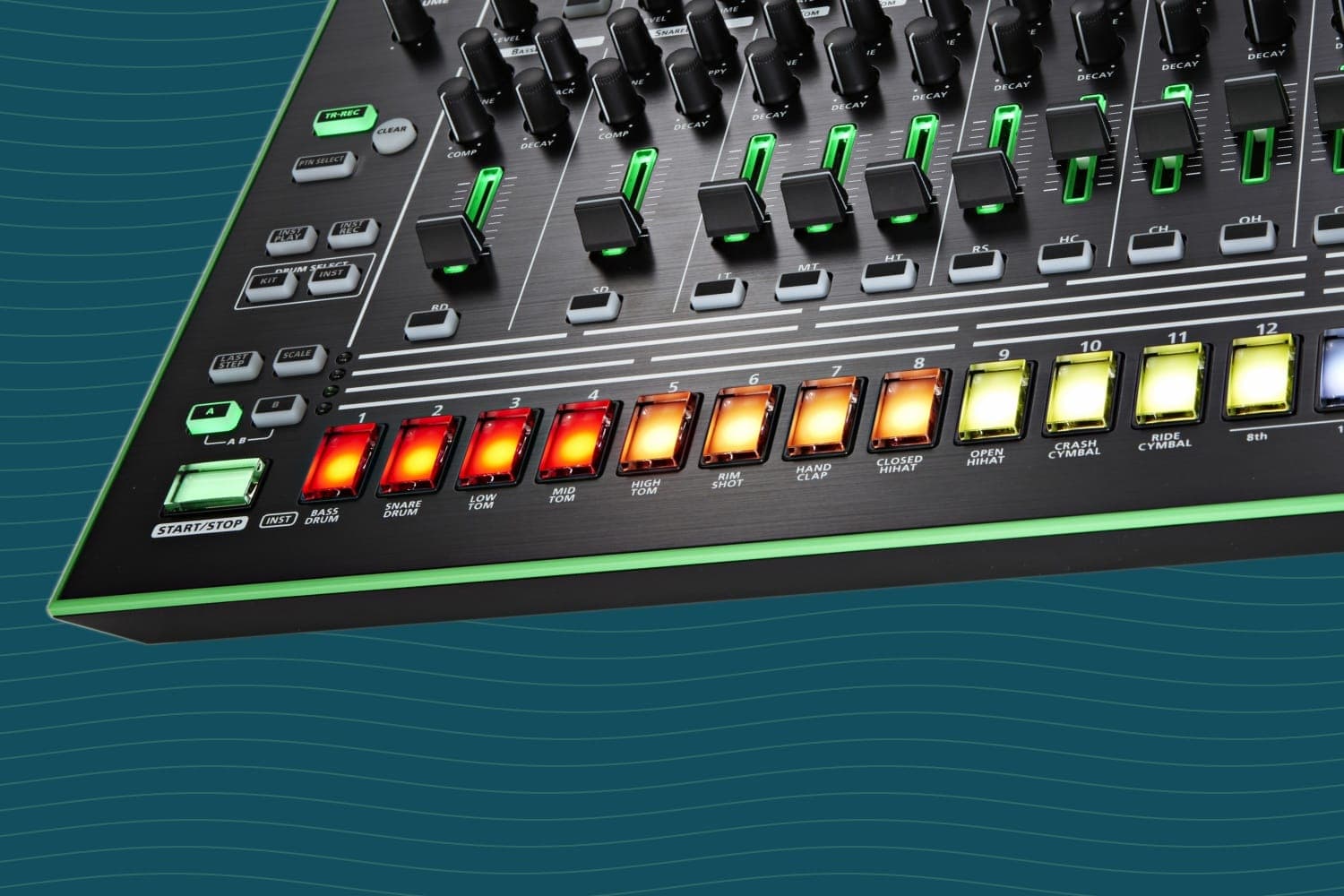
The Roland AIRA TR-8S is the most comprehensive drum machine for beginners who want a device they'll use for years. It includes every sound from Roland's legendary TR drum machines — 808, 909, 707, 606, and 626 — recreated through ACB (Analog Circuit Behaviour) technology that models the original analogue circuits.
The ability to import your own samples via SD card transforms the TR-8S from a classic drum machine into a modern production tool. Load any WAV file, assign it to a pad, and sequence it alongside the classic TR sounds. Per-instrument effects (delay, reverb, filter) and a master effects bus provide studio-quality processing without external gear.
The 16-step sequencer with real-time recording and per-step parameter editing makes programming beats intuitive. Knob-per-function design means you can tweak any sound parameter without menu diving. 128 pattern memory with pattern chaining lets you build complete arrangements.
Individual audio outputs for each instrument allow separate recording and processing in a DAW. USB audio sends all channels to your computer simultaneously. This is the drum machine that grows from bedroom production to live performance.
2. Korg Volca Beats
Best Budget Analogue
| Spec | Detail |
|---|---|
| Sound Engine | Analogue synthesis + PCM |
| Parts | 6 analogue + 1 PCM |
| Sequencer | 16-step Electribe-style |
| Memory | 8 patterns |
| Power | Battery or AC adapter |
The Korg Volca Beats delivers genuine analogue drum sounds at a fraction of the price of larger machines. Six analogue parts (kick, snare, hi-hat open/closed, tom, clap) produce warm, punchy sounds that sit naturally in electronic music mixes. A PCM part adds additional percussion options.
The 16-step Electribe-style sequencer is fast and intuitive — tap a step, assign a sound, and the pattern plays immediately. The Stutter function creates rapid-fire retriggering effects that dramatically change the feel of a pattern in real time. Active Step mode lets you skip steps for polyrhythmic patterns.
Battery power and a built-in speaker mean you can make beats anywhere — on a train, in a park, or away from your studio. The compact form factor takes up minimal desk space. MIDI and sync connections let you integrate with other Volca units or your DAW.
At around $150, it's the most affordable way to experience real analogue drum synthesis. The limited pattern memory (8 slots) and basic sound editing are the trade-offs, but the immediacy and character of the sound more than compensate.
3. Native Instruments Maschine MK3
Best for Production
| Spec | Detail |
|---|---|
| Type | Hardware/software integrated system |
| Pads | 16 velocity-sensitive, RGB |
| Sound Library | 25 GB Komplete 11 Select |
| Features | Sampler, arranger, mixer, FX, audio interface |
| Connectivity | USB, MIDI, audio I/O |
The Native Instruments Maschine MK3 blurs the line between drum machine, sampler, and DAW controller. It's a complete production workstation — the hardware provides tactile control over the included Maschine software, which handles sound generation, sampling, arrangement, and mixing.
Sixteen velocity-sensitive RGB pads respond to finger drumming with excellent sensitivity and feel. The dual high-resolution displays show waveforms, parameters, and arrangement without looking at your computer screen. Touch-sensitive knobs provide parameter control with visual feedback.
The included 25 GB Komplete 11 Select library provides thousands of sounds — drum kits, instruments, effects, and samples. The built-in audio interface handles recording and playback. Integration with major DAWs (Ableton Live, Logic Pro, FL Studio) is seamless.
The Maschine MK3 is more complex to learn than a standalone drum machine and requires a computer to function. But for beginners who want a single device that handles beat-making, sampling, arrangement, and production, nothing else offers this much capability at this price.
4. Behringer RD-6
Best Classic Sound
| Spec | Detail |
|---|---|
| Sound Engine | True analogue circuits |
| Sounds | 8 analogue drum voices |
| Sequencer | 16-step with accent |
| Sync | DIN sync, MIDI, USB |
| Power | USB or battery |
The Behringer RD-6 recreates the sound of Roland's classic 606 drum machine using genuine analogue circuits — not digital modelling. The result is authentic, warm drum sounds with the character and imperfections that make analogue hardware appealing. At under $100, it's the most affordable true analogue drum machine available.
Eight drum voices (bass drum, snare, low tom, high tom, cymbal, open hat, closed hat, clap) cover the essentials for electronic music production. The global accent function adds dynamic emphasis to selected steps. The 16-step sequencer with pattern chaining allows complete song arrangements.
Six independent analogue outputs enable external processing and multitrack recording. DIN sync output connects to other analogue gear. USB and MIDI connectivity integrate with modern production setups. Battery power option adds portability.
The build quality is lightweight plastic, and the sound palette is limited to 606-style tones. But for the price, no other hardware delivers this level of analogue authenticity. Perfect for house, techno, and acid producers who want that specific vintage sound.
Other Drum Machines Worth Considering
Teenage Engineering Pocket Operator PO-32 — A micro drum machine at around $89 that punches well above its weight. Sixteen preset sounds with Microtonic VST transfer capability for custom sound design. Pattern chaining for song arrangement. Genuinely portable — it runs on batteries and fits in a pocket.
IK Multimedia UNO Drum — A hybrid analogue/PCM drum machine with 12 PCM and 6 analogue voices. Compact, portable, and affordable. The dual sound engine offers more variety than pure analogue machines. USB and MIDI connectivity. 64-step sequencer with 100 pattern/kit presets.
Alesis SR-18 — A no-frills drum machine with over 500 professional sounds and an onboard effects processor. MIDI support, pattern play mode, and tap tempo. Long battery life for portable use. Best for DJs and performers who want a reliable rhythm source without deep sound design.
Roland AIRA TR-8 — The predecessor to the TR-8S, offering 808 and 909 sounds through ACB technology at a lower price point. Lacks the sample import capability of the TR-8S but delivers the same classic Roland sound quality. Worth considering if you find it discounted.
Latest Standalone Beat-Makers
The newest standalone grooveboxes and samplers landing in DJ booths in 2025–2026:
Akai MPC Live III
Akai MPC Sample
AlphaTheta RMX-IGNITE
Korg Kaoss Pad V
FAQs
What is the best drum machine for beginners?
The Roland AIRA TR-8S is the best overall drum machine for beginners who want a device they won't outgrow. It includes every classic TR drum sound (808, 909, 707, 606), supports custom sample import via SD card, and has an intuitive step sequencer. For a tighter budget, the Korg Volca Beats offers genuine analogue sound at a fraction of the price.
Do I need a drum machine if I have a DAW?
Not strictly, no. DAWs like Ableton Live, FL Studio, and Logic Pro include drum machine plugins that replicate classic hardware sounds. However, hardware drum machines offer tactile, hands-on control that inspires different creative choices. Many producers use both — software for studio production and hardware for live performance and jamming.
What is the difference between a drum machine and a sampler?
A drum machine generates sounds internally (either through synthesis or pre-loaded samples) and has a built-in sequencer for programming patterns. A sampler records and plays back external audio, with more flexible sound manipulation. Some devices like the Native Instruments Maschine MK3 blur the line by offering both sampling and drum machine functionality.
Can I use a drum machine for live DJ sets?
Yes. Many DJs layer drum machine patterns over their sets for live percussion, breakdown fills, and energy builds. The Roland DJ-202 controller has built-in TR drum sounds. Dedicated drum machines like the TR-8S can be connected to a DJ mixer's line input and triggered live alongside your tracks.
How much should I spend on a first drum machine?
Between $50 and $400 covers the full beginner range. Budget options like the Korg Volca Beats ($150) and Teenage Engineering PO-32 ($89) deliver genuine beat-making capability. The $300–$400 range (Roland TR-8S, IK Multimedia UNO Drum) offers professional-quality sound and features that last for years.
Verdict
The Roland AIRA TR-8S is the best drum machine for beginners who want to invest in a device that grows with them. Every classic TR sound, sample import capability, per-instrument effects, and individual outputs make it a complete rhythm production tool.
For budget-conscious beginners, the Korg Volca Beats delivers real analogue character at around $150 — the most affordable way to experience hardware drum synthesis. The Native Instruments Maschine MK3 is the best choice for producers who want an integrated beat-making and production workstation. And the Behringer RD-6 offers true analogue circuits at under $100 for producers chasing that specific vintage 606 sound.
Start with whatever fits your budget. The tactile experience of programming beats on hardware — twisting knobs, tapping pads, hearing sounds change in real time — is fundamentally different from clicking a mouse. That's the point.