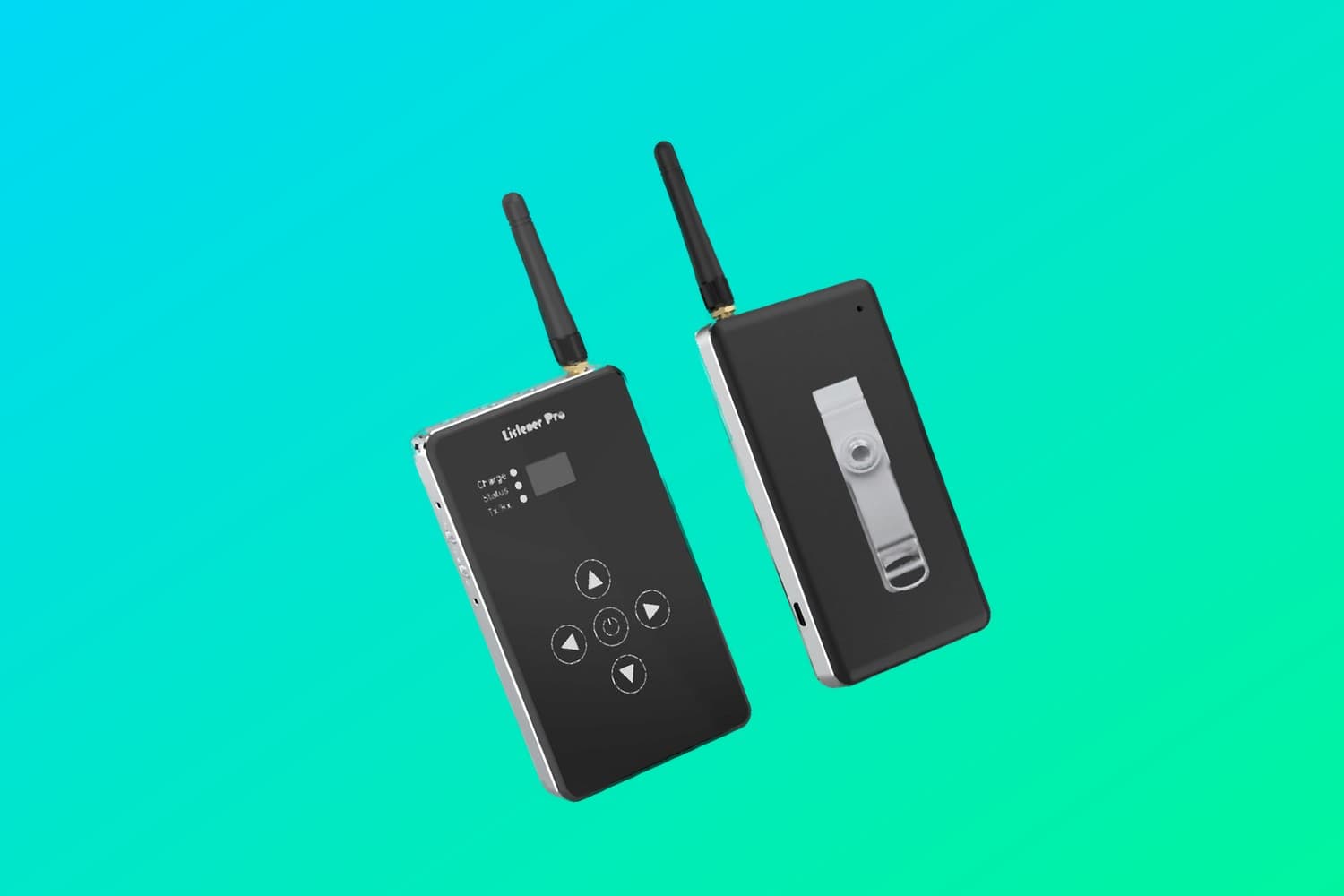
The Listener Pro is one of the cheapest ways to try wireless in-ear monitoring, and its appeal is simplicity. The 2.4GHz design needs no frequency coordination and works worldwide, every unit can flip between transmitter and receiver duty, and built-in rechargeable batteries save the ongoing cost of AAs. Street pricing shifts with whichever marketplace seller currently stocks it, but the manufacturer's own trade listing put a single transmitter-and-receiver set at US$108 as of August 2026 — a fraction of what the pro UHF systems cost. For a performer stepping away from wedge monitors for the first time, it lowers the barrier to entry about as far as it goes.
Build and design
The system — sold under the LP-PT100 model name — ships as a pair of near-identical beltpack-sized units, and the 2-in-1 design is its cleverest idea: a switch turns any unit into either a transmitter or a receiver. That means no separate half-rack transmitter to house, and a band can grow the rig one unit at a time, since a single transmitter can feed multiple receivers. Each unit carries dual antennas, an LCD, and a 3.5mm socket layout that accepts a stereo feed or a microphone input and passes audio out through a standard 3.5mm headphone jack.
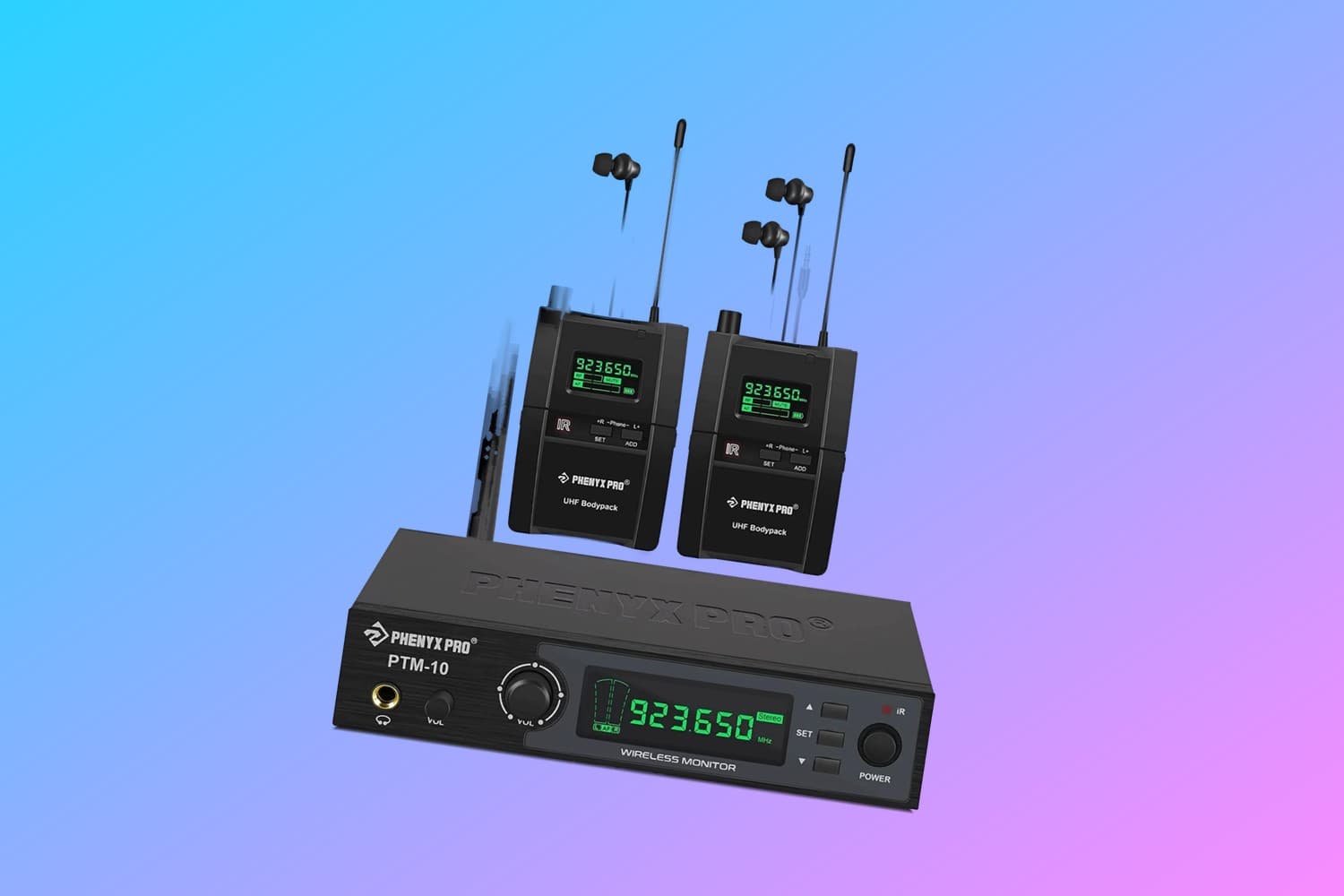
Listener Pro's spec sheet claims a metal frame under a piano-black shell, which — if accurate — would put it a step ahead of the all-plastic Phenyx Pro PTM-10. Treat that the way you'd treat any marketplace-brand spec: unverified until it's in your hands. What is certain is that the bundled earphones are basic. That's the same story as every budget IEM system, and they're the first thing to upgrade, because even a modest aftermarket pair will reveal more of the mix than the stock set.
Audio and the 2.4GHz trade-off
The choice of 2.4GHz is the defining engineering decision, and it cuts both ways. In its favour, the 2400–2483MHz ISM band is licence-free everywhere in the world. UHF systems need region-specific frequency variants, and in some countries a licence on top; the US 600MHz spectrum auction turned a generation of UHF wireless gear into paperweights when those frequencies were reallocated. A 2.4GHz system sidesteps all of it — buy one unit, use it in any country, coordinate nothing.
The cost is company. The 2.4GHz band is the same spectrum used by WiFi routers, Bluetooth devices and every phone in the audience, so the RF environment on a busy Friday night is far more hostile than a coordinated UHF channel. Listener Pro's marketing claims the system "can avoid interference caused by UHF, Bluetooth, WiFi", but frequency-hopping can only dodge congestion, not remove it — and the brand publishes no detail on how its scheme actually works.
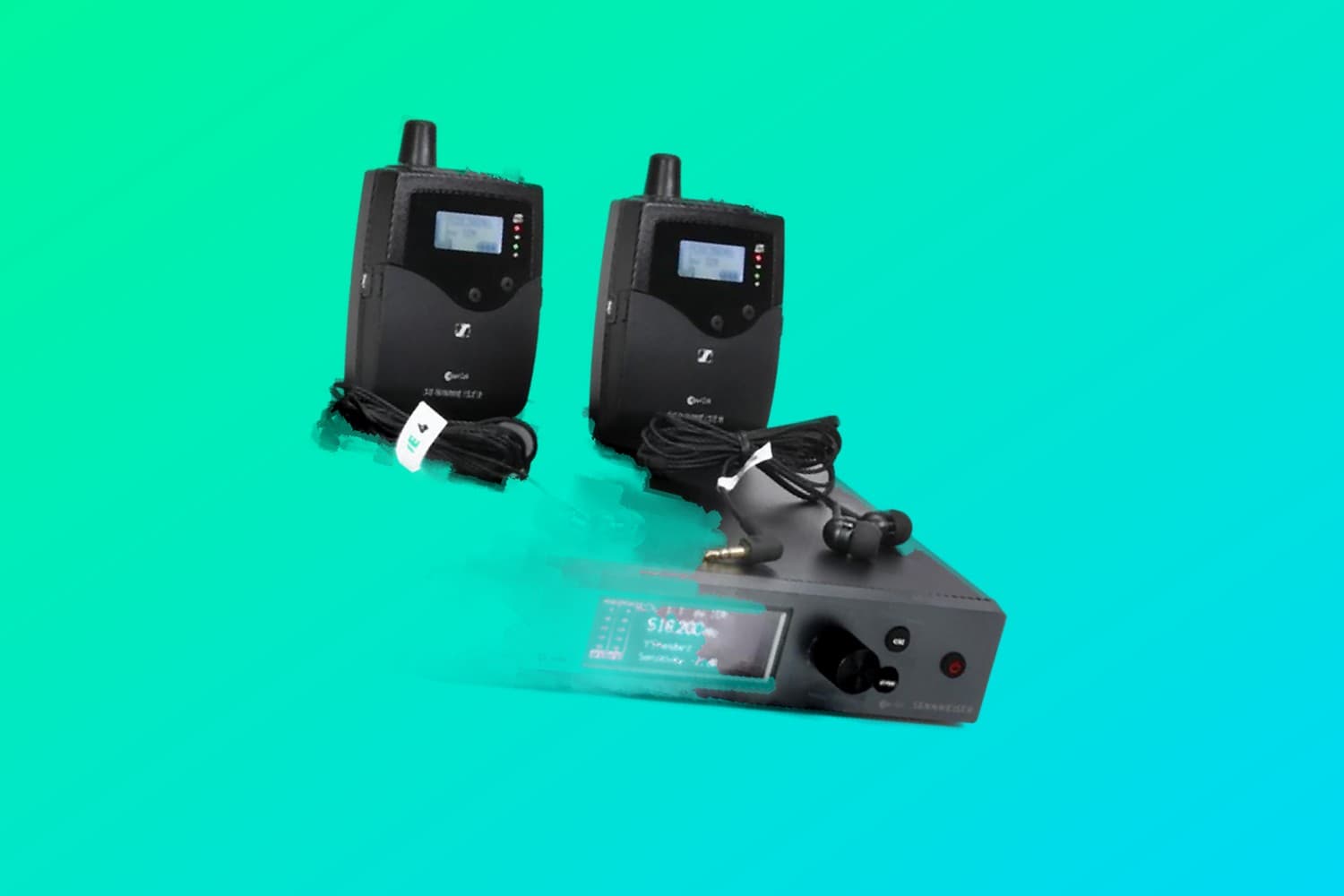
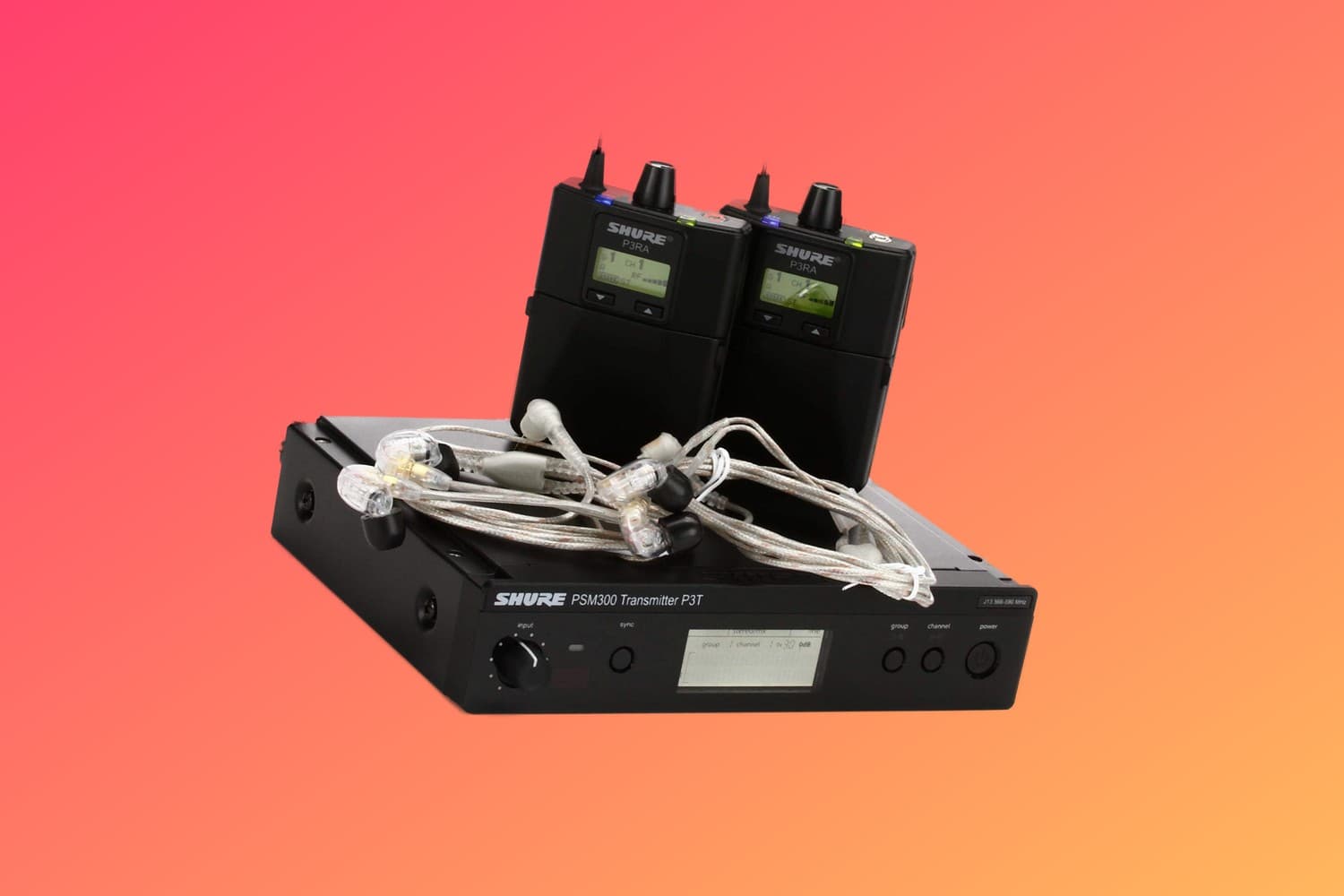
Latency is the second trade-off. Analog UHF systems like Shure's PSM300 and Sennheiser's EW IEM G4 transmit as FM audio, with effectively no conversion delay. The Listener Pro is digital, and digital means conversion time: the spec sheet claims 10–15ms of latency. That sits right at the edge of what a vocalist can feel — your voice arriving in your ears a fraction behind your skull — and no independent measurement backs the figure up, so budget for the real number landing at the top of that range or above.
On paper the audio chain is 16-bit, with a quoted 20Hz–20kHz frequency response, 0.3% THD and a signal-to-noise ratio of 80dB. That last figure is the telling one: it sits well shy of pro-system territory, and it squares with the audible noise floor that separates every budget IEM system from the genuinely quiet Shure and Sennheiser rigs. The same spec sheet lists a sampling figure of "64K @ 16bit" without saying whether that's a sample rate or a bitrate — a small thing, but typical of how loosely this class of product is documented.
In use
Setup is the strong suit. Power on two units, set one to transmit, and audio is flowing in under a minute — no frequency scanning, no channel tables, no gain structure beyond the source level and the receiver volume. For rehearsal rooms, small-venue solo sets and silent-stage practice, that immediacy is most of what you're paying for, and in those settings a 2.4GHz link has far less competing traffic to fight than it would on a packed dancefloor.
The claims get looser from there. Marketplace listings advertise 1,000 ft of range in open air but only 200–300 ft indoors, while the manufacturer's own spec page quotes the indoor figure as 200–300 meters through wood and drywall — a discrepancy of more than three times that nobody at the company appears to have noticed. Plan around the pessimistic reading: dependable across a small venue, not something to trust across a field. Battery life is similarly slippery. The spec sheet says 6 hours for a transmitting unit and 10 for a receiving one; Amazon listing copy claims 8–12. USB charging is the saving grace — any power bank tops a unit up between sets, with no proprietary dock or AA stockpile involved.
Support, spares and the longevity question
This is where the budget-marketplace reality bites hardest. Listener Pro Co., Ltd. is a Chinese OEM that sells through Amazon, eBay and business-to-business trade portals rather than a dealer network. There's no published manual library, no firmware page, no spares channel, and — tellingly — almost no community footprint: no long-term owner threads, no forum troubleshooting archive to lean on when something misbehaves. If a unit fails outside a marketplace return window, the realistic outcome is replacement rather than repair, and there's no guarantee the same listing will still exist when you go looking.
Compare that with what the extra money buys at the pro end. Shure and Sennheiser run service networks, publish full documentation, and support product lines for a decade or more. That gap never shows up in a spec table, but across a few years of gigging it's often the difference that matters most.
Where it fits — and the step up
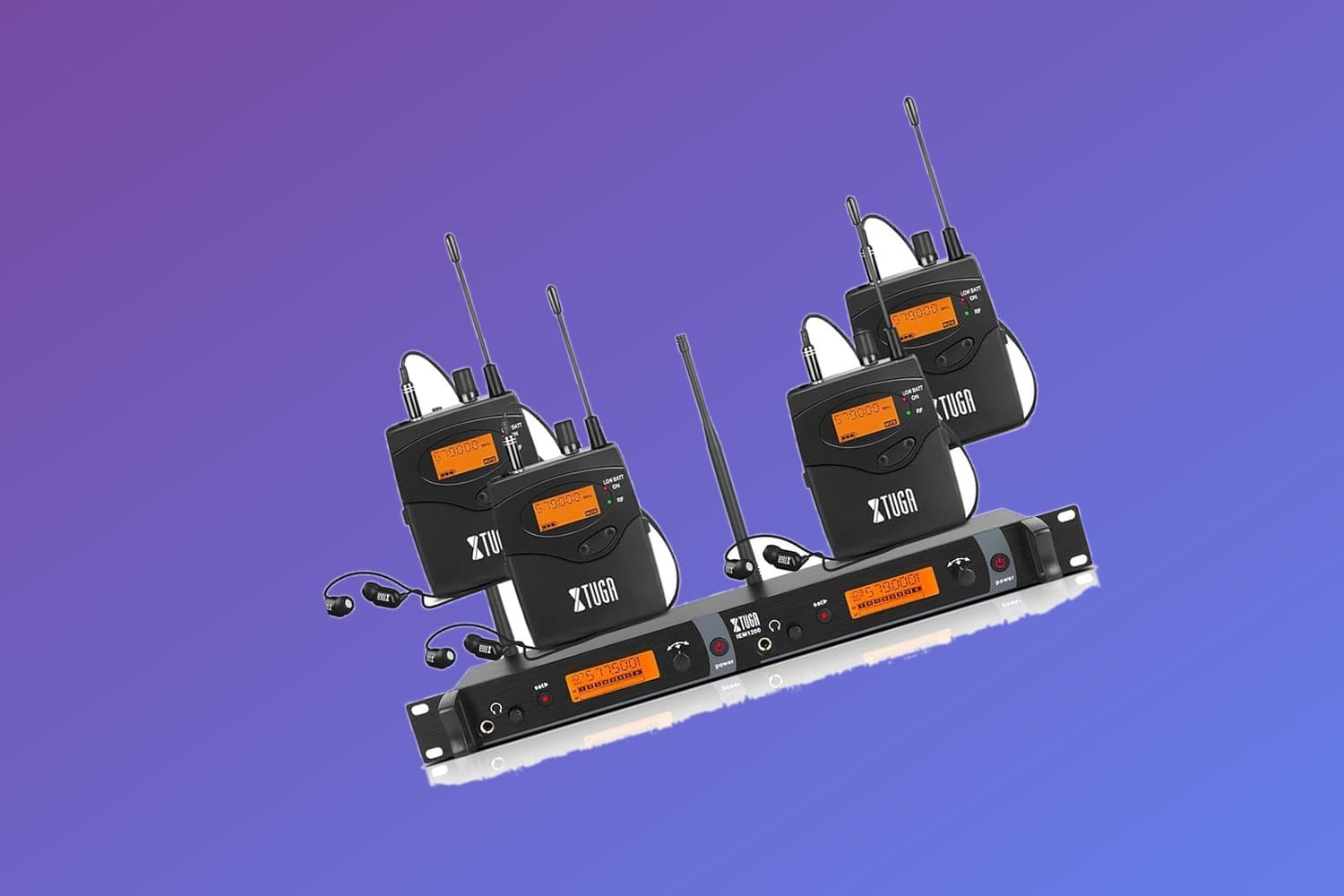
Think of the Listener Pro as a low-cost way to find out whether in-ears suit how you perform, rather than a system you'll gig on for years. If the budget is fixed but you need a whole band on ears, the XTUGA IEM1200 multi-receiver bundles cost less per person; if you'd rather have UHF at a similar price, the Phenyx Pro PTM-10 trades 2.4GHz convenience for selectable channels. And if you catch the bug, the Shure PSM300 or Sennheiser EW IEM G4 are the step up — steadier RF, a quieter signal path and real support behind them. See the full picture in our best in-ear monitors guide.