If you want one drum machine to learn on, buy the Roland TR-6S: it is a six-track version of the TR-8S with the same circuit models of Roland's 808, 909, 606 and 707, and it runs on four AA batteries or USB power. MusicRadar calls it very hard to beat as a first drum machine; step up to the TR-8S for separate outputs and a knob for every sound, or to the Elektron Digitakt II if you want to build beats from your own samples.
Which drum machine to buy
Analogue drums on a small budget: Korg volca beats
The volca beats pairs analogue drum sounds with a PCM engine and an Electribe-style step sequencer, and Korg lists battery power and a built-in speaker, so it works anywhere. MusicRadar's drum machine guide recommends it for quality analogue drum sounds on a budget. The limits come with the size: MusicRadar's review notes a 16-step sequencer and a single mini-jack shared by the headphones and the main output. Choose the TR-6S below if you want more sounds to choose from and room to load your own.
Drums and a bassline in one small box: Roland T-8
The T-8 has six drum tracks with sounds from the TR-808, TR-909 and TR-606, plus a bass track modelled on the TB-303, so one box plays a whole groove. Roland lists a built-in rechargeable battery good for up to 4.5 hours and a class-compliant USB-C audio and MIDI connection. MusicRadar calls it great fun and a genuinely useful combination of drums and bass, held back by deeper settings that run through a four-character LED display. Apart from the clap and toms, its drum sounds can't be changed much or swapped, so choose the TR-6S if you care more about the drums than the bass.
Your first drum machine: Roland TR-6S
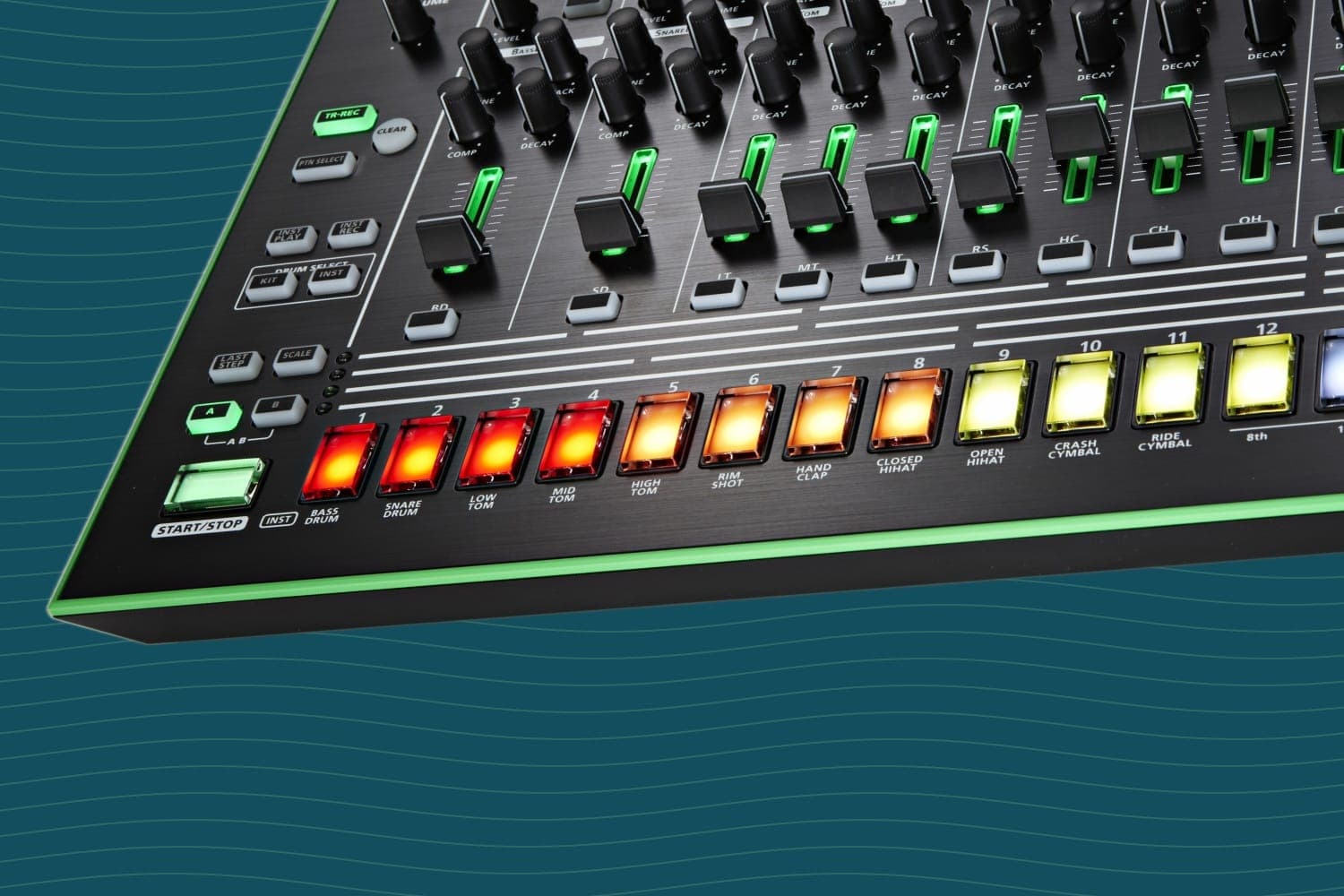
Roland describes the TR-6S as a six-track version of the TR-8S, with circuit models of the TR-808, TR-909, TR-606, TR-707 and CR-78, more than 300 preset samples, an FM engine, and your own samples loaded from an SD card. It runs on four AA batteries, for about 4.5 hours on alkalines, or on USB power, and works as a USB audio and MIDI interface. MusicRadar's review found it keeps most of the TR-8S's depth and calls it very hard to beat as a first drum machine. The compromises are small rubber step buttons, one set of three knobs shared by all six sounds, a single stereo output, and no SD card in the box.
Room to grow, with separate outputs: Roland TR-8S
Choose the TR-8S over the TR-6S if you want a fader and knobs for every sound, and outputs to match. It has 11 instrument tracks, each with its own tune, decay and assignable control knob, and six assignable outputs beside the stereo mix out, plus a stereo external input and a trigger output. It plays your own samples from an SD card but can't record them itself, MusicRadar's review notes, and it runs from its AC adaptor rather than batteries.
Sampling your own sounds: Elektron Digitakt II
The Digitakt II is a 16-track drum computer and stereo sampler. It records its own samples, up to 30 minutes of stereo audio per project, and any track can sequence other gear over MIDI instead. Its sequencer runs to 128 steps per pattern, with parameter locks, conditional trigs and a Euclidean generator. MusicRadar's review warns that the workflow is complex enough to send newcomers to the manual often, and that there are no individual outputs: Elektron's Overbridge software streams each track into a DAW over USB instead. If you want classic drum sounds you can play straight away, the TR-8S is the easier machine.
Analogue 808 and 909 for a studio centrepiece: Roland TR-1000
The TR-1000 is the first Roland drum machine with a true analogue engine in over 40 years, Roland says: 16 voices recreated from the TR-808 and TR-909 circuits, alongside modelled, FM and PCM sounds, a stereo sampler with 46 GB free for your own sounds, and an individual output for each of its ten drum tracks. It weighs 5.5 kg and runs from mains power. MusicRadar's review preferred its analogue sounds to the TR-8S versions but found the difference small in a full mix, and says the TR-8S is far better value if you only want 808 and 909 sounds. It also found lag when the TR-1000 follows another machine's clock, and advised waiting for firmware fixes. Roland's current system program is version 1.22, and its page doesn't say whether that problem is solved.
Also considered
- Roland TR-8. Roland lists it as discontinued. The TR-8S is its follow-up, adding sample playback and more outputs.
- Behringer RD-6. Thomann UK lists the black RD-6 as no longer available, and Behringer's product page for it didn't load on 12 October 2026. Check stock before planning around one.
- Korg drumlogue. A hybrid with four analogue parts (kick, snare and two toms), six sample parts you can load from a computer over USB, a synth engine, a 64-step sequencer, and four assignable outputs beside the stereo pair, per Korg.
- Elektron Syntakt. The Digitakt's synthesis sibling, with 12 tracks, four analogue and eight digital. MusicRadar suggests it if you like the idea of a Digitakt but don't need sampling.
- Arturia DrumBrute Impact. A compact all-analogue machine with ten instruments and separate outputs for the kick, snare, hats and FM sound. MusicRadar calls it not the most versatile, but praises its sound and its sequencer.
- IK Multimedia UNO Drum. Six analogue sounds alongside 54 PCM sounds, with 100 preset kits and room for 100 patterns, in a lightweight plastic case, per MusicRadar.
- Teenage Engineering PO-32 tonic. A pocket drum synth and sequencer that runs on two AAA batteries. It has 16 preset sounds; with Sonic Charge's Microtonic plugin, sold separately, you can design more and send them to it through its built-in microphone, per Teenage Engineering.
- Roland DJ-202. For DJs who want drums inside the controller: a Serato DJ Lite controller with Roland's TR drum sounds and a step sequencer. Eight of nine professional reviews recommend it, though reviewers and owners agree the sequencer is buried under shift and pad modes.
How to choose a drum machine
Analogue, modelled or sampled
Analogue machines such as the volca beats and the TR-1000 make their sounds in circuits. Roland's other picks model those circuits digitally, and sample-based machines play back recordings, including your own. The engine matters less than you might expect: MusicRadar compared the TR-1000's analogue 808 and 909 with the TR-8S's models and found the difference hard to hear in a full mix. What separates the picks more is whether you can bring in your own sounds, which every pick from the TR-6S up can do.
Tracks and the sequencer
The track count is how many separate sounds a pattern can play: six drum tracks on the T-8 and TR-6S, 11 on the TR-8S, 16 on the Digitakt II. Every pick programs beats on a row of step buttons, and the guide to making a drum beat explains step programming. If you want to build whole tracks on the machine, check how it chains patterns: MusicRadar calls pattern chaining a must for that, and the TR-1000 and Digitakt II have a full song mode.
Outputs and recording
A stereo output is enough to play and to record a finished beat. Separate outputs let you process or record each sound on its own, MusicRadar notes; with stereo only, you record one sound at a time. Several picks get around this over USB: the TR-6S and TR-8S stream each track to a computer as an audio interface, and the Digitakt II does the same through Overbridge. The audio interface explainer covers what that means for recording.
Playing alongside a DJ set
A drum machine goes into a spare channel on the mixer like any other source; the volca beats and T-8 have mini-jack outputs, so you need an adapter cable for a mixer with jack or RCA inputs. Keeping it in time with the decks means syncing it over MIDI or setting its tempo by ear, and the MIDI guide explains the connections. For a mixer with channels to spare, see the best DJ mixers; for triggering sounds from pads instead, see whether DJs use drum pads.
Size and power
The volca beats, T-8 and TR-6S run on batteries, so they work away from a socket. The TR-8S needs its AC adaptor, and the TR-1000, at 5.5 kg with a mains lead, is built to stay on a desk or stage.
How these picks are made
Each recommendation links the manufacturer page or independent review it relies on, and every product figure on this page comes from one of those sources. We haven't tested these machines, and the site has no product pages or owner-review records for drum machines yet, so there are no price cards here. The methodology explains the whole process.