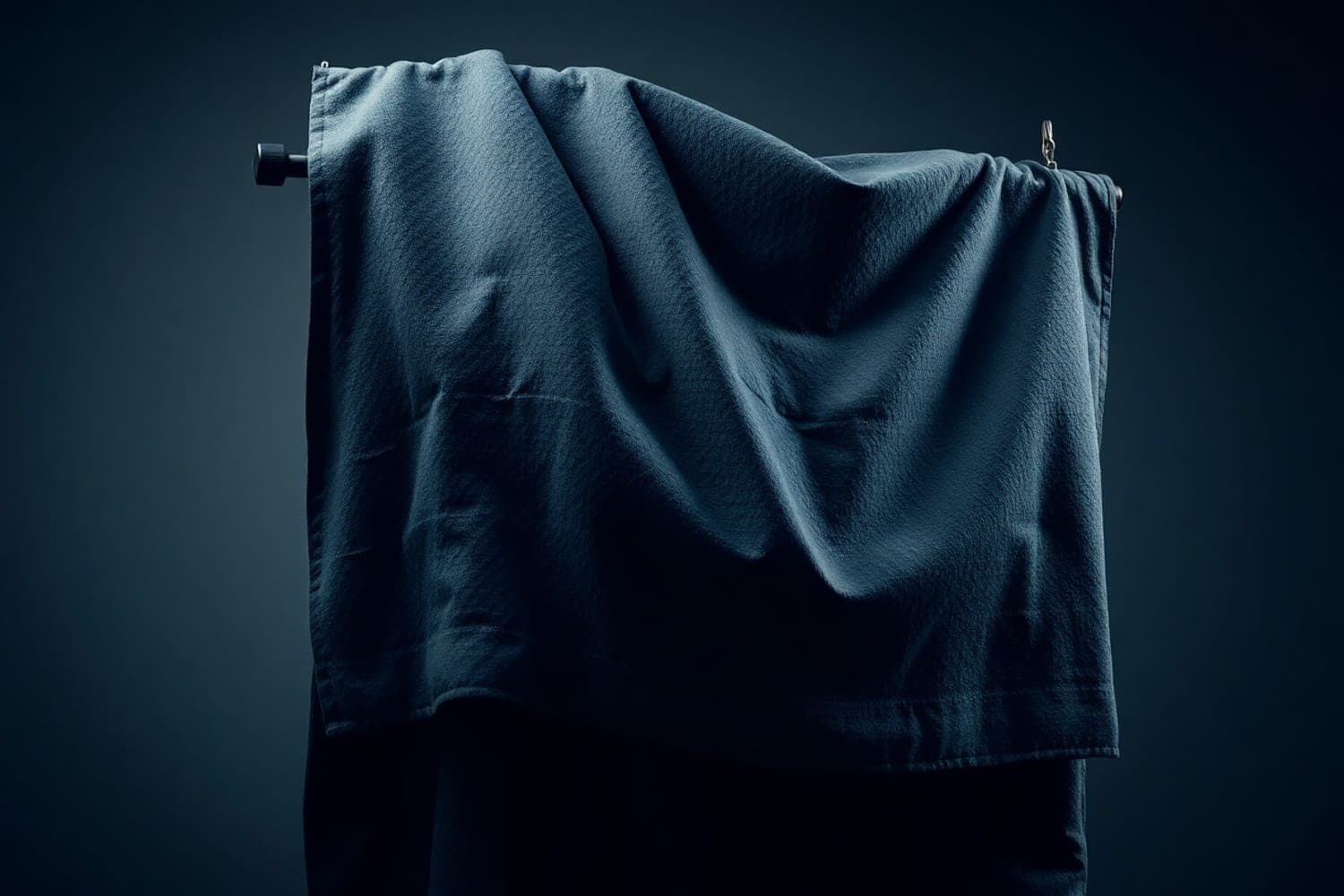
Sound blankets absorb echo inside your room, but they won't stop your music reaching the neighbours, because blocking sound takes mass and an airtight seal, and thin absorbers do little for bass. Buy Audimute Sound Absorption Sheets to treat a room you mix or record in, and Audimute's isolé, which adds a mass-loaded vinyl layer, for a door that lets sound through.
What a sound blanket can and can't do
It absorbs mid and high frequencies
Audimute publishes the lab report for its Sound Absorption Sheets, tested by Riverbank Acoustical Laboratories to ASTM C423 with the sheets hung 76 mm (3 in) off the wall. From 500 Hz to 4 kHz the absorption coefficient is about 1, meaning almost all the sound that hits the sheet is absorbed. At 250 Hz it falls to 0.38 and at 125 Hz to 0.12, where most of the sound reflects straight back. That is the pattern for any thin absorber, and why a room hung with blankets sounds dead when you clap but the bass sounds the same. Acoustician Ethan Winer puts it plainly: thin treatments, blankets and foam included, do nothing to control low-frequency reverb or reflections, and hand claps won't reveal that.
It doesn't block sound
Absorbing echo and stopping sound leaving the room are different jobs. Winer's article says acoustic treatment controls the sound within a room and is not meant to stop sound passing between rooms; that takes construction, with thick, massive walls and structures isolated from each other. A building digest from the National Research Council of Canada names mass per unit area as the most important property for blocking airborne sound, with each doubling of mass adding only about 6 dB. A blanket hung on a wall adds a few kilograms. The makers say so too: Audimute says its Sound Absorption Sheets are not a sound-blocking product, and VocalBoothToGo's product pages state that its blankets are not soundproof.
Bass is the hardest part to stop
The same mass law says each doubling of frequency also adds about 6 dB of loss, which means the reverse: the lower the note, the more easily it passes through a wall. The digest adds that in real buildings sound also travels between rooms through the surrounding construction as well as through the shared wall, which it calls flanking paths, and that in a poor design these carry more sound than the wall itself. So the kick and the bassline are what neighbours hear, and blankets on one wall won't change that.
Which blankets to buy
Treating a room you mix or record in: Audimute Sound Absorption Sheets
Sheets of about 1.2 × 2.4 m (4 × 8 ft) and 4.5 kg (10 lb), made from recycled cotton and cellulose that Audimute calls eco-C-tex, with three metal grommets along the short top edge and three hanging knobs and screws included. Audimute rates them at NRC 0.85 and publishes the lab report behind the rating.
A door that lets sound through: Audimute isolé
The one blanket here with a blocking layer: Audimute combines an NRC 0.75 absorber with a 1/16 in layer of mass-loaded vinyl rated STC 20. At 88 × 208 cm (34.5 × 82 in) and about 8 kg (18 lb), it is sized to cover a standard 32 × 80 in interior door, and hangs from three grommets. Audimute says it should not be thought of as a total soundproofing product, that it cuts sound transmission significantly only when properly installed, and sells it alongside an Acoustic Door Seal Kit for the gaps around the door, because "if air can get through, so can sound".
A vocal booth or a portable studio: VocalBoothToGo Producer's Choice
The VB71-G is an all-black 80 × 80 in (2 × 2 m) blanket, filled with recycled cotton in a cotton-mix shell, washable, with grommets, and rated NRC 0.8; its page lists two weights, 4 to 4.5 kg (9 to 10 lb) in the description and 5.4 kg (12 lb) in the specifications. For high ceilings, the studio size is 120 × 80 in (3 × 2 m) for ceilings up to 10 ft, about 6.4 kg (14 lb), with eight grommets along the 80 in side. Choose these over the Audimute sheets when you hang blankets on stands or a frame to build a booth around a microphone and want darker, softer fabric you can wash. The streaming mics guide covers the microphone.
The cheapest real absorber: US Cargo Control Sound Blanket
A heavier version of a moving blanket: US Cargo Control makes it from a woven cotton and polyester shell, 85 g fabric against the 30 to 35 g of its non-woven blankets, around a recycled cotton filler. It measures 72 × 80 in (1.8 × 2 m), weighs 4 kg (9 lb), has 18 grommets along one long and one short side, and is machine washable; an 80 × 96 in size is also listed. US Cargo Control publishes no absorption rating for it, and warns that the coloured recycled filler can mark light furniture.
How to hang them
Start at the first reflection points
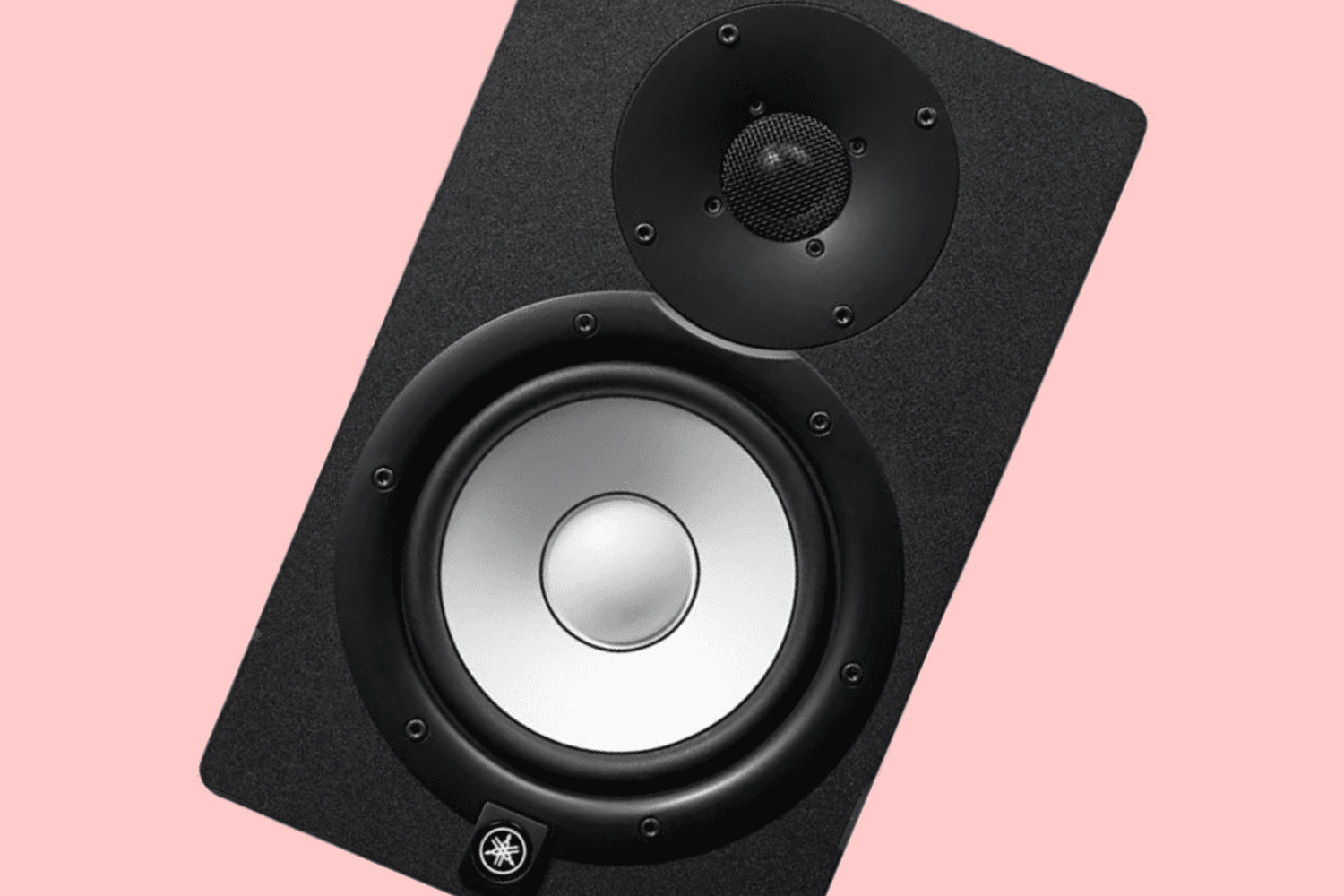
Winer says the first reflections to reach your ears come from the side walls, and from the ceiling and floor if they are bare. Winer's method for finding them: sit where you mix, have someone slide a mirror flat along the side wall, and treat every spot where you can see a speaker in the mirror, plus a margin around it; then do the same on the ceiling. The studio monitors guide covers speaker placement.
Leave a gap behind the blanket
Winer notes that spacing an absorber away from the wall lowers the frequencies it absorbs. The NRC figures for the Audimute and VocalBoothToGo blankets were both measured on the G-75 mounting, which Audimute's lab report describes as hung 76 mm (3 in) off the wall. A blanket pinned flat to the wall won't match its rating at the low end.
Bass needs bass traps, not more blankets
More layers of a thin absorber won't fix the low end. Winer says that even thick fibreglass spaced a foot off the wall doesn't absorb the lowest frequencies as well as a purpose-built bass trap. In small rooms, Winer adds, the low end is dominated by ringing at the room's own resonant frequencies rather than reverb, and that is what bass traps are for.
If you rent or share walls
Blankets won't make a home studio neighbour-proof, so work on what does help. Seal the gaps around doors and windows first, for the reason Audimute gives. Cover the weakest door with something that has mass, like the isolé. Turn the subwoofer down, or off, at night, since bass is what passes through walls most easily, and practise on DJ headphones when the neighbours are home. Real isolation means building: Winer points readers to Rod Gervais's book Home Recording Studio: Build It Like the Pros for the construction.
How these picks are made
Each recommendation links the manufacturer page it relies on, and every product figure on this page comes from one of those pages or Audimute's lab report, read on 9 November 2026. The acoustics come from Ethan Winer's article on acoustic treatment and the National Research Council of Canada's building digest on sound transmission, both linked above. We haven't tested these blankets, and the site has no owner-review records for acoustic treatment yet. Price tracking doesn't cover these blankets yet, so they have no price cards here. The methodology explains the whole process.