Make the mic you own wireless
Xvive U3
A plug-on transmitter and receiver that make your own dynamic mic wireless; crowded 2.4 GHz can cause dropouts.
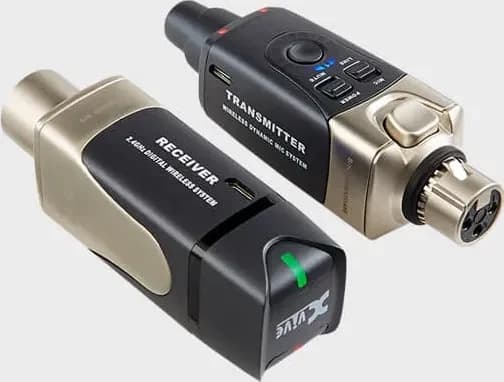
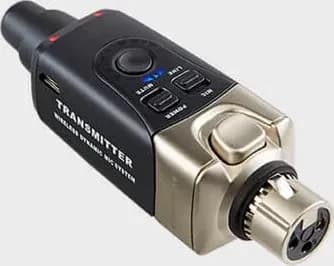
Photos: Xvive
Only 2 professional reviews so far, 2 recommending it35 owner reviews read
Choose it if you already own a dynamic mic, such as a Shure SM58, and want it wireless; if you don't, add one, or take the Shure GLXD24+, which comes with its own SM58. The transmitter plugs onto the mic's XLR and the receiver into your mixer; Xvive quotes 2.4 GHz, 5 ms of delay, 27.5 m of line-of-sight range and about five hours per charge, and says it also works with battery-powered condenser mics. Sound On Sound called it one of the simplest radio mic systems, with excellent sound, and advised keeping it about 3 m from Wi-Fi routers. Bonedo scored it 4 out of 5, and most of the 35 owners read at Thomann say it sounds like a cable; the complaints are dropouts where the 2.4 GHz band is crowded and small slide switches that some owners knocked or broke. For two voices, buy two: Xvive says up to six U3 systems run at once, and it also sells a pair as the U3D.
- Best for
- DJs who already own a dynamic mic, such as an SM58, and want it wireless.
- Skip it if
- You play rooms full of Wi-Fi, or need more than about 27 m of range.
What people praise
- Sounds the same as a cable
- Stable link with no dropouts in normal use
What to know first
- Small slide switches that are fiddly, easy to knock, and broke for some owners
- Dropouts or interference where the 2.4 GHz band is crowded, for example beside Wi-Fi mixers
When the speeches can't fail
Shure GLXD24+/SM58
A dual-band SM58 wireless system that reviewers found free of dropouts, with up to 12 hours per charge.
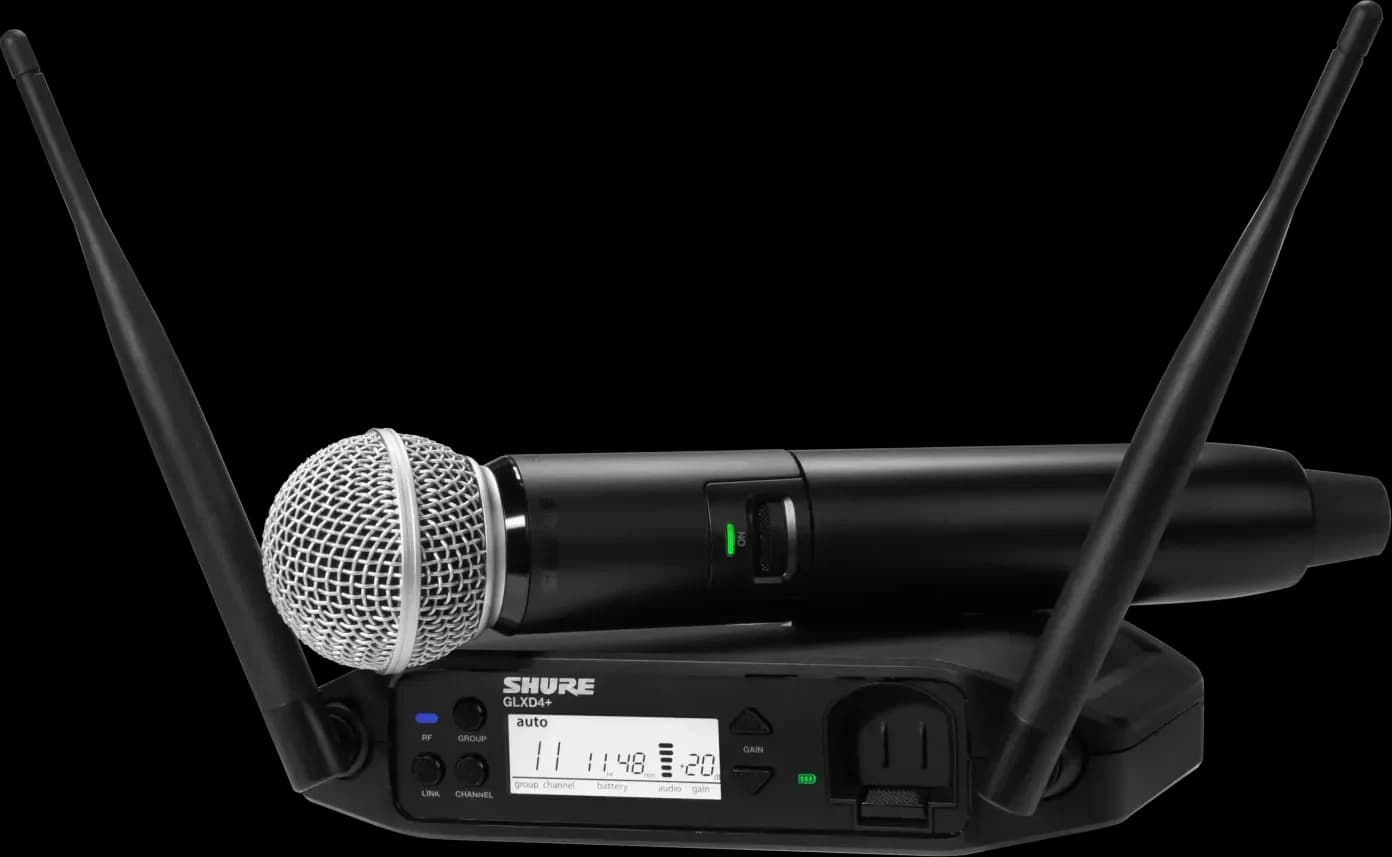
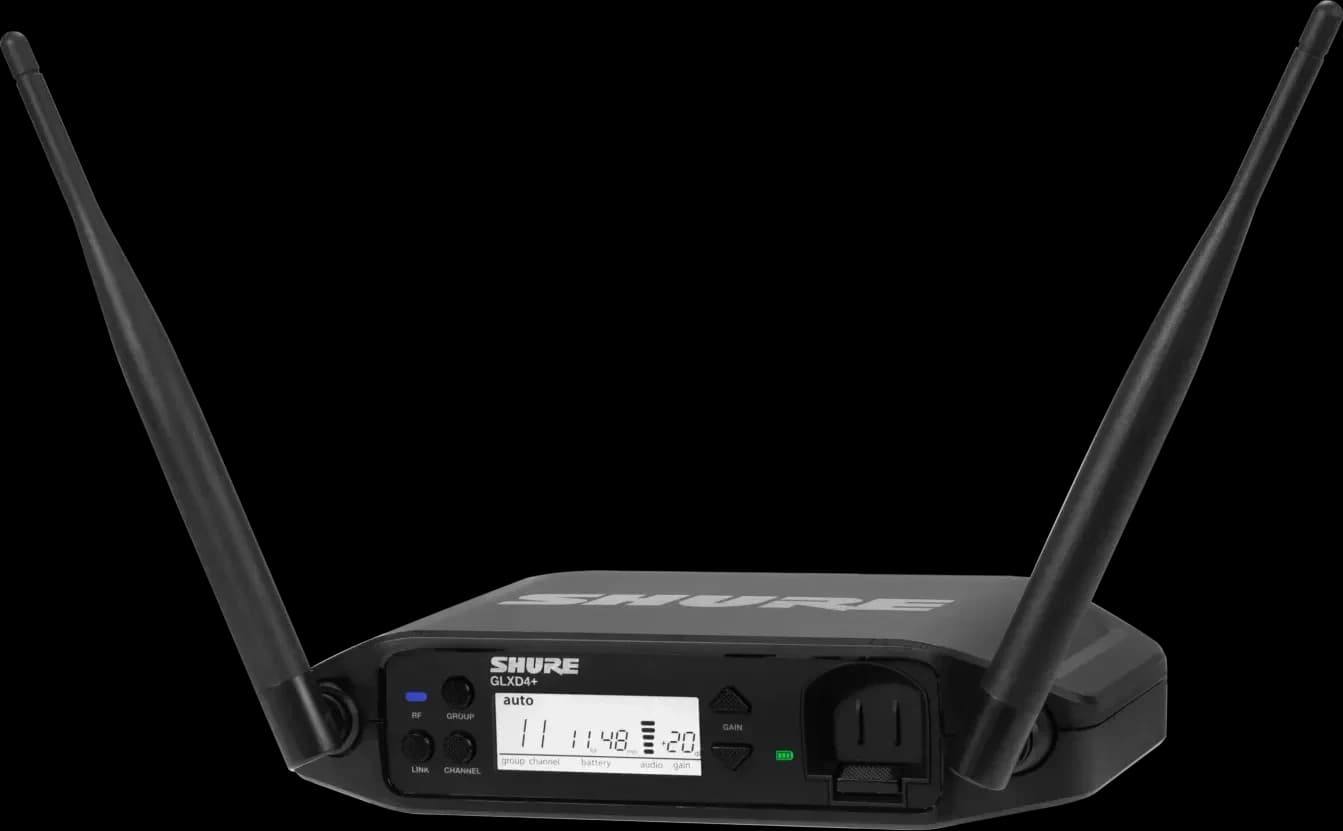
Photos: Shure
Only 2 professional reviews so far, 2 recommending it4 owner reviews read
Choose it if the speeches at a wedding or a corporate event can't fail, or the room is full of Wi-Fi. Shure calls it a dual-band system and quotes up to 12 hours on its rechargeable battery; Mix, which tested the rack version, says it uses 5.8 GHz as well as 2.4 GHz and had no dropouts in hostile radio environments. The previous generation was MusicRadar's best wireless mic overall and scored 5 out of 5 at Delamar. It costs about three times the U3, with the mic included. Mobile DJs on Reddit call it fine for MCing and smaller events, and some step up to Shure's SLX-D for weddings.
- Best for
- Weddings and events where the mic can't drop out.
- Skip it if
- You only MC now and then: the simpler 2.4 GHz sets do that.
What people praise
- Reliable signal with no dropouts
- Good, clear sound
Also considered
- Sennheiser XSW-D Vocal Set. A handheld mic whose receiver plugs straight into a DJ mixer's XLR input; three of four professional reviews recommend its cable-like sound, and all four note a five-hour battery that can't be replaced. It isn't a pick because on 9 November 2026 no shop tracked here had it new in the UK, Germany or France.
- JBL PartyBox Wireless Mic. Two mics made for JBL's PartyBox speakers, with a 6.3 mm output for other gear. It has no published review yet, and JBL's US store showed it sold out.
- Samson XPD2 and XPD2m. Licence-free 2.4 GHz systems, one with a USB-stick receiver and one with two mics into one receiver. Neither has a professional review yet.
- Behringer ULM302MIC. MusicRadar's budget pick, but Thomann no longer sells it.
- AKG DMS100 and DMS300. Well reviewed, including 4.5 out of 5 at Bonedo, but hard to buy: Thomann lists the DMS300 as no longer available.
How to choose a wireless mic for DJing
Budget decides what is on the table, then six things decide whether a wireless mic works at a gig: a legal frequency, a backup, range, delay, how the receiver connects and how it charges.
How much to spend
The two picks sit at two price points, and the table above shows today's price for each in your country. At the end of October 2026 they cost about $200 and $650 in the US.
Under $50 and under $100
Nothing at this price has a professional review yet, so nothing here is a pick. The systems that sit there are in Also considered: Samson's XPD2 and XPD2m and JBL's PartyBox Wireless Mic have no published review, and Behringer's ULM302MIC, MusicRadar's budget choice, is no longer sold by Thomann. If you buy one anyway, keep a wired mic plugged in as backup, as the next sections explain, because a cheap 2.4 GHz system shares its band with every Wi-Fi network in the room.
Under $200
The Xvive U3, at about $200 in the US and £175 in the UK, makes a dynamic mic you already own wireless. If you don't own one, add the price of the mic; a Shure SM58 is the usual partner. Its evidence is two professional reviews and 35 owner reviews, and its 27.5 m range is a little shorter than the Shure's.
Under $500
No pick sits here now. The Sennheiser XSW-D Vocal Set, a handheld mic with a receiver for any DJ mixer's XLR input, is in Also considered because it wasn't sold new in the UK, Germany or France. A U3 on a Shure SM58 does the same job: its receiver plugs into the same XLR input.
Under $1,000
The Shure GLXD24+ with SM58, at about $650 in the US and £470 in the UK, is for the gigs where the speeches can't fail: dual band to dodge Wi-Fi, and up to 12 hours a charge. Above it sit Shure's SLX-D and other licensed systems, which some mobile DJs move to for weddings; none has a record here yet.
Check the frequency is legal where you play
Wireless mic rules differ by country, and Shure notes that a system sold in one region may not be legal in another; the band is printed on a label on the transmitter and receiver. In the US, mics have had to stop using 617 to 652 MHz and 663 to 698 MHz since 13 July 2020, per the FCC, so an older or imported UHF kit tuned there is illegal to run. In the UK, Ofcom allows 173.8 to 175 MHz, 863 to 865 MHz and 2400 to 2483.5 MHz without a licence. Both picks use licence-free bands: 2.4 GHz for the Xvive, and 2.4 and 5.8 GHz for the Shure. The trade-off, Ofcom points out, is that licence-free bands are shared with other low-power equipment, Wi-Fi included, so they can pick up interference.
Keep a wired mic as backup
DJs who play weddings and corporate events say budget wireless isn't reliable enough on its own, and the advice on Reddit's mobile DJ forum is to keep a wired mic plugged in and ready. A flat battery or a burst of interference then costs you a few seconds, not the speeches.
Range
Range figures are best cases: Xvive's 27.5 m is for line of sight. Bodies and walls between the mic and the receiver cut it, so put the receiver where it can see the room you'll speak in, not behind the booth.
Latency
Digital systems add a small delay. Xvive quotes 5 ms for the U3. Check for a figure before buying any digital system you will speak through live.
Getting the receiver into your mixer or controller
Mic inputs differ more than you'd expect. The DDJ-FLX4 and the DJM-250MK2 take a 1/4-inch jack, so an XLR receiver needs an XLR-to-1/4-inch adapter cable. The DJM-750MK2 and the DDJ-FLX10 have XLR combo inputs that take it directly. If your controller has no spare input, a PA speaker with its own mic input works too. For the mixers themselves, see the best DJ mixers.
Batteries
None of the picks takes AA batteries: the U3 runs about five hours per charge and the Shure up to 12. Start every gig fully charged, charge between sets, and keep a USB charger in the bag.
How these picks are made
Each recommendation links the manufacturer page or review it relies on, and every product figure on this page comes from one of those sources or a regulator. We haven't tested these microphones; the evidence under each pick lists the reviews and owner reports behind it. Prices on this page come from daily tracking across the retailers we link to. The methodology explains the whole process.