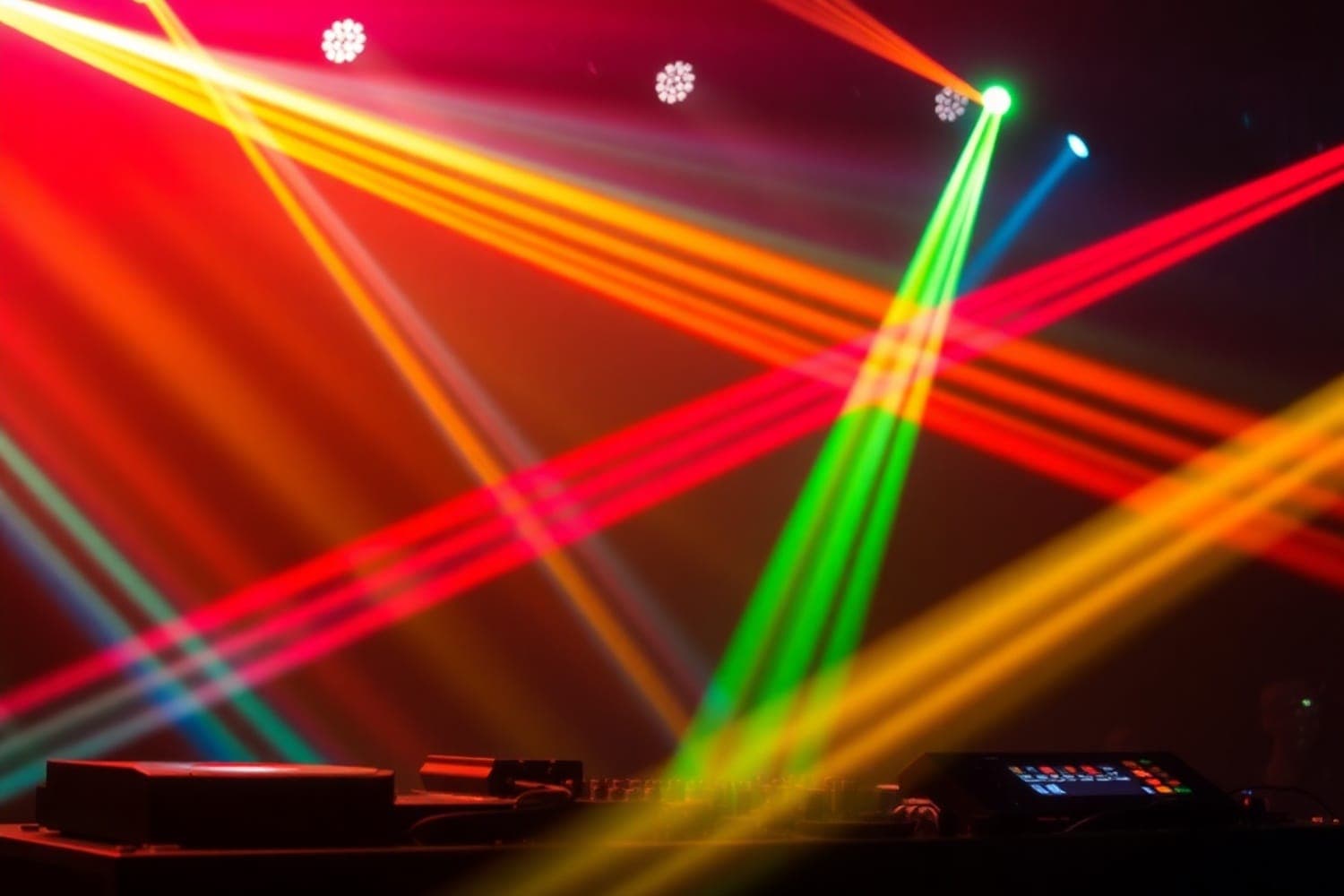
Lighting is the most underrated element of a DJ performance. Great sound gets people dancing, but great lighting creates an atmosphere that makes the entire experience memorable. Even a modest setup — a couple of wash lights and an effect fixture — transforms a plain room into an event.
For mobile DJs, lighting is also a competitive advantage. Clients notice when you bring your own light show. It makes you more bookable and justifies higher rates. For bedroom DJs, even basic RGB lighting changes the feel of a practice session entirely.
This guide covers the types of DJ lights available, how to control them, and what to look for when building your lighting setup.
Types of DJ Lights
Understanding the different categories helps you build a balanced rig. A good lighting setup combines ambient colour (wash lights) with movement and effects.
Wash Lights and PAR Cans
PAR cans (Parabolic Aluminized Reflector) are the foundation of any lighting setup. They project a broad wash of colour onto walls, ceilings, and dance floors. Modern LED PAR cans produce vivid RGB or RGBW colour mixing with minimal heat and low power consumption.
Use wash lights to set the mood and colour theme of a room. A set of four PAR cans on a T-bar stand can uplift an entire venue. The Chauvet DJ SlimPAR series is the go-to for mobile DJs — lightweight, bright, and affordable. ADJ Mega Par Profile is another solid choice with a wider beam angle.
Moving Heads
Moving head fixtures are the most dynamic DJ lights available. A motorised yoke allows the light to pan (rotate horizontally) and tilt (rotate vertically), creating sweeping beam effects across the room. They come in three main types: spot (focused beam with gobos), wash (wide colour coverage), and beam (tight, intense ray).
Moving heads are the most impactful lights in any rig, especially when used in pairs or groups. The ADJ Inno Spot Pro is a strong entry-level moving head with gobos and prism effects. For a more accessible option, the Chauvet DJ Intimidator Spot 110 offers moving-head impact at a lower price point.
The trade-off is cost and complexity. Moving heads are significantly more expensive than static fixtures and benefit most from DMX control to coordinate their movement.
Effect Lights
Effect lights create patterns and movement on walls and dance floors. This category includes moonflowers (multi-coloured rotating beams), derbies (similar but with wider coverage), and mirror-ball effects. They add visual energy without the cost of moving heads.
The ADJ Starburst projects sharp multi-coloured beams like a modern mirror ball — a great centrepiece light. The Chauvet DJ Swarm 5 FX combines derby, laser, and strobe effects in a single compact unit, which is excellent value for mobile DJs who want variety without carrying multiple fixtures.
Lasers
Lasers project concentrated beams that become visible lines and patterns when combined with haze or fog. They're immediately recognisable and create a high-energy club atmosphere. Modern DJ lasers produce multiple colours and can project patterns, text, and animations.
Lasers are the most regulated type of DJ lighting. In the US, audience-scanning lasers require FDA/CDRH compliance. For most mobile DJs, aerial-only laser effects (beams that pass above the audience) are the safest approach. The U'King 5-Beam Laser offers multiple colours and pre-programmed patterns at an accessible price point.
Strobes
Strobe lights produce rapid, bright flashes that create a stop-motion visual effect. They're most effective during high-energy drops in dance music. Modern LED strobes are more controllable and energy-efficient than older xenon models.
The Chauvet DJ Shocker Panel takes strobe effects further with four discrete control zones, enabling chase patterns and frame-by-frame effects rather than simple full-room flashing. It's built for intense club use with a die-cast housing.
Use strobes sparingly — they're powerful but can be overwhelming and uncomfortable for some guests, particularly at private events.
Controlling Your Lights
How you control your lights determines whether they enhance your performance or distract from it.
Sound Activation
Most DJ lights include a built-in microphone that triggers effects in response to bass frequencies. This is the simplest control method — set your lights to sound-active mode and they'll react to the music automatically.
Sound activation is convenient but imprecise. The microphone reacts to volume, not musical phrasing, so light changes don't always align with musical moments. It's a good starting point, but serious DJs outgrow it quickly.
Auto-Run Programs
Most fixtures come with built-in auto-run sequences — pre-programmed colour changes and movement patterns that cycle continuously. These require zero input from you. Combine sound activation on some fixtures with auto-run on others for basic variety.
DMX Control
DMX (Digital Multiplex) is the industry standard protocol for lighting control. A DMX controller connects to your fixtures via XLR cables and gives you manual control over every parameter — colour, intensity, movement, speed, and effects.
Entry-level DMX controllers like the Chauvet DJ Obey 40 or ADJ DMX Operator let you program scenes and chases that you can trigger during your set. More advanced options include software-based DMX controllers like SoundSwitch (integrates with Serato and Engine DJ) and QLC+ (free, open-source).
For mobile DJs, a basic DMX controller is the single biggest upgrade you can make to your light show. Programming 4–8 scenes that match different energy levels gives you a professional-quality performance with minimal effort during the set.
Software Integration
Tools like SoundSwitch integrate directly with DJ software, automatically syncing lighting changes to the beat, phrase, and energy of your tracks. This is the future of DJ lighting — hands-free, musically accurate control that reacts to what you're playing in real time.
What to Look For
When building your lighting rig, consider these factors.
Brightness and output. LED brightness is measured in lumens. For small venues and house parties, fixtures in the 1,000–3,000 lumen range are adequate. Larger venues need 5,000+ lumens. Moving heads and spots typically output more focused brightness than wash lights.
Weight and portability. Mobile DJs carry lighting to every gig. A full rig of lights, stands, and cables adds up quickly. LED fixtures are significantly lighter and cooler than older halogen or discharge models. T-bar stands and carry bags help with transport.
Power consumption. LED fixtures consume a fraction of the power of traditional lights. This matters at venues with limited power circuits. A single 20A circuit can typically run 8–12 LED PAR cans, but only 2–3 traditional fixtures.
DMX channels. Each fixture uses a number of DMX channels to control its features. Simple PAR cans might use 4–7 channels. Moving heads can use 16+. Ensure your DMX controller has enough channels and fixtures capacity for your planned setup.
Build quality. DJ lights get transported, set up, and torn down repeatedly. Metal housings outlast plastic. Locking power connectors prevent accidental disconnection. Clamp-compatible yokes allow secure mounting on truss and T-bars.
Recommended Lights
A curated set of currently-available DJ lights spanning all the main use-cases above — full-room rigs, accent wash, moving heads, strobes, and atmospherics.
Chauvet DJ GigBAR Move + ILS
Chauvet DJ SlimPAR Q12 BT ILS
Chauvet DJ Intimidator Spot 360X
Chauvet DJ Shocker 2
Chauvet DJ Hurricane Haze 4D
Chauvet DJ Freedom Flex Stick X4
Chauvet DJ COLORband PIX-M ILS
Booth Lights
LittleLite XLR Gooseneck Lamp
Mighty Bright Encore LED Music Stand Light
FAQs
How much should I spend on DJ lighting?
For a basic mobile DJ lighting setup, budget $200–$500 for a pair of effect lights and a stand or T-bar. Mid-range setups with moving heads, a wash light, and a DMX controller run $500–$1,500. Professional rigs with multiple moving heads, lasers, and a lighting console can exceed $3,000. Start small and add fixtures as your gigs grow.
Do I need a DMX controller?
Not necessarily. Many modern DJ lights have built-in sound-activation and auto-run modes that work without any controller. However, a DMX controller gives you precise manual control over colours, movement, intensity, and timing. For serious mobile DJs, even a basic DMX controller dramatically improves the quality and consistency of your light show.
What is the best DJ light for beginners?
A pair of LED PAR cans or wash lights is the simplest and most versatile starting point. They're affordable, durable, and provide ambient colour that transforms a room immediately. Chauvet DJ and ADJ both make excellent entry-level PAR lights. Add a single effect light (moonflower or derby) for movement and visual interest.
Are laser lights legal for DJ events?
Laser use is regulated in most countries. In the US, lasers used for entertainment must comply with FDA/CDRH regulations. Class 3B and Class 4 lasers require variance approval. For mobile DJs, audience-scanning lasers must meet specific safety standards. Always check local regulations and avoid pointing lasers directly at audiences or into the sky.
How do I sync lights to music?
There are three main approaches. Sound-activation mode uses a built-in microphone to react to bass hits — simple but imprecise. DMX software like SoundSwitch or QLC+ can sync lights to your DJ software for beat-accurate control. The most precise method is manual DMX programming, where you pre-program scenes and trigger them during your set.
Verdict
Start with wash lights — a set of four LED PAR cans on a T-bar stand transforms any venue for under $300. Add one or two effect lights (a derby or moonflower) for movement and visual interest. Once you've outgrown sound-activation mode, invest in a basic DMX controller to take manual control of your show.
For DJs who want maximum impact, moving heads are the upgrade that makes the biggest difference — even a pair creates dramatic sweeping effects that elevate your entire performance. And if you use Serato or Engine DJ, SoundSwitch offers beat-synced lighting automation that's genuinely impressive.
Build your rig incrementally. Every fixture you add makes a visible difference, and even a modest lighting setup separates you from DJs who show up with nothing but speakers and a controller.